
DeepSeek Harness to Enterprise Production: Agent Governance & Runtime
Why local agent demos collapse in production and how Tencent Cloud ADP pairs with DeepSeek Harness to deliver isolated sandboxes, tool governance, and enterprise reliability.
Executive Summary
The open-source release of DeepSeek Harness (DSH) has catalyzed a paradigm shift in how developers approach autonomous AI agents. For months, the AI industry focused almost exclusively on foundation model parameter counts, reasoning benchmarks, and context window lengths. DeepSeek Harness pulled the curtain back on a vital reality: the operational ceiling of an AI agent is fundamentally dictated by its external runtime execution harness.
When an AI system merely answers questions, a static loop of Prompt -> LLM -> Response suffices for a compelling local demo. However, when an agent must autonomously inspect file trees, execute Python scripts, invoke external microservices, decompose complex multi-stage objectives, spawn child subagents, recover from API timeouts, and maintain state over hours of asynchronous execution, it requires a robust, stateful execution shell—an Agent Harness.
While developer-centric harnesses provide extraordinary flexibility on local workstations, enterprise adoption demands an entirely new set of guarantees: zero-trust multi-tenancy, containerized session isolation, deterministic tool governance, fine-grained access control, cost predictability, and audit-ready observability.
This technical guide bridges the gap between local agent experimentation and enterprise-grade production. We dissect the anatomical differences between local and cloud harnesses, explore the sandboxed execution mechanics of Tencent Cloud ADP 4.0 Claw Mode, examine dynamic tool loading via Model Context Protocol (MCP) and the Skill Hub, outline full-stack AgentOps governance, and provide an end-to-end implementation blueprint for deploying mission-critical agents on Tencent Cloud ADP.
Key Takeaways
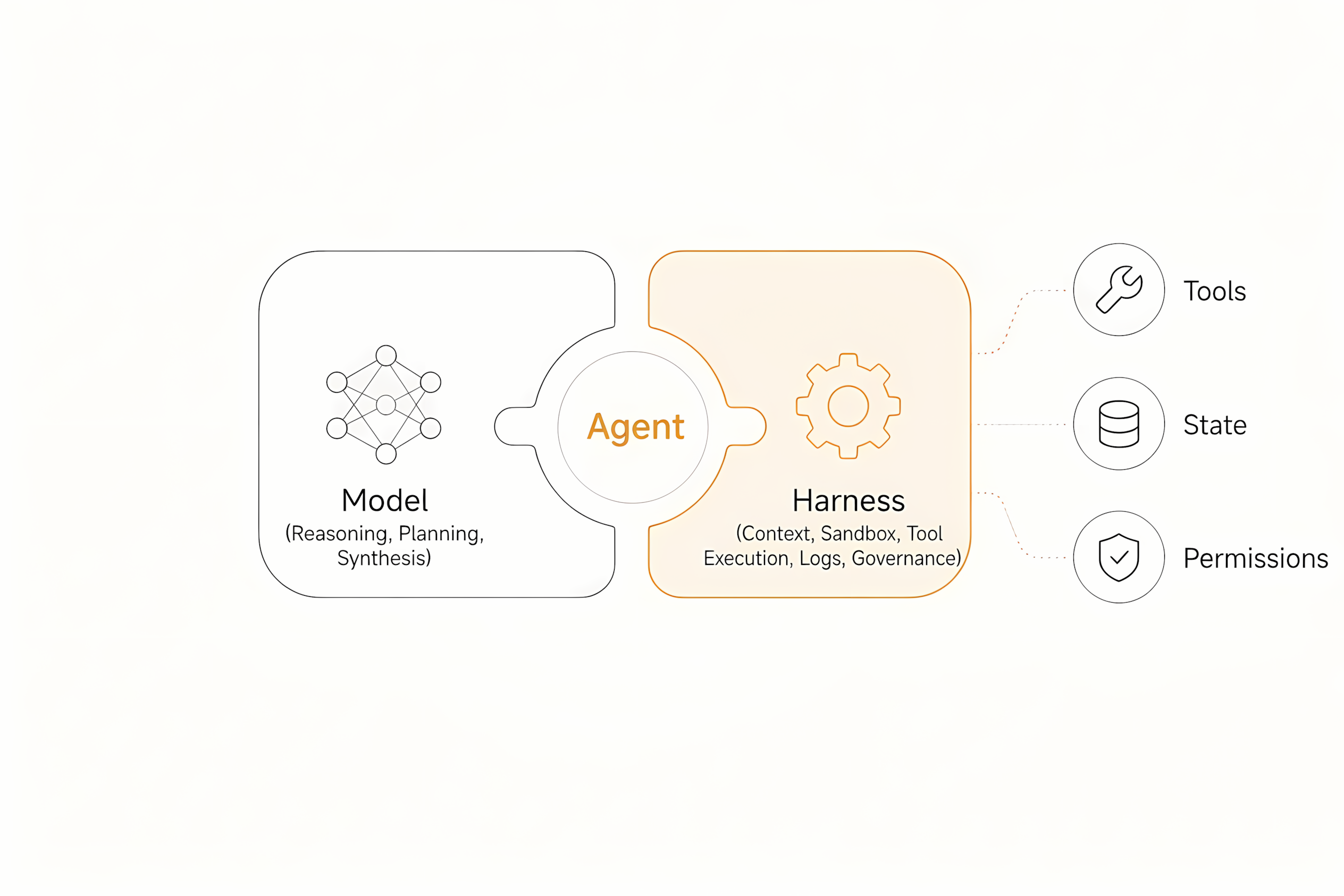
- Agent = Model + Harness: Foundation models supply linguistic comprehension and reasoning; the harness orchestrates tools, manages state machines, enforces permissions, isolates execution environments, tracks session logs, and recovers from runtime failures.
- Composable Plugin Runtimes: DeepSeek Harness popularizes the "Everything is a Plugin" philosophy. Agent architectures are transitioning from rigid, monolithic scripts into dynamic, swappable runtime modules.
- The Prototype-to-Production Chasm: Local developer harnesses prioritize unbounded freedom; enterprise runtimes require strict determinism, containerized sandboxes, role-based access control (RBAC), and continuous data governance.
- MCP vs. Connectors vs. Harness: Model Context Protocol (MCP) standardizes tool interfaces; enterprise connectors handle authentication, semantic data mapping, and VPC networking; the harness manages execution timing, authorization gates, and failure recovery.
- Context Window Optimization: Registering dozens of static tools into system prompts causes severe context bloat and model hallucinations. Dynamic skill loading and tool routing ensure only relevant tools enter the context per conversational turn.
- Enterprise AgentOps: Scaling hundreds of production agents across business units necessitates centralized lifecycle management, release snapshots, token and Credit quota enforcement, and continuous golden-dataset regression benchmarking.
- Turnkey Production with ADP 4.0: Tencent Cloud ADP 4.0 provides a managed cloud harness featuring Claw Mode sandboxes, enterprise Skill Hubs, bidirectional workflow orchestration, and resilient multi-model routing across Hunyuan and DeepSeek.
1. The Anatomy of Agent Runtimes: Local Harness vs. Distributed Cloud Runtime
To understand why local agent scripts struggle in production, we must examine the architectural anatomy of an agent execution loop.
In traditional generative AI applications, the interaction loop is stateless:
In autonomous agent systems, the model is merely one component within an active control loop:
Local Harness vs. Enterprise Cloud Runtime
The following comparative matrix outlines the fundamental architectural divergence between a local developer harness and a multi-tenant cloud agent runtime:
| Architectural Dimension | Local Developer Harness (e.g., DSH CLI) | Distributed Enterprise Cloud Runtime (Tencent Cloud ADP) |
|---|---|---|
| Concurrency & Multi-Tenancy | Single-user sequential execution bound to a local OS thread. | Tens of thousands of parallel tenant sessions with hard memory and state boundaries. |
| Execution Environment | Host OS file system or local Docker daemon with broad system privileges. | Ephemeral Linux micro-sandboxes provisioned dynamically per session in Claw Mode. |
| Security & Permissions | Interactive CLI confirmation prompts asking the developer for consent. | Fine-grained RBAC, workspace isolation, policy gates, and automated security scanners. |
| Tool Loading Strategy | Static local tool definitions or manually loaded CLI plugins. | Semantic Skill Hub routing and dynamic Model Context Protocol (MCP) discovery. |
| State Persistence & Recovery | Local JSON/SQLite session dumps; manual script restarts on crash. | Distributed state checkpoints, automatic rollback, and resilient task resumption. |
| Model Gateway & Resilience | Single API key with direct HTTP calls; crashes on 429/529 limits. | Intelligent multi-model routing, automatic failover matrix (Hunyuan/DeepSeek), and token caching. |
| Observability & Auditability | Local terminal stdout/stderr logs. | Centralized AgentOps, step-level token attribution, execution graphs, and compliance logs. |
| Cost & Resource Governance | Unbounded local execution; risk of infinite prompt loops. | Workspace Credit quotas, max-round circuit breakers, and billing alerts. |
2. "Everything is a Plugin": Modular Runtimes and Governance Challenges
DeepSeek Harness demonstrates the power of decomposing the agent execution stack into interchangeable plugins. In a modular harness, model adapters, tool registries, session storage engines, agent loops (e.g., ReAct, Plan-and-Solve, Ralph iterative loops), and user interfaces are decoupled into discrete plugins.
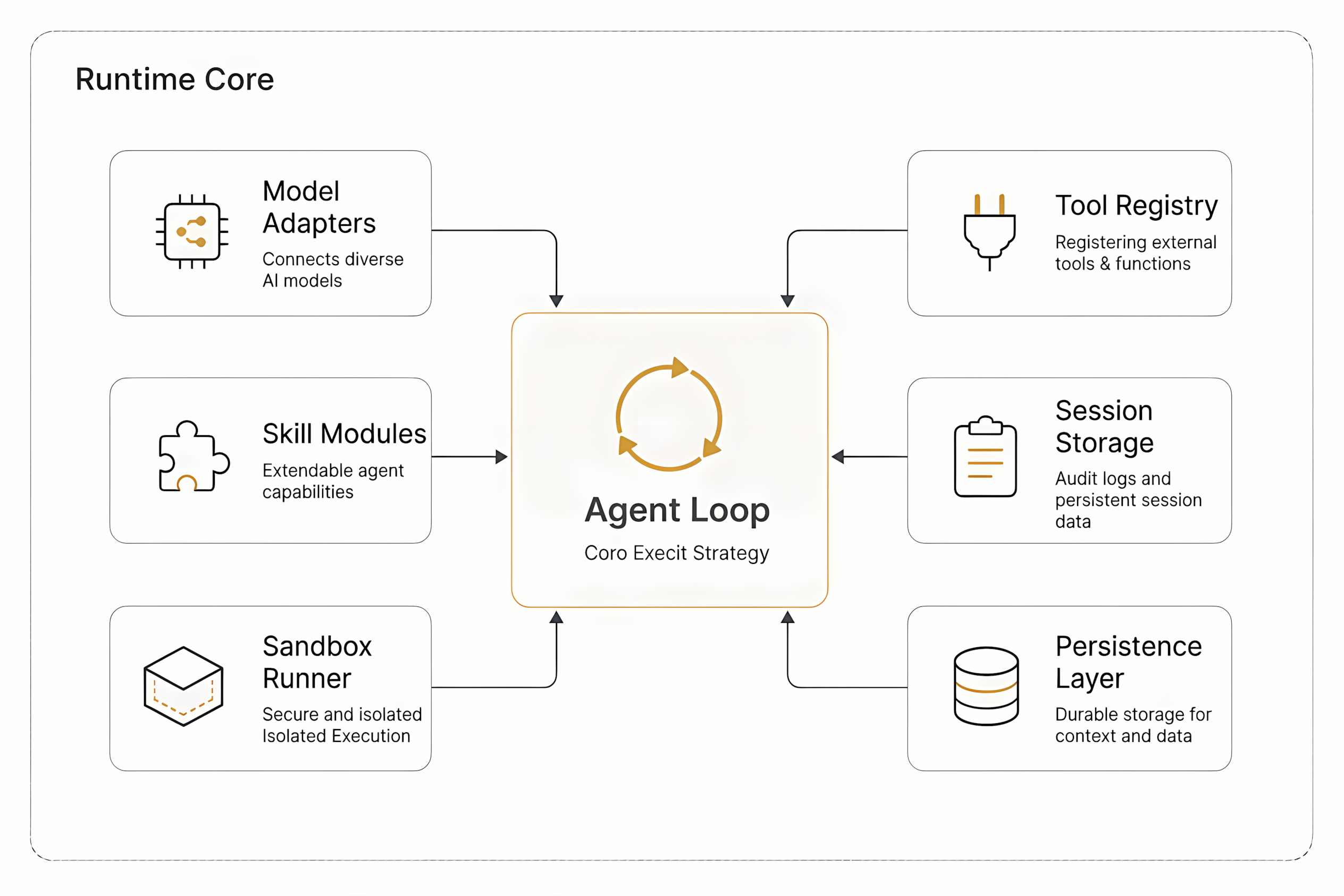
This architecture provides three decisive engineering advantages:
- Model Decoupling: Teams can retain identical tool pipelines, custom variables, and business rules while swapping underlying model adapters, enabling objective benchmarks across model releases.
- Infrastructure Extensibility: Internal storage buckets, custom telemetry collectors, and proprietary authorization middleware can be registered as standard runtime plugins.
- Ecosystem Reusability: Domain-specific skills, analysis scripts, and UI widgets can be packaged and shared across development teams without forking the runtime core.
The Enterprise Plugin Governance Checklist
However, architectural openness introduces security vulnerabilities if unmanaged. In an enterprise environment, a malicious or poorly written plugin can exfiltrate proprietary data, overwrite databases, or exhaust infrastructure budgets.
Enterprises must implement rigorous plugin governance across six pillars:
3. Sandboxed Execution & Session Isolation: The ADP 4.0 Claw Architecture
When agents are granted the capability to write code, execute scripts, and manipulate files, the sandbox environment becomes the primary defense boundary.
In unmanaged developer environments, an agent generating a script with a command like rm -rf / or attempting to read /etc/passwd risks damaging the host system. In multi-tenant cloud platforms, cross-session contamination where User B accesses files generated by User A is a critical security vulnerability.
To eliminate these risks, Tencent Cloud ADP 4.0 introduced Claw Mode.
Core Security Mechanics of ADP Claw Sandboxes
- Per-Session Ephemeral Sandboxes: Every conversational session receives a dedicated micro-sandbox provisioned on demand. When the session terminates or expires, the sandbox and its temporary storage are securely destroyed.
- Virtual File System (VFS) Isolation: Files uploaded by users (e.g., CSV datasets, PDF manuals) or generated by the agent (e.g., Excel balance sheets, Matplotlib charts) exist strictly within that session's virtual file system. No agent instance can view or mount another session's directory.
- Strict Resource CGroups: Each sandbox runs with enforced CPU, memory, and execution timeout quotas (e.g., max 2GB RAM, 60-second execution cap). Runaway infinite loops or memory leaks are automatically terminated without degrading adjacent cluster nodes.
- Egress Network Filtering: Outbound network requests from the sandbox execution environment are restricted to enterprise-approved domain allowlists, neutralizing prompt-injection data exfiltration vectors.
4. Dynamic Context & Modular Tool Loading: Preventing Context Window Bloat
A common anti-pattern in early enterprise agent implementations is static tool loading. As developers connect more enterprise capabilities, they register dozens of OpenAPI tool schemas directly into the agent's base system prompt.
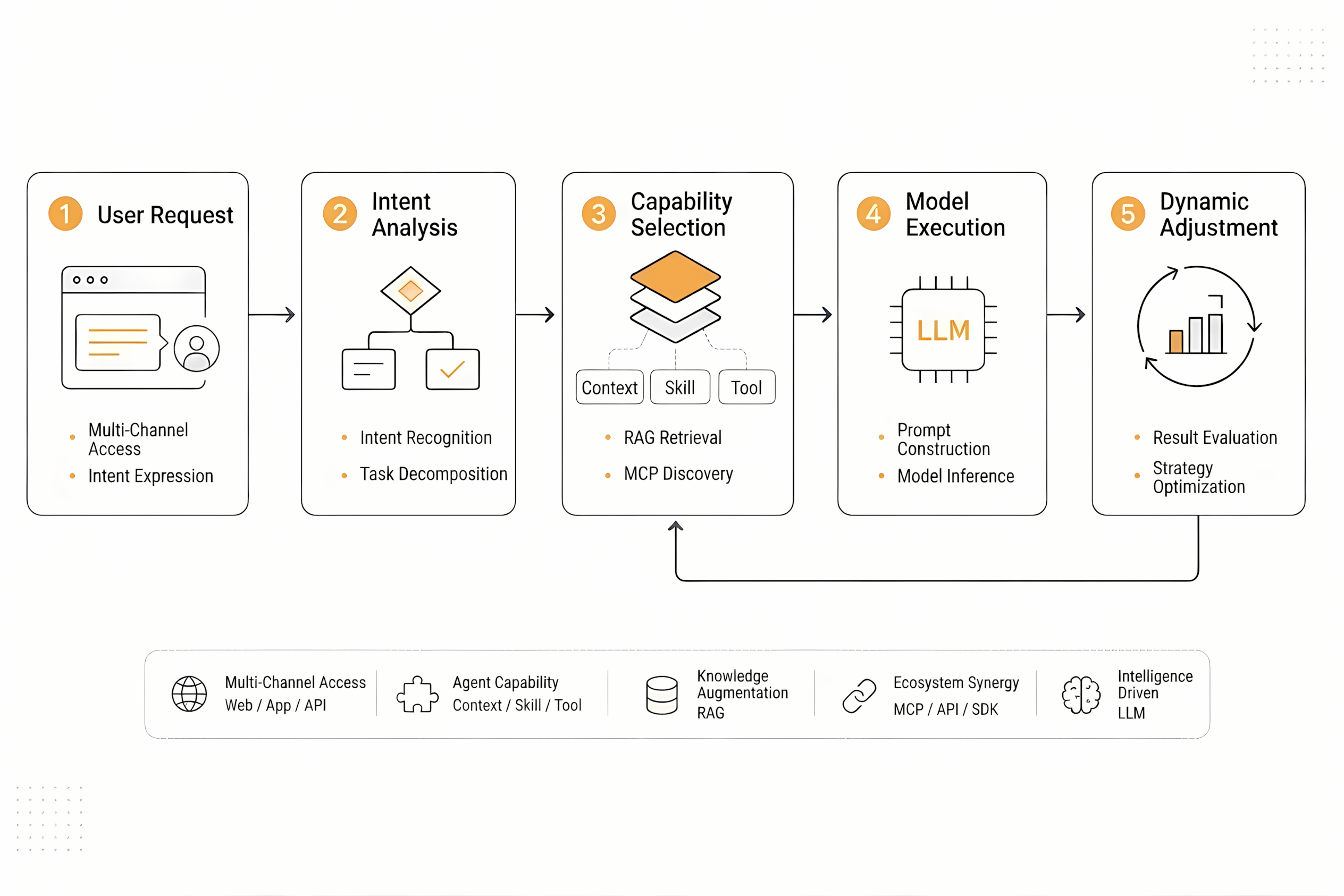
The Consequences of Static Tool Bloat
- Context Window Saturation: Injecting 40 detailed JSON schemas can consume 12,000 to 20,000 prompt tokens per request, drastically increasing inference costs.
- Model Attention Degradation (Tool Confusion): When presented with dozens of overlapping tool definitions, LLMs frequently select incorrect tools or hallucinate invalid argument structures.
- Increased Time-to-First-Token (TTFT): Massive system prompts slow processing speeds, degrading end-user experience in interactive applications.
Dynamic Tool & Skill Orchestration in ADP
Tencent Cloud ADP resolves this challenge by treating tools and context as dynamic runtime assets:
- Semantic Skill Routing: Enterprise tools are grouped into modular Skills inside the ADP Skill Hub. When a user sends a query, ADP's lightweight router matches user intent against skill descriptors and injects only the 2–3 required tool definitions into that specific conversational turn.
- Model Context Protocol (MCP) Integration: ADP natively supports the open Model Context Protocol (MCP). Organizations can host secure MCP servers within internal VPCs, enabling ADP agents to query and execute on-premises tools dynamically.
- Context Pruning and Compaction: For multi-turn conversational workflows, ADP dynamically prunes intermediate tool execution logs, retaining only high-signal observations and structured summaries.
- Externalized Artifact Storage: Large tool outputs (such as a 10MB SQL query dump or a generated 50-page document) are offloaded to object storage (Tencent Cloud COS) and passed into the context as structured URI references, keeping context consumption minimal.
5. Long-Running Tasks and Session Logs: Replay, Audit, and Recovery
Production agents rarely complete enterprise workflows in a single turn. Multi-step operations—such as reconciling financial discrepancies, diagnosing microservice log anomalies, or executing comprehensive market research—require agents to execute continuous loops over dozens of intermediate steps.
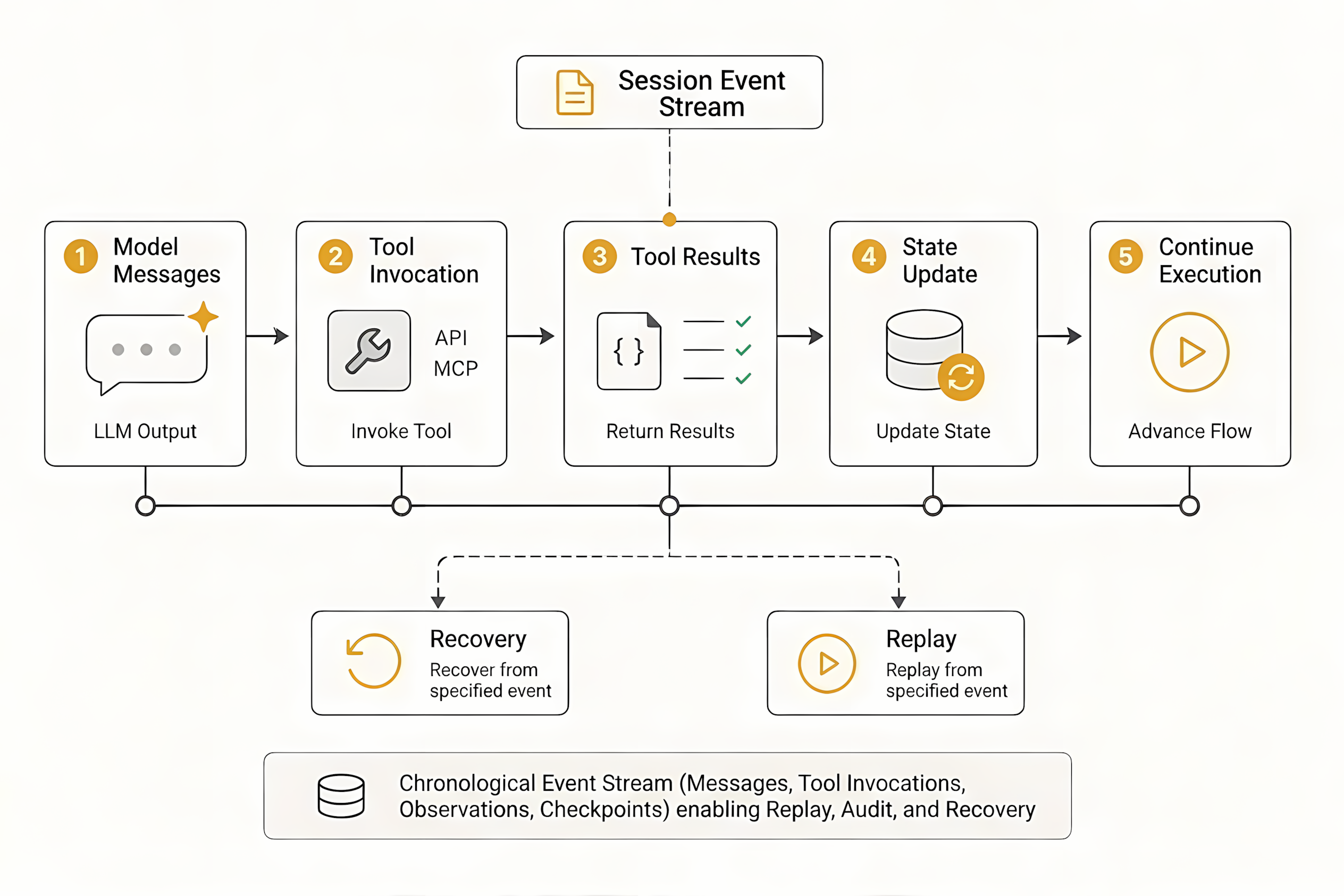
DeepSeek Harness established an important standard by treating agent execution as an append-only, sequential event stream. In Tencent Cloud ADP, this architecture is extended into an enterprise-grade cloud event log:
Operational Value of Cloud Session Logs
- Deterministic Execution Replay: Engineering teams can replay any historical session step-by-step to inspect the exact prompt, tool arguments, and environment state that produced a specific output.
- Resilient Failure Recovery: If an external API encounters a transient network partition on Step 8 of a 10-step workflow, ADP restores the execution state from Step 7 without re-running prior idempotent actions.
- Regulatory Audit Compliance: Financial, legal, and healthcare applications maintain an immutable audit trail of which user authorized an action, which data points were retrieved, and which external APIs were invoked.
- Golden Dataset Curation: Production session logs with high user ratings can be exported into curated evaluation datasets to benchmark prompt iterations and model updates.
6. MCP, Enterprise Connectors, and Harness: Layered Architecture
The terms MCP, Connectors, and Agent Harness are often conflated. In production architectures, they operate across distinct, complementary layers:
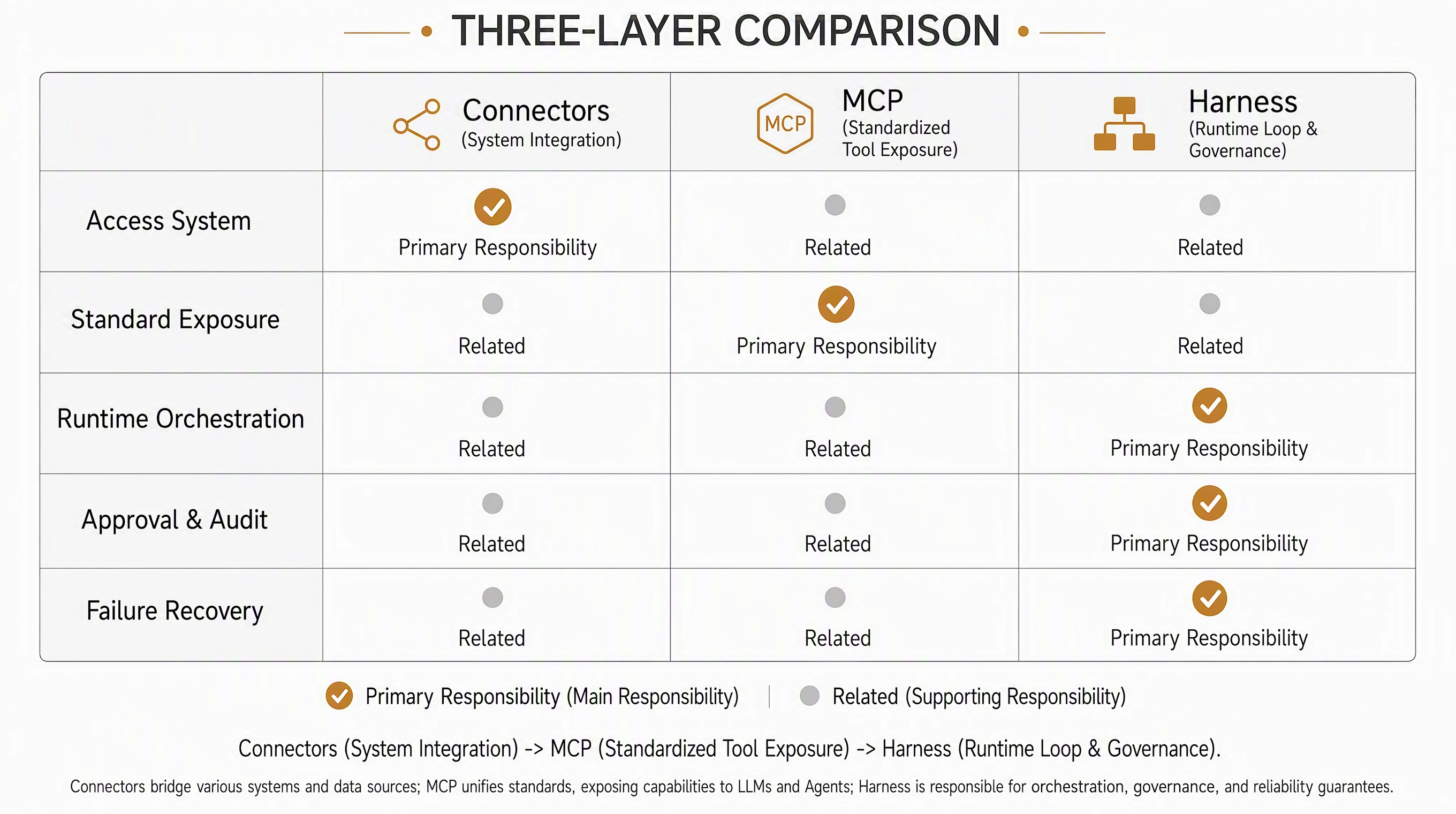
- Model Context Protocol (MCP) defines how tools and data resources are formatted and exposed across heterogeneous systems.
- Enterprise Connectors define how enterprise software (SAP, Salesforce, Jira, internal databases) securely connects to cloud infrastructure with proper network routes and credentials.
- The Agent Harness defines how the autonomous loop executes, deciding when to call a tool, verifying user authorization, isolating the environment, and recovering from failures.
7. Enterprise AgentOps and Multi-Model Gateway Resilience
Deploying hundreds of autonomous agents across multiple departments introduces operational complexity. Without centralized governance, organizations suffer from model downtime, uncontrolled inference spending, and unmonitored prompt drift.
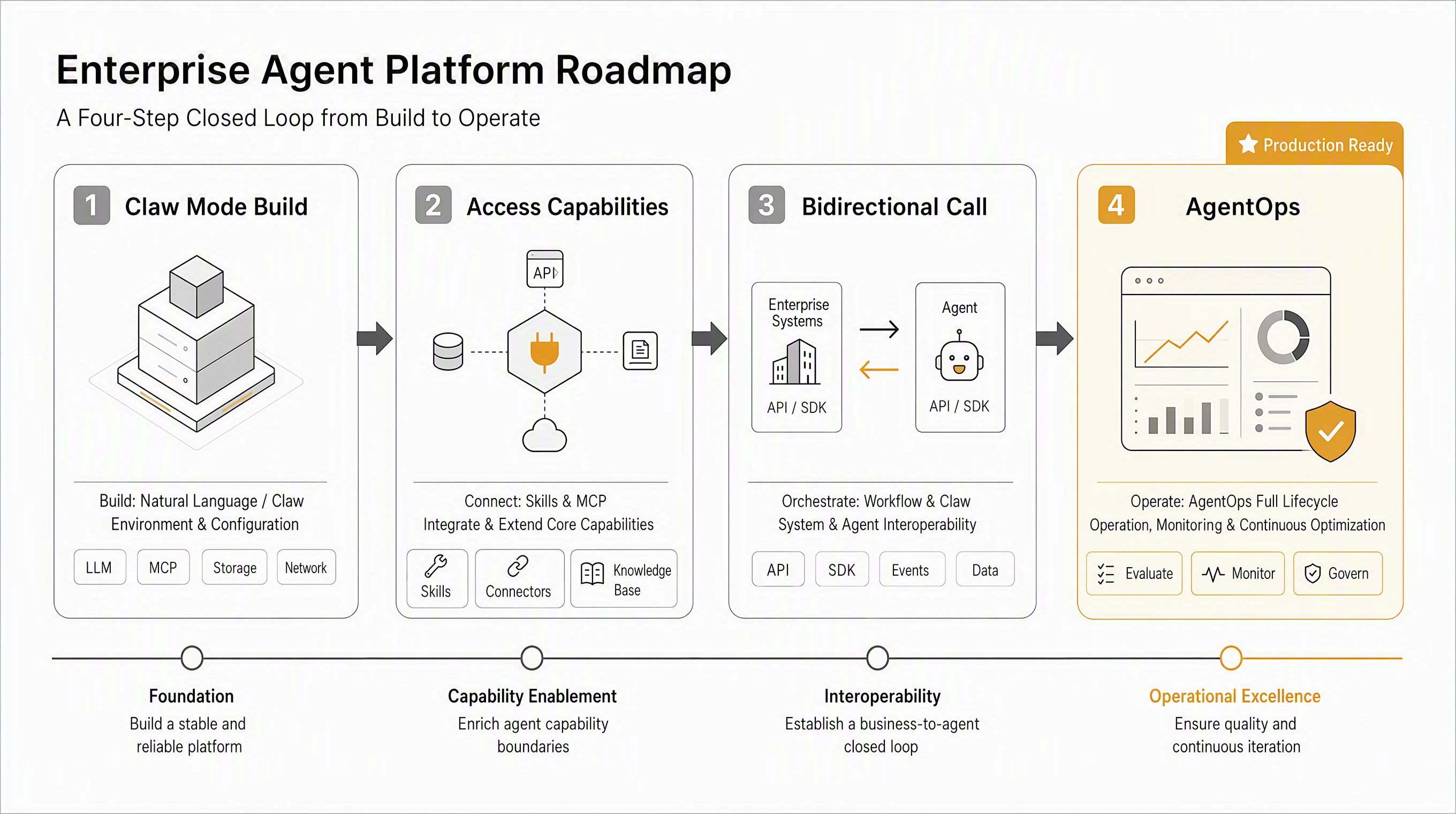
Multi-Model Gateway & Automated Failover Matrix
Tencent Cloud ADP provides an intelligent model gateway supporting the Tencent Hunyuan flagship series (Hunyuan-Pro, Hunyuan-Turbo, Hy4 Preview) alongside leading open and commercial foundation models including DeepSeek (DeepSeek-V4 Pro, DeepSeek-V3.2), GLM-5.3, and Kimi.
- Zero-Downtime Model Failover: If the primary reasoning model experiences transient latency spikes or upstream throttling, the gateway automatically retries with exponential backoff and fails over to a designated secondary model without dropping the user's active streaming connection.
- Credit Quota Governance: Enterprise administrators assign monthly Credit consumption caps per workspace (
SpaceId), preventing unexpected billing spikes from runaway subagent recursions. - Loop Circuit Breakers: Multi-agent collaborative workflows enforce strict
max_goal_roundsand execution timeout caps, terminating cyclical agent behavior automatically.
8. End-to-End Setup Guide: Bridging DeepSeek Harness to Tencent Cloud ADP
Let us walk through configuring a production-grade Claw agent on Tencent Cloud ADP and connecting it to local or cloud workflows.
Step 1: Obtain Cloud Credentials
From the Tencent Cloud ADP Console, generate the required authentication keys:
- Management API Keys (
SecretId/SecretKey): Used for control-plane configuration (CreateApp,ModifyAgent,CreateRelease) via the OpenAPI gateway (adp.tencentcloudapi.com, API Version2026-05-20). - Application Key (
AppKey): Used for runtime data-plane client interactions over SSE/WebSocket (https://adp.tencentcloud.com/adp/v2/chat).
Step 2: Configure the DeepSeek Harness ADP Plugin
If you are orchestrating agents locally via DeepSeek Harness, configure the official Tencent Cloud ADP plugin in your DSH environment:
{
  "plugins": {
    "@tencentcloudadp/dsh-adp": {
      "enabled": true,
      "config": {
        "endpoint": "https://adp.tencentcloudapi.com",
        "secretId": "AKIDxxxxxxxxxxxxxxxxxxxxxxxx",
        "secretKey": "YourTencentCloudSecretKey",
        "spaceId": "space-enterprise-prod-01",
        "defaultModel": "hunyuan-pro",
        "defaultAppMode": 4
      }
    }
  }
}
Step 3: Provision an Enterprise Claw Application via OpenAPI
Deploy a dedicated Claw Mode application programmatically using the Tencent Cloud API:
import json
import requests

# 1. Management API Configuration
API_ENDPOINT = "https://adp.tencentcloudapi.com"
API_VERSION = "2026-05-20"
SPACE_ID = "space-enterprise-prod-01"

# 2. Provision Claw Application (Dedicated Sandbox Workspace)
payload = {
    "SpaceId": SPACE_ID,
    "AppName": "Enterprise Financial Risk Auditor",
    "AppMode": 4,  # Claw Mode with sandboxed execution environment
    "Description": "Performs multi-step financial risk modeling, executes Python in Claw sandboxes, and verifies audit compliance."
}

# (Execute request using Tencent Cloud V3 HMAC-SHA256 signature protocol)
# response = requests.post(API_ENDPOINT, headers=signed_headers, json=payload)
# app_id = response.json()["Response"]["AppId"]
Step 4: Configure Agent Capabilities and Dynamic Skills
Attach instructions, bind modular skills, and enable dynamic in-conversation configuration (AllowDynamicConfig: true):
{
  "Action": "ModifyAgent",
  "AppId": "app-8f92a10e",
  "AgentConfig": {
    "AgentName": "RiskAuditorCore",
    "ModelId": "hunyuan-pro",
    "SystemPrompt": "You are a Senior Financial Risk Auditor. Analyze financial data, execute Python scripts in your Claw sandbox to compute variance metrics, and generate verified audit reports. Always cite source documents.",
    "SkillIds": [
      "skill-financial-analysis",
      "skill-audit-compliance-check"
    ],
    "PluginIds": [
      "plugin-enterprise-sql-connector",
      "plugin-compliance-search"
    ],
    "AllowDynamicConfig": true
  }
}
Step 5: Stream Verified Outputs via Server-Sent Events (SSE)
Front-end applications (e.g., Web, Mobile, WeChat Work, or custom portals) communicate with the published agent using streaming APIs:
curl -X POST "https://adp.tencentcloud.com/adp/v2/chat" \
  -H "Content-Type: application/json" \
  -H "X-AppKey: appkey-7c3d2e1b4a8f9012" \
  -d '{
    "session_id": "session-audit-8841",
    "user_id": "auditor_zhang_01",
    "content": "Analyze the attached Q2 portfolio dataset, execute variance calculations for foreign exchange exposure, and generate a summary chart.",
    "custom_variables": {
      "department": "RiskManagement",
      "region": "APAC"
    },
    "streaming": true
  }'
EVENT: thought
DATA: {"text": "Initializing Claw sandbox workspace and loading portfolio dataset..."}
EVENT: tool_call
DATA: {"tool": "claw_code_interpreter", "input": "import pandas as pd; df = pd.read_csv('portfolio_q2.csv'); ..."}
EVENT: tool_result
DATA: {"status": "success", "artifact": "fx_variance_chart.png"}
EVENT: reply
DATA: {"text": "The Q2 portfolio analysis is complete. FX hedging variance remained within the 1.5% target ceiling. The generated distribution chart has been saved to your session workspace."}Enterprise FAQ
Q1: How does ADP Claw Mode differ from standard Docker container deployment?
Answer: Managing traditional Docker containers manually requires engineering teams to build custom daemon orchestration, lifecycle garbage collection, port routing, and file system mounting per session. ADP Claw Mode provides a fully managed, serverless micro-sandbox lifecycle. Sandboxes are provisioned dynamically upon session creation, automatically enforce virtual file system isolation, include pre-installed data science runtimes, and terminate cleanly without infrastructure maintenance overhead.
Q2: What is the difference between Configuration-End Agents (Kind=0) and User-End Agents (Kind=1)?
Answer: In Tencent Cloud ADP, Kind=0 represents the base application configuration managed by developers and published via formal releases (CreateRelease). When AllowDynamicConfig is enabled, the platform can instantiate dynamic Kind=1 user-level agents (CopyAgentFromApp). This enables client applications to dynamically adjust system prompts, bind specialized user skills, or switch underlying models on a per-user or per-session basis over API without requiring application republishing.
Q3: Can we integrate our proprietary internal APIs and private databases with ADP?
Answer: Yes. ADP supports three enterprise integration patterns:
- Model Context Protocol (MCP): Deploy internal MCP servers within your enterprise VPC and bind them to your ADP workspace.
- API Connectors: Register private REST/GraphQL endpoints with custom token or HMAC authentication headers.
- Local Hybrid Bridging: Use DeepSeek Harness with the ADP plugin on internal development machines to bridge local network assets to cloud-hosted models and enterprise knowledge bases.
Q4: How does ADP prevent runaway multi-agent loops from inflating cloud costs?
Answer: ADP incorporates three layers of automated circuit breakers:
- Round Ceilings (
max_goal_rounds): Every multi-agent collaborative task enforces a configurable hard cap on execution iterations. - Credit Quotas: Enterprise workspaces enforce monthly and hourly Credit budget ceilings with automated administrative alerts.
- Anomaly Detection: Real-time AgentOps monitors detect repetitive tool invocation loops and terminate unresponsive subagents gracefully.
Q5: How does Tencent Cloud ADP ensure enterprise data privacy during model inference?
Answer: Customer data, uploaded documents, and conversation histories processed through Tencent Cloud ADP are strictly isolated within enterprise tenant boundaries and are never utilized to train public foundation models. Furthermore, enterprise workspaces support Key Management Service (KMS) encryption, Cloud Access Management (CAM) role policies, and global compliance certifications (SOC2, ISO 27001).
Summary & Call to Action
The evolution of frameworks like DeepSeek Harness has demonstrated that the future of AI lies in autonomous, tool-executing agent runtimes. However, taking agents from single-developer terminals into mission-critical enterprise production demands industrial-strength isolation, dynamic context management, multi-model resilience, and comprehensive AgentOps governance.
By combining the lightweight agility of local harnesses with the secure, scalable cloud infrastructure of Tencent Cloud ADP 4.0, enterprises can deploy reliable, compliant, and cost-effective autonomous AI workforces.
Start Building Enterprise-Grade Agents
- Explore the Global Platform: Visit adp.tencentcloud.com to access the international console.
- Tencent Cloud Product Center: Learn more about enterprise capabilities at tencentcloud.com/products/adp.
- Official Documentation: Review API references and integration guides at Tencent Cloud ADP Documentation.

Start building today
If you need more support, please contact us