
Enterprise Agent Security Governance: A Practical Implementation Blueprint
Enterprise AI agents are rapidly moving into production, but shared identity credentials, insufficient sandbox isolation, and gaps between evaluation results and real-world behavior are amplifying security risks.


Introduction
AI Agents are moving from proof of concept into business systems. They are starting to access enterprise Knowledge Bases, call APIs, read and write files, execute Workflows, and even participate in production tasks such as customer service, marketing content generation, business analysis, and office collaboration. As autonomy increases, enterprise AI agent security is entering a new stage of governance: risks no longer come only from model output quality, but also from identity and permissions, tool invocation, runtime isolation, pre-release evaluation, operational observability, and approval processes.
【Figure 1:Survey bars compare Agent incidents, identity gaps, sandbox adoption, evaluation failures, and automation trust.】
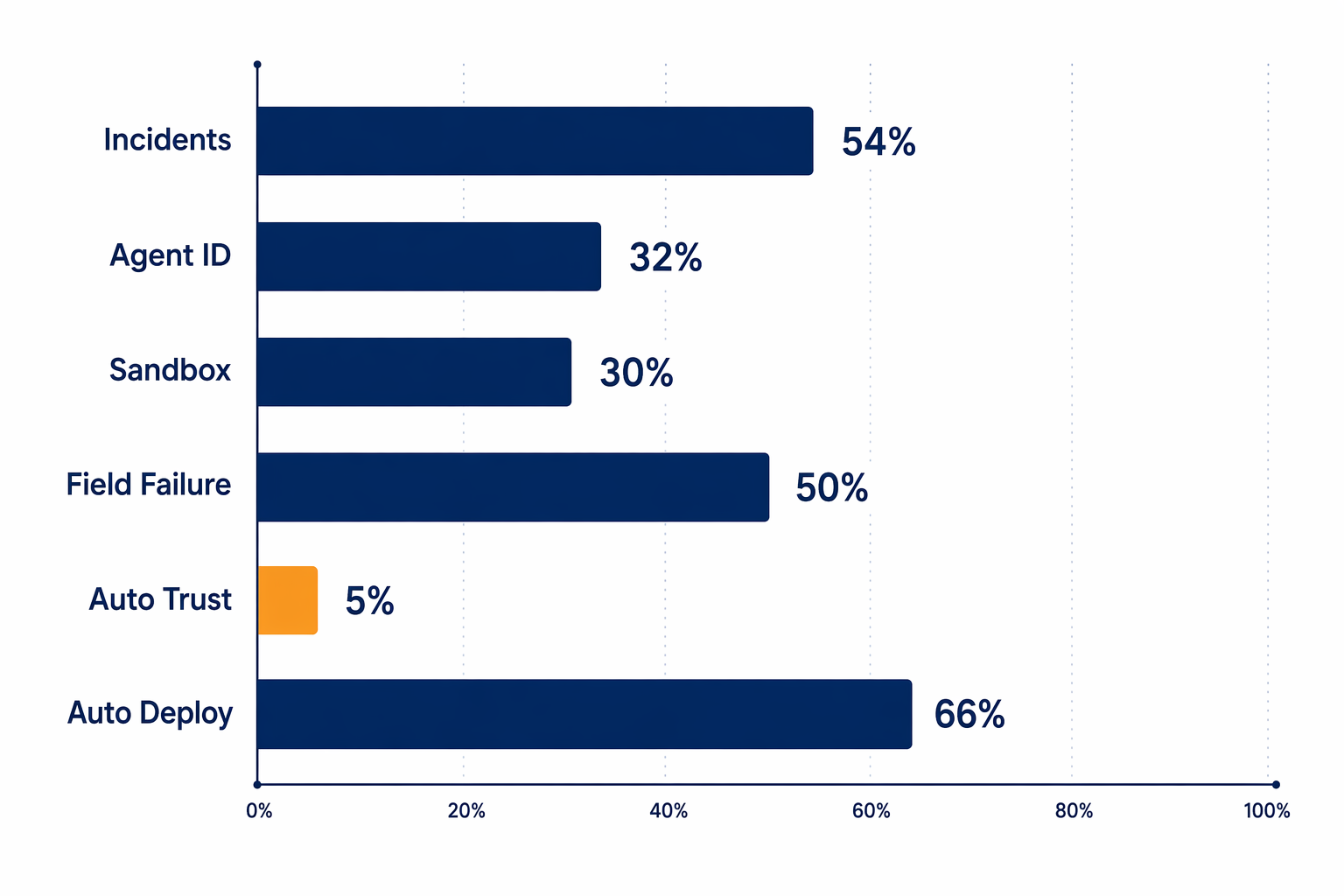
Two Pulse Research surveys published by VentureBeat in July 2026 provide a clear signal: enterprises are accelerating the deployment of AI Agents into production, while security and evaluation systems have not fully caught up. An Agent security survey of 107 enterprises found that 54% of organizations had already experienced a confirmed AI Agent security incident or a near-miss that could have caused harm; only 32% assigned each Agent an independent, controlled identity credential; and only 30% isolated their highest-risk Agents in sandboxes. Another Agent evaluation survey covering 157 enterprises found that 50% of organizations had deployed an Agent or LLM feature in the past year that passed internal evaluation but failed in customer-facing scenarios; only 5% fully trusted automated evaluation; and 66% had already allowed, or planned to allow within 12 months, low-risk Agents to be deployed based on automated evaluation results without human intervention.
These figures come from single survey samples and should be viewed as directional references. For CIOs, CTOs, CISOs, AI platform owners, and enterprise architects, they point to the same practical challenge: once AI Agents gain access to real systems, enterprises need an AgentOps platform approach that brings development, connectivity, evaluation, release, operations, and governance into a unified closed loop.
Tencent Cloud AI Agent Development Platform ADP 4.0 is built around capabilities such as the Intelligent Workspace, Claw mode, bidirectional invocation, Connectors, Skills, Knowledge Bases, MCP, and Agent Portal. It helps enterprises move beyond “quickly building Agents” toward “operating Agents in a stable, secure, and controllable way.” This article combines industry research with ADP 4.0 capabilities to outline a practical path for enterprise AI agent security governance.
Key Takeaways
- Enterprise AI agent security risks have entered production: VentureBeat research shows that 54% of surveyed enterprises have experienced confirmed Agent security incidents or near-misses, indicating that risk management must shift left into development and release processes.
- Identity management is the foundation of Agent security governance: Only 32% of surveyed enterprises provide each Agent with an independent, controlled identity. Shared credentials expand the blast radius of unauthorized access and incidents.
- Sandbox isolation determines the failure radius: Only 30% of enterprises isolate their highest-risk Agents in sandboxes. For Agents that can read and write files, call tools, and execute code, isolation directly affects production security.
- AI Agent evaluation must align with real business outcomes: 50% of surveyed enterprises have deployed Agents or LLM features that passed internal tests but failed in customer-facing scenarios, showing that evaluation cases, runtime observability, and release strategies must be connected.
- An AgentOps platform should cover the full lifecycle: Enterprises need unified management across Agent building, tool connectivity, permission approval, Skills governance, runtime observability, quality evaluation, and release compliance.
- Tencent Cloud ADP 4.0 provides practical governance levers: The Intelligent Workspace lowers the development barrier; Claw mode supports complex tasks and cloud sandboxes; bidirectional invocation connects Workflows and Agents; and capabilities such as security report visualization, Skill governance, permission management, approvals, and observability help enterprises build a controllable operating system.
1. From “Runnable” to “Governable”: How Enterprise Agent Security Risks Are Changing
Traditional AI applications are mostly focused on Q&A, retrieval, and content generation. Their risks are usually concentrated around output accuracy, content compliance, and the scope of data usage. Once AI Agents enter production, their capability boundaries change: they can connect to enterprise Knowledge Bases and tools, call business applications such as CRM, ERP, ticketing, customer service, and document systems, automatically decompose tasks, and execute multi-step operations.
【Figure 2:Side-by-side matrix contrasts runnable AI assistants with governable enterprise Agents across risk and control dimensions.】
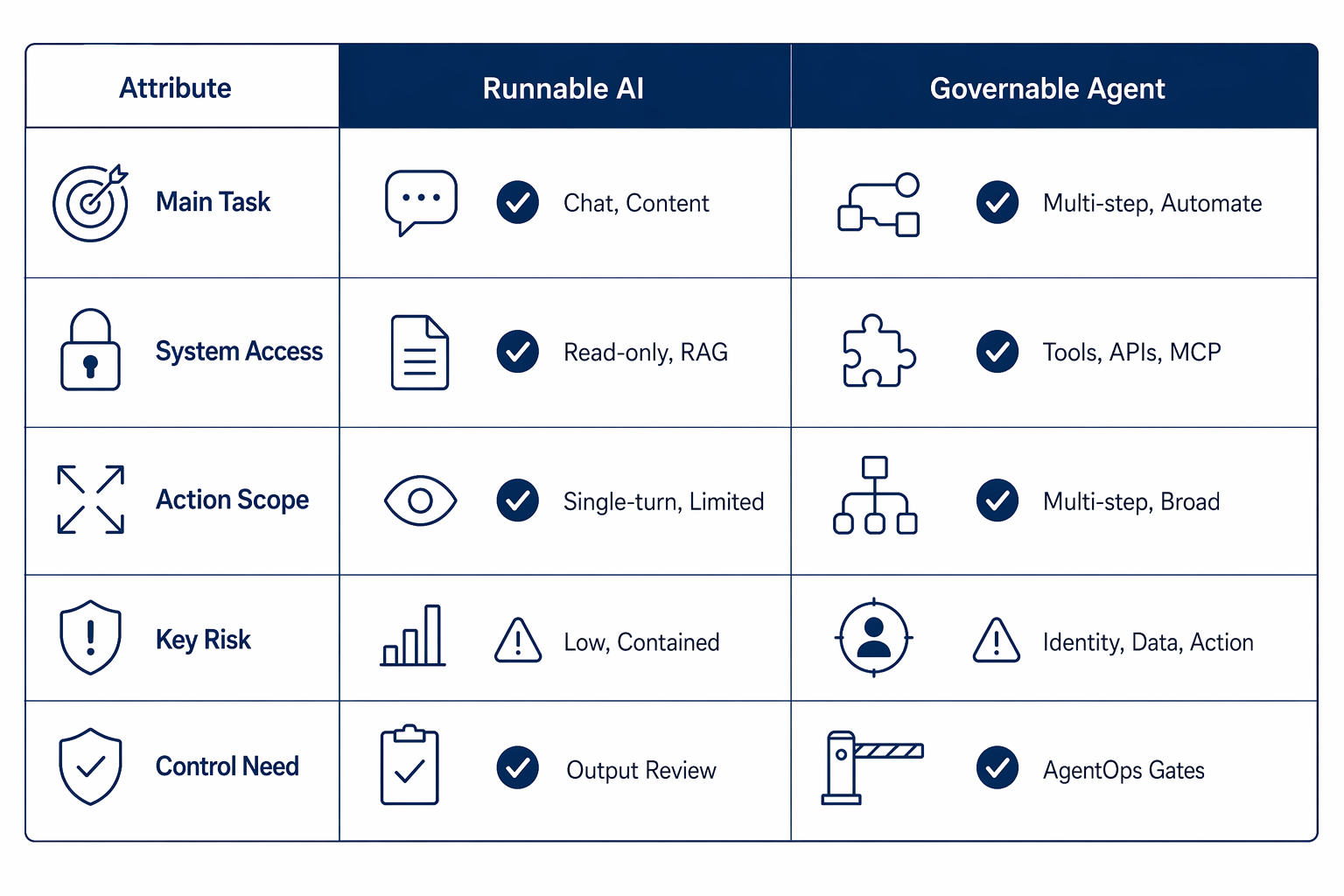
This means an Agent can possess capabilities close to those of a business operator. A customer service Agent may read customer profiles and initiate ticket routing; an operations analytics Agent may access sales, inventory, and membership data; and an office automation Agent may generate documents, process spreadsheets, and trigger notifications. The efficiency gains from deploying enterprise AI applications often come with more complex security control requirements.
VentureBeat’s Agent security survey summarizes this tension as the “Agent security gap”: enterprises are giving AI Agents greater autonomy, while control systems for identity, isolation, and execution constraints lag behind. In the survey, 54% of respondents had already experienced confirmed security incidents or near-misses, including 18% with confirmed incidents and 36% with events that nearly caused damage but were intercepted. The relatively high proportion of near-misses suggests that many enterprises are beginning to identify problems, but often only when they are already close to the production boundary.
For enterprise leaders, enterprise-grade Agent security should not be treated merely as a model security issue, nor as a point solution procurement problem. It is closer to a cross-functional engineering system: business teams define scenarios and task boundaries; AI platform teams handle construction and orchestration; security teams manage identity, permissions, audit, and compliance; and IT architecture teams connect enterprise systems while controlling access scope.
Tencent Cloud ADP 4.0 has been upgraded against this backdrop: from an AI Agent development platform to an AgentOps platform covering building, deployment, connectivity, and governance. It helps enterprises improve Agent productivity while shifting governance capabilities left to the source of development.
2. Identity and Credentials: Avoid Shared Accounts That Amplify Agent Risk
Agent identity management is the first line of control for enterprise-grade Agent security. VentureBeat research shows that only 32% of enterprises provide each Agent with an independent, controlled identity; 48% say that some Agents have controlled identities, but many still share credentials; and 32% say Agents primarily run on shared API keys, human accounts, or service account credentials. Because respondents could select multiple options, the study further notes that 69% of enterprises have some form of credential sharing across Agent groups.
【Figure 3:Minimal blast-radius illustration shows shared credentials spreading risk while individual Agent identities contain impact.】
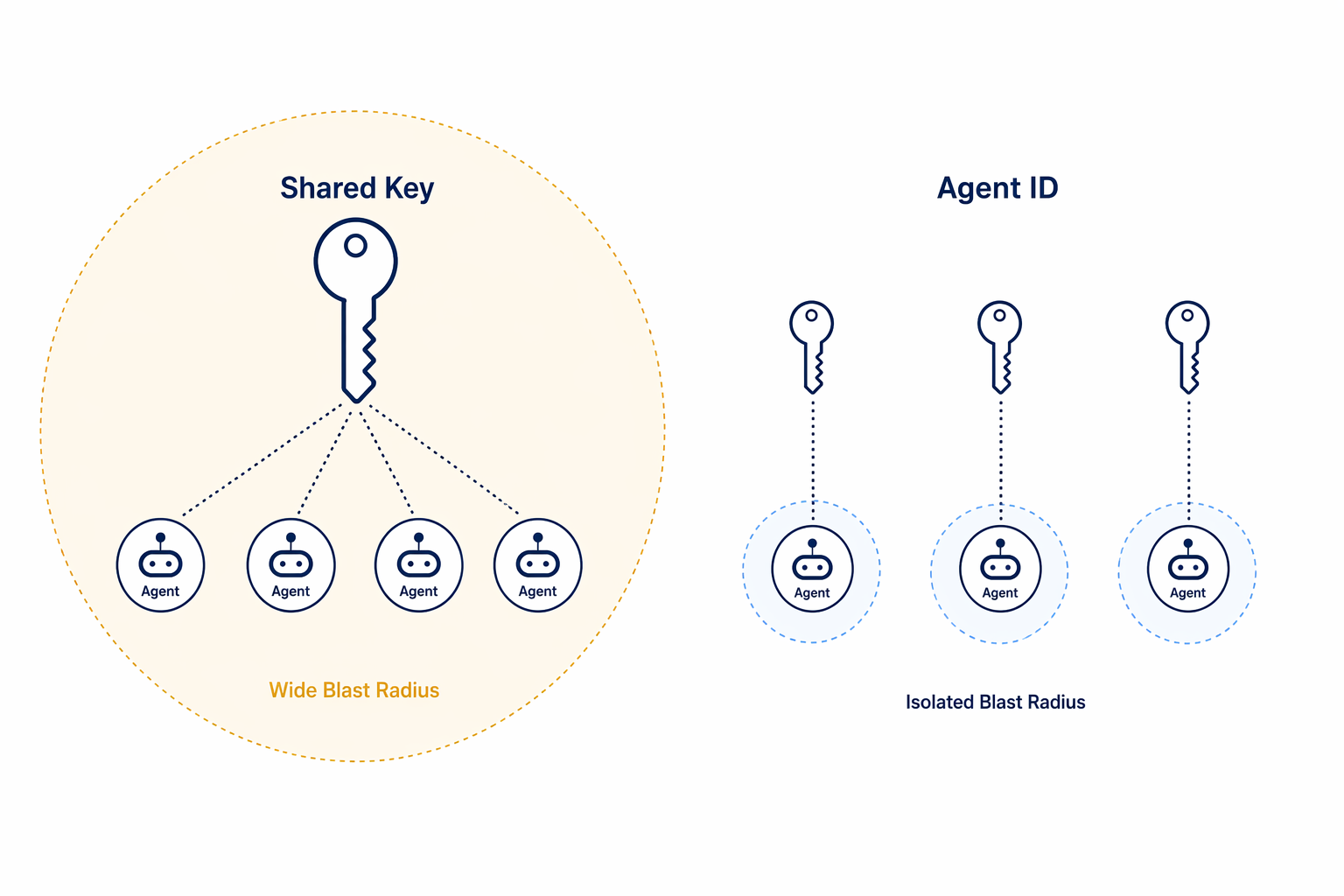
The problem with shared credentials is straightforward: once an Agent is misconfigured, induced to call a tool it should not call, or uses an over-privileged service account, the impact expands from a single task to all systems accessible by the shared credential. For CISOs, this weakens least privilege, accountability, and auditability. For business system owners, troubleshooting also becomes harder, because logs show the behavior of a shared account rather than a specific Agent, application, or Workflow node.
When planning Agent identity management, enterprises can prioritize the following principles:
- One Agent, one identity: Agents running in production should use independent identities wherever possible, avoiding long-term reuse of human accounts or shared API keys.
- Bind identity to permission scope: Agent access permissions should be designed around business tasks and grant only the required Knowledge Bases, Connectors, tools, and Workflow capabilities.
- Bind identity to environment: Credentials for development, testing, staging, and production should be separated to prevent test Agents from accessing production data.
- Make actions auditable and traceable: Every tool invocation, data read, external request, and Workflow trigger should be traceable to the Agent, user, application, and task context.
- Review regularly and reclaim on decommissioning: When an Agent is retired, its scenario changes, or its permissions are adjusted, credentials and tool authorizations should be revoked accordingly.
ADP 4.0 provides a permission management approach across enterprise, workspace, and application layers, combined with an RBAC role-permission matrix to help enterprises implement layered isolation for functional permissions and data permissions. For large-scale Agent initiatives, enterprises should incorporate Agent identities into existing IAM, approval, and audit processes to avoid the governance lag of “getting the business running first and fixing permissions later.”
3. Sandbox and Runtime Isolation: Controlling the Blast Radius of Code, Files, and Tool Calls
As Agent capabilities expand, runtime isolation becomes significantly more important. VentureBeat research shows that only 30% of enterprises isolate their highest-risk Agents in sandboxes. At the same time, many enterprises have already allowed Agents to access real systems and data, creating a mismatch between security boundaries and execution capabilities.
【Figure 4:Runtime isolation flow shows policy checks, sandbox execution, scoped tools, file access, and audit logging.】
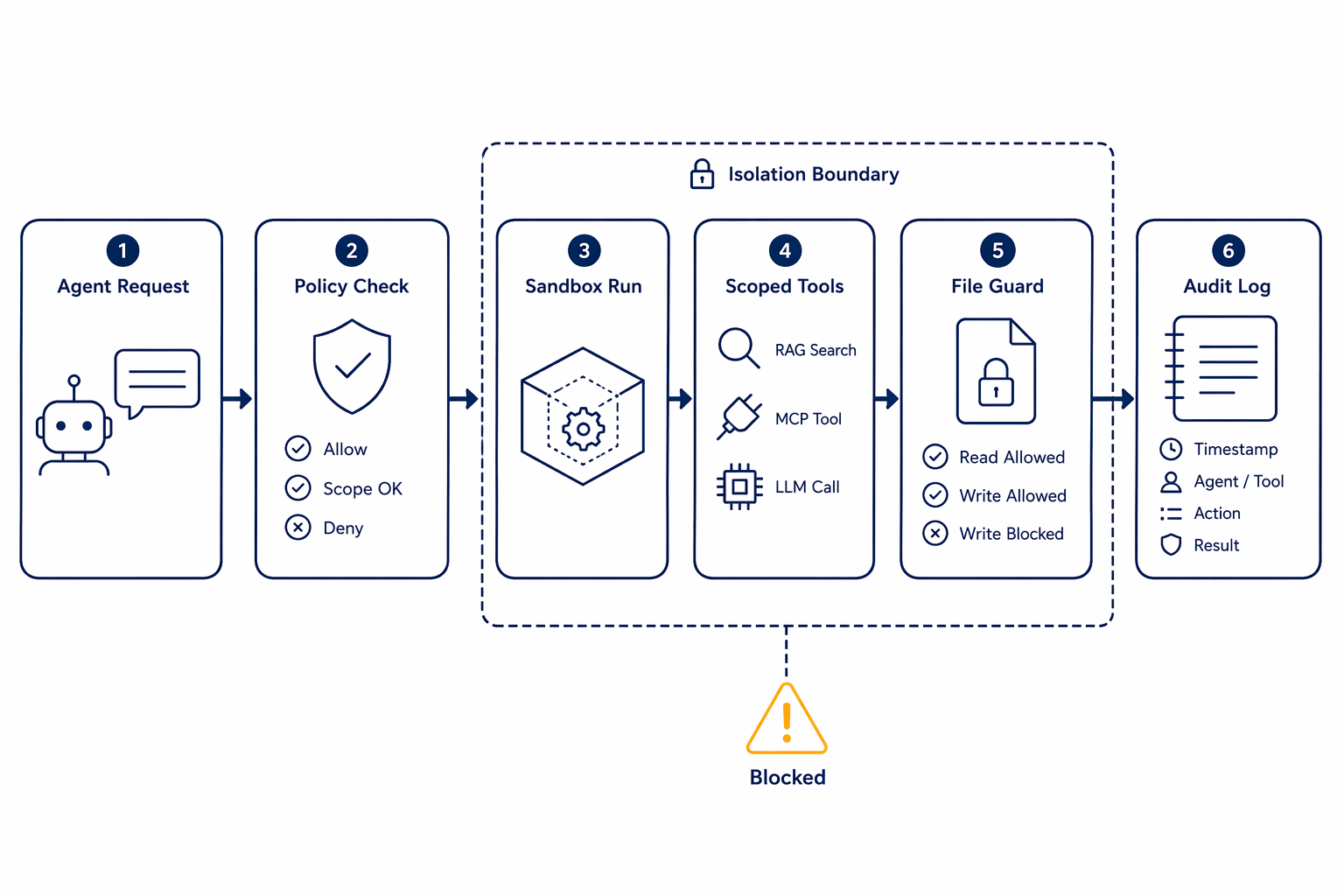
This is especially relevant in complex task scenarios, where Agents may need to autonomously write and run code, read and write files, call multiple tools, generate documents, or analyze data. Without sandbox isolation, risks such as faulty code, abnormal tool invocation, unauthorized file access, and external network requests are more likely to affect production systems. The value of a sandbox lies in limiting Agent execution to a controlled environment while providing enterprises with an observable, interruptible, and rollback-ready runtime foundation.
Tencent Cloud ADP 4.0’s Claw mode provides an independent runtime workspace for long-running, complex-logic, and non-fixed-rule tasks. Built on Tencent Cloud Agent Runtime, it supports autonomous Python code writing and execution, file reading and writing, and mounting native Skills. For enterprises, Claw mode is suitable for tasks requiring stronger execution capabilities, such as data analysis, document processing, image processing, and business analysis.
For enterprise-grade Agent sandbox isolation design, a risk-based rollout is recommended:
- Low-risk tasks: For internal knowledge Q&A, text summarization, and first-draft content generation, basic permission controls and invocation logs may be sufficient.
- Medium-risk tasks: For reading business data, generating operations dashboards, and processing office documents, more granular data permissions and operational auditing should be enabled.
- High-risk tasks: For writing to business systems, triggering external processes, executing code, or accessing sensitive data, isolated environments should be prioritized, with approval, rate limiting, timeouts, rollback, and anomaly alerts configured.
- Cross-system tasks: For tasks connecting CRM, ERP, customer service, and document systems at the same time, enterprises should pay attention to the permission boundaries of every Connector and Skill in the chain to prevent overly broad configuration at one point from expanding overall risk.
Sandbox isolation is not only for security teams. It also helps AI platform teams improve debugging efficiency. With real-time preview and execution records in a cloud sandbox, developers can identify issues in tool invocation, file I/O, data formats, and Workflow orchestration before release.
4. Skills and Connector Governance: Ensure Reusable Capabilities Pass Security Review First
The practical value of Agents comes from connecting enterprise systems, knowledge, and tools. Through Connectors, Skills, plugins, Knowledge Bases, and MCP, ADP 4.0 turns distributed business resources into callable and reusable AI capability assets. The international edition initially provides nearly 40 Connectors covering high-frequency scenarios such as CRM, ERP, ticketing, customer service, Knowledge Bases, and document systems, with support for common enterprise applications such as Google Workspace, Confluence, and Jira. The domestic 4.0 version also strengthens Connector and tool capabilities, significantly expanding the upper limit for Connectors and tools to 1,000.
As connectivity improves, governance complexity also increases. In the past, a business system API might have been called only by a fixed application. Now, multiple Agents, Workflows, and Skills may call the same API. Enterprises need to answer several questions: Who can create a Skill? What data can the Skill access? Is outbound network access allowed? Are dependencies trusted? Who approves it before release? How is it monitored after release?
ADP 4.0 provides a more systematic mechanism for Skills governance. According to product materials, before custom Skills enter the enterprise zone, they must pass security checks and multi-level approvals, including static code scanning, data access review, external network review, and dependency allowlisting. Skills created by individuals can also be upgraded with one click into enterprise-level shared Skills for team reuse.
For enterprise AI agent security governance, Skills and Connectors should be managed as assets:
- Centralized registration: Include Connectors, tools, Skills, Knowledge Bases, and Workflow nodes in a unified asset catalog.
- Classification and tiering: Categorize risk levels by data sensitivity, write capability, external network capability, and business impact scope.
- Admission approval: Complete code, dependency, network, data access, and compliance reviews before high-risk Skills are listed.
- Invocation authorization: Different Agents should only mount Skills relevant to their tasks, instead of having all tools open by default.
- Runtime monitoring: Monitor invocation volume, failure rate, abnormal cost, output quality, error types, and security risks.
- Version management: Keep version records for Skill updates, and route critical changes through canary release or approval processes.
In this way, enterprises can turn scattered tool capabilities into controllable enterprise-grade AI assets, supporting reuse by business teams while preventing Agents from freely calling unreviewed external capabilities.
5. AI Agent Evaluation: From Passing Internal Tests to Aligning with Real Outcomes
Security governance must also cover quality and reliability. VentureBeat’s Agent evaluation survey of 157 enterprises found that 50% of organizations had deployed an Agent or LLM feature in the past year that passed internal evaluation but failed in customer-facing scenarios, including 26% that experienced this once and 24% that experienced it multiple times. Only 5% of organizations fully trust automated evaluation, and 29% cited “poor alignment between evaluation and real-world outcomes” as the limitation that most affects trust.
This shows that enterprises are not only dealing with insufficient test coverage, but also with the gap between evaluation scenarios and real business outcomes. An Agent performing well on a standard question set does not mean it can handle real user expressions, abnormal inputs, missing context, interrupted multi-turn tasks, external system errors, and insufficient permissions.
Enterprises can improve AI Agent evaluation across four layers:
- Scenario evaluation: Build test cases around real business processes rather than only single-turn Q&A. For example, a customer service Agent should cover intent recognition, Knowledge Base retrieval, ticket creation, human handoff, and exception fallback.
- Tool invocation evaluation: Verify whether the Agent calls the right tool at the right time, passes correct parameters, and handles API failures and insufficient permissions.
- Security evaluation: Test risks such as prompt injection, unauthorized access, sensitive information leakage, external network requests, and erroneous write operations.
- Production observability feedback: Feed online invocation volume, response quality, error rates, user feedback, cost, and security incidents back into the evaluation case library.
ADP 4.0’s Intelligent Workspace can generate application plans through natural language and execute complex work. Combined with real-time preview in a cloud sandbox, it helps teams verify Agent behavior faster before release. The security report visualization Skill can automatically generate security and compliance reports, making runtime risks and data compliance status more visible. Agent Portal, along with business and resource dashboards, can be used to centrally manage Agents across platforms and scenarios, while monitoring key metrics such as invocation volume, response quality, runtime cost, and errors in real time.
For enterprises planning to deploy low-risk Agents automatically, it is even more important to establish a binding relationship among evaluation results, risk levels, and release strategies. Low-risk scenarios can explore more automated release processes, while medium- and high-risk scenarios should still retain human approval, canary release, and rollback mechanisms.
6. Release and Change Governance: Shift Security Gates Left to the Source of Development
In VentureBeat’s evaluation survey, 66% of enterprises have already allowed or are building capabilities for low-risk Agents to be deployed without human intervention based on automated evaluation results, including 34% that already allow it and 33% that plan to do so within 12 months. This trend means Agent release velocity will continue to increase. The faster the release, the more standardized change governance must become.
【Figure 5:Shift-left release pipeline connects source changes, permission review, evaluation, approval, staged rollout, and monitoring.】
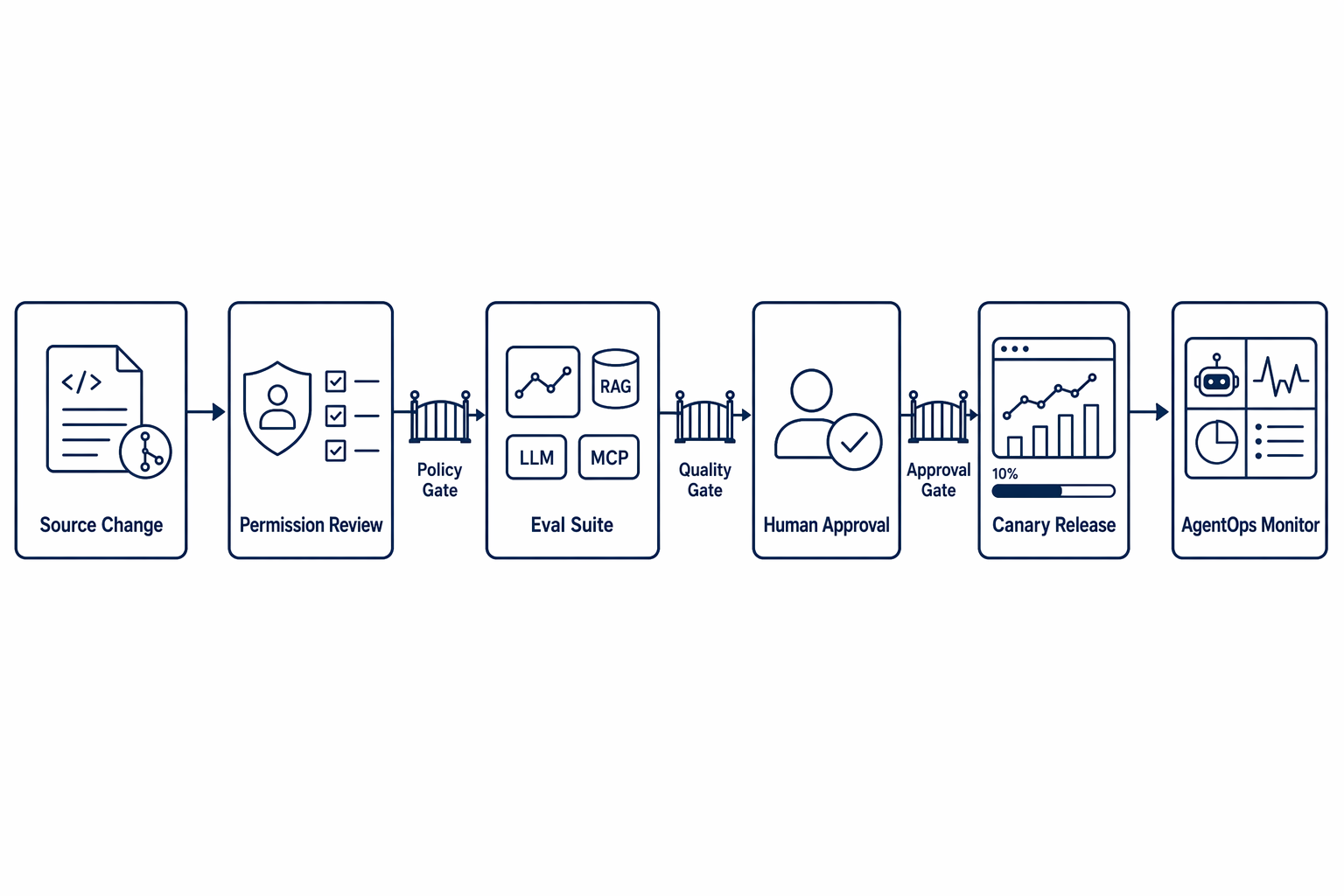
Common enterprise risks include: business teams quickly creating Agents and connecting them directly to production APIs; mixed configurations between test and production environments; prompt changes without version records; newly added tools without re-evaluation; Workflow node changes that do not trigger approval; and lack of monitoring metrics and accountable owners after release.
ADP 4.0’s Intelligent Workspace brings application building, release, and operations into a conversational interaction model. Users can describe requirements in a single sentence, generate enterprise-grade applications, enable service status on the release page, and copy API links for production integration. This efficiency gain is highly valuable for business innovation, but it also requires enterprises to establish release gates at the same time.
Enterprises are advised to build Agent release governance around the following process:
- Requirement registration: Clarify business objectives, user scope, data scope, systems to be called, risk level, and owner.
- Development configuration: Configure models, prompts, Knowledge Bases, Connectors, Skills, and Workflows within the workspace.
- Security check: Review identity permissions, data access, external calls, code dependencies, log masking, and compliance requirements.
- Evaluation and validation: Run tests for functionality, quality, security, cost, and exception handling.
- Approval and release: Set approval processes by risk level, and retain records for production API integration.
- Canary and rollback: Use canary strategies for customer-facing or critical business scenarios, and prepare rollback plans.
- Operational review: Continuously monitor response quality, errors, cost, invocation volume, and security incidents after launch.
By shifting security gates left to the source of development, enterprises can reduce post-release remediation costs and create a shared collaboration language between AI platform teams and security teams.
7. Bidirectional Invocation and AgentOps: Bringing Deterministic Processes and Intelligent Decision-Making into One Closed Loop
Enterprise business processes include both deterministic steps and open-ended judgment. Order review, ticket routing, field validation, and approval notifications are suitable for Workflows. Contract review, complex data analysis, multi-document summarization, and unstructured problem handling are better suited for Agents. If these two capabilities are separated, enterprises can end up with stable processes that lack intelligence, or flexible Agents that are difficult to govern.
ADP 4.0 supports bidirectional invocation between Workflows and Claw mode Agents:
- In a Claw application, existing Workflows can be called directly, allowing the Agent to handle highly structured and stable processes.
- In the Workflow editor, a published Claw application can be inserted as a functional node, allowing the process to call an Agent when it encounters unstructured judgment or open-ended tasks.
This bidirectional invocation helps enterprises establish an AgentOps platform closed loop. Workflows handle steps with clear rules, predictable costs, and high stability requirements. Claw mode Agents handle long-chain tasks, complex reasoning, code execution, and file processing. Connectors and Skills connect enterprise systems. Permissions, approvals, sandboxes, evaluation, and observability cover the entire lifecycle.
For production environments, enterprises can break AgentOps down into six capability domains:
| Capability Domain | Governance Objective | Key Focus Areas |
|---|---|---|
| Build | Lower the development barrier and unify standards | Intelligent Workspace, prompt templates, Knowledge Bases, application configuration |
| Connect | Securely connect enterprise systems | Connectors, MCP, APIs, data scope, system permissions |
| Execute | Control runtime boundaries | Claw mode, cloud sandbox, tool invocation, file read/write |
| Evaluate | Improve alignment with real outcomes | Scenario cases, tool invocation testing, security testing, online feedback |
| Release | Manage launch risk | Approvals, versions, canary release, rollback, production API integration |
| Operate | Maintain continuous observability and optimization | Agent Portal, quality, errors, cost, invocation volume, security reports |
For enterprise architects, the key value of AgentOps is turning individual Agent projects into platform capabilities, enabling different business lines to quickly reuse models, knowledge, tools, and processes under a unified security framework.
8. Implementation Metrics: Quantifying Governance Maturity
Enterprise-grade Agent security governance must be measurable. Enterprises are advised to establish maturity metrics across five dimensions: identity, isolation, evaluation, release, and operations. These metrics can be used to assess the current state, define a transformation roadmap, and continuously report governance outcomes to management.
【Figure 6:Governance maturity radar tracks identity, sandbox, evaluation, release, and operations metrics for Agent programs.】
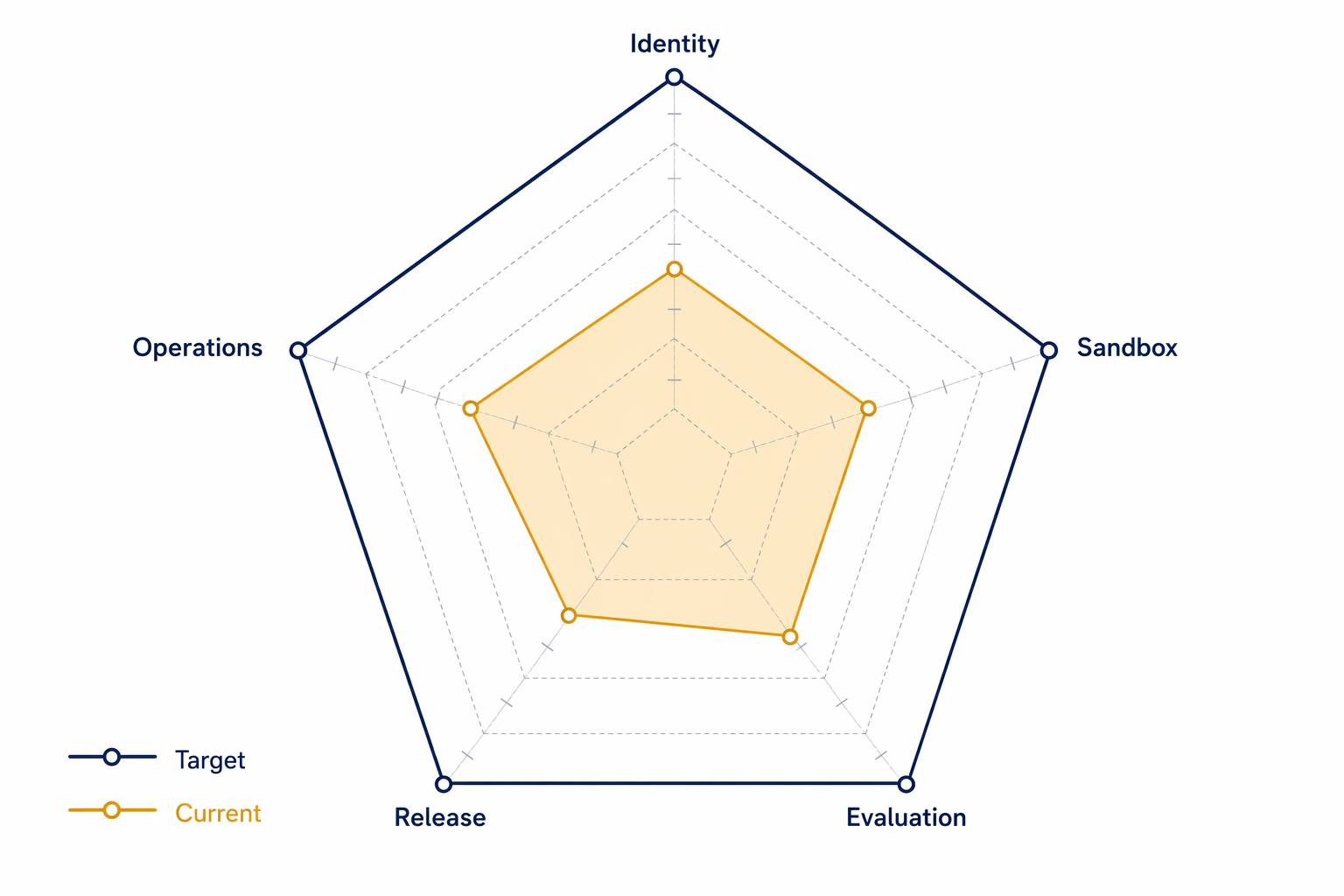
Identity and Permission Metrics
- Percentage of Agents with independent identities
- Number and percentage of Agents using shared credentials
- Number of high-privilege tool invocations
- Permission approval completion rate
- Time to reclaim abnormal authorizations and expired credentials
Sandbox and Isolation Metrics
- Sandbox coverage rate for high-risk Agents
- Isolation environment coverage rate for code-execution tasks
- Audit coverage for file read/write, external network access, and system write operations
- Coverage of timeout, interruption, and rollback capabilities for high-risk tasks
Evaluation and Quality Metrics
- Number of real business scenarios covered by pre-release evaluation
- Tool invocation test pass rate
- Security test case coverage
- Online error rate, customer-side failure rate, human takeover rate
- Proportion of evaluation cases fed back from online issues
Release and Change Metrics
- Approval coverage rate for production Agents
- Completeness of change records for prompts, Skills, Connectors, and Workflows
- Canary release coverage
- Average rollback time
- Number of incidents involving unapproved production API integration
Operations and Cost Metrics
- Agent invocation volume, response quality, and error count
- Cost of model and tool invocations
- Security report generation frequency
- Number of abnormal cost alerts
- Agent decommissioning, consolidation, and reuse status
These metrics do not need to be rolled out all at once. A more practical path is to first cover high-risk Agents and critical business systems, then gradually expand to more business lines. For enterprises that already have multiple AI Agent pilots, a current-state assessment can start with the following questions: Which Agents are already connected to production? Are there shared credentials? Do any Agents call high-risk tools? Are there release evaluation records? Can every error and invocation cost be traced?
Tencent Cloud ADP 4.0’s Intelligent Workspace, Claw mode, bidirectional invocation, Skills governance, security report visualization, Agent Portal, and resource dashboards can serve as product levers for implementing these metrics, helping enterprises gradually establish an AgentOps security closed loop from development to operations.
FAQ
1. How is enterprise-grade Agent security different from traditional application security?
Traditional applications usually follow processes predefined by developers, and system behavior is relatively deterministic. AI Agents are more autonomous and may dynamically select tools, call APIs, read and write files, or execute code based on context. Therefore, in addition to traditional controls such as identity, permissions, and auditing, enterprise-grade Agent security must also address prompts, tool invocation, runtime isolation, AI Agent evaluation, model output quality, and production observability.
2. Why should Agent identity management be governed first?
Once Agents share API keys, human accounts, or service account credentials, the blast radius of incidents expands and auditability and accountability are weakened. VentureBeat research shows that only 32% of surveyed enterprises provide each Agent with an independent, controlled identity, while 69% have some form of credential sharing across Agent groups. Enterprises should prioritize one Agent, one identity, least privilege, and regular credential reclamation.
3. Which Agents need sandbox isolation the most?
Agents with capabilities such as code execution, file read/write, external network access, production system write operations, and sensitive data access need sandbox isolation the most. For Agents such as those running in Claw mode that handle long-chain and complex tasks, a cloud sandbox helps enterprises control execution boundaries while supporting pre-release debugging, execution records, and risk observability.
4. Can an Agent go live directly after passing automated evaluation?
It depends on the risk level. VentureBeat research shows that 50% of surveyed enterprises have deployed Agents or LLM features that passed internal evaluation but failed in customer-facing scenarios, and only 5% fully trust automated evaluation. Low-risk scenarios can explore more automated release processes. For scenarios involving customers, funds, sensitive data, or production write operations, human approval, canary release, and rollback mechanisms are recommended.
5. How does Tencent Cloud ADP 4.0 support enterprise AI Agent implementation and governance?
ADP 4.0 provides capabilities such as the Intelligent Workspace, Claw mode, bidirectional invocation, Connectors, Skills, Knowledge Bases, MCP, and Agent Portal, covering Agent building, connectivity, deployment, and governance. Enterprises can lower the development barrier through the Intelligent Workspace, handle complex tasks with Claw mode, integrate Workflows and Agents through bidirectional invocation, and improve controllability through permission management, Skills approval, security report visualization, and operations dashboards.
Conclusion and CTA
After AI Agents enter production, enterprises need to answer three questions at the same time: Can they be built quickly? Can they connect securely? Can they be governed continuously? VentureBeat’s research indicates that shared identity credentials, lack of sandbox isolation, and misalignment between evaluation and real outcomes have become key gaps in enterprise AI agent security governance.
Tencent Cloud ADP 4.0 uses AgentOps platform capabilities to shift governance left to the source of development and release: the Intelligent Workspace improves build efficiency; Claw mode and cloud sandboxes support complex tasks; bidirectional invocation connects Workflows and Agents; and Skills governance, permission management, security report visualization, and Agent Portal support controllable operations.
If your enterprise is already piloting AI Agents in customer service, knowledge management, office collaboration, business analysis, or process automation, it is time to assess the maturity of identity, isolation, evaluation, and release governance across existing scenarios.
Book a Tencent Cloud ADP demo to assess the maturity of identity, isolation, evaluation, and release governance for your existing Agent scenarios, and plan a practical AgentOps security closed loop.

Start building today
If you need more support, please contact us