
Enterprise AI Customer Service: Support Operations into Governance
Transform reactive support firefighting into proactive governance with Tencent Cloud ADP and Qidian Customer Service, automating QA mining and SLA risk alerts.

Executive Summary
Enterprise customer service centers generate massive volumes of operational data every day: live chat transcripts, human agent dialogs, automated bot interaction logs, customer satisfaction (CSAT) ratings, agent occupancy metrics, ticket escalation paths, and knowledge base hit rates.
For customer service operations teams, the fundamental bottleneck is rarely a lack of data. Instead, it is the latency and manual friction required to convert raw service logs into actionable operational improvements. Traditionally, operations managers spend hours every week toggling between disparate backend dashboards—manually exporting spreadsheets, cleaning text, categorizing customer complaints, compiling weekly summaries, and chasing SLA-breaching tickets across departments.
The Tencent Cloud Agent Development Platform, in conjunction with built-in Qidian Customer Service integration skills, transforms customer service management. Rather than simply deploying another end-user chatbot, ADP establishes an intelligent operational copilot for customer service managers, supervisors, and operations teams.
By unifying data querying, root-cause analysis, content generation, and task execution into natural-language AI agent workflows, enterprises transition from reactive ticket firefighting to proactive, closed-loop operational governance.
Key Takeaways
- High-Frequency Operational Triggers: Customer service AI agents deliver the highest ROI when applied to high-frequency operational tasks: automated knowledge base curation, bot miss-rate governance, low CSAT root-cause attribution, ticket SLA management, service hotspot discovery, and scheduled reporting.
- Non-Disruptive Platform Overlay: For organizations using Qidian Customer Service, Tencent Cloud ADP overlays an intelligent operational layer on top of existing live chat routing, human agent queues, knowledge repositories, and ticketing workflows without requiring infrastructure re-architecting or staff retraining.
- Skill-Based Operational Automation: Repeatable, structured operational workflows are encapsulated into reusable ADP Skills and scheduled cron routines, allowing managers to trigger complex multi-system operations with a single natural language instruction.
- Human-in-the-Loop Governance: AI-generated knowledge base entries, customer compensation drafts, and risk intervention playbooks follow strict verification guardrails, requiring supervisor sign-off before entering production databases.
- Iterative Pilot Methodology: Enterprises should start with high-visibility, easily auditable pilots (e.g., transcript QA extraction or weekly bot miss analysis) before scaling to automated ticket triage and enterprise-wide recurring cron workflows.
1. Why Support Operations Demand an Autonomous AI Agent
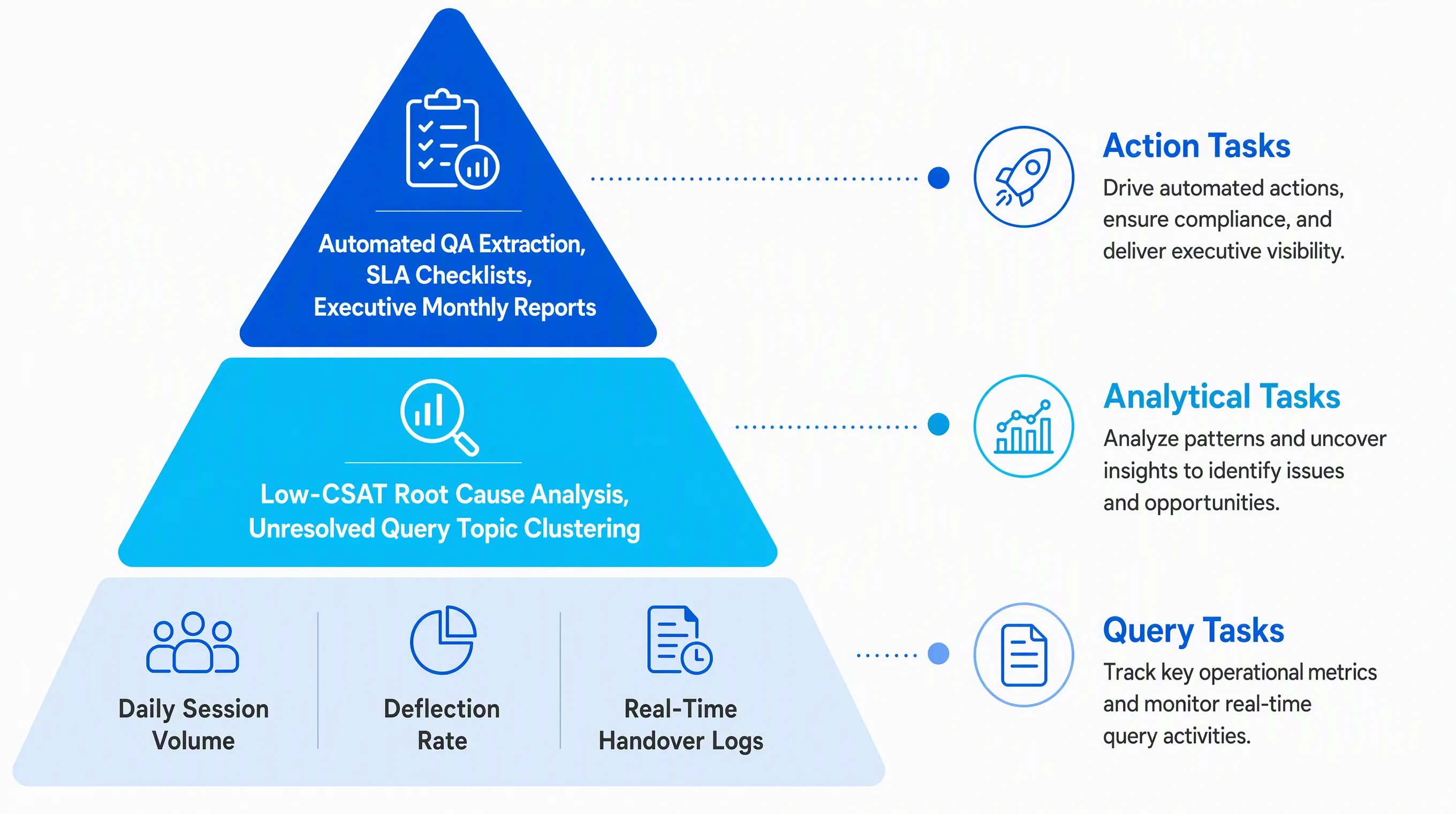
The daily responsibilities of customer support operations fall into three interdependent layers:
- Data Query Tasks: Retrieving yesterday's customer traffic, queue bottlenecks, CSAT distributions, bot resolution rates, and pending ticket volumes across shifts. While traditional CRM dashboards provide charts, operators must constantly filter by dimensions, date ranges, and custom business tags.
- Analytical Tasks: Determining why customers gave 1-star ratings, isolating why bots escalated specific intents to human agents, summarizing emerging software bugs from unstructured transcripts, and pinpointing which product lines generate overdue tickets.
- Execution & Action Tasks: Writing new knowledge base Q&A pairs, generating remediation playbooks, assembling ticket escalation task forces for daily standups, drafting monthly executive summaries, and coaching frontline agents.
Traditionally, these three layers are disconnected. Operations managers spend 70% of their bandwidth on data retrieval and manual spreadsheet consolidation, leaving little time for root-cause resolution.
The Unified Agent Workflow
An enterprise customer service agent built on Tencent Cloud ADP bridges these three layers. Operating over authorized Qidian Customer Service APIs, the agent reads raw interaction logs, performs deep semantic clustering and attribution, and produces ready-to-execute outputs: verified knowledge articles, prioritized ticket checklists, customer de-escalation drafts, and automated scheduled briefings.
Existing frontline agent interfaces and customer communication channels remain completely untouched. Operational leadership gains a 24/7 AI copilot that turns real-time customer feedback into systematic service improvements.
2. Six Core Operational Capabilities Powered by ADP + Qidian
By pairing Tencent Cloud ADP's reasoning engine with Qidian Customer Service's operational data assets, enterprises unlock six production-grade operational workflows.
Capability 1: Automated QA Extraction from Human Chat Transcripts
The efficacy of front-end customer support bots depends entirely on the freshness and realism of their knowledge bases. Traditional knowledge authoring relies on manual review of past chat logs—a tedious process where operators read hundreds of transcripts, extract customer intents, clean agent replies, generate semantic variations, and format CSVs for import.
With the ADP Customer Service Agent, operations teams execute transcript mining through natural language:
Operator Prompt: "Extract standardized knowledge base Q&A pairs and question variations from today's human support transcripts, filtering out casual greetings and non-actionable chatter."
The ADP Agent processes raw multi-turn dialogs, filters out small talk ("Hello", "Please wait while I check"), extracts core customer problem formulations, synthesizes canonical answers from successful agent resolutions, and outputs structured Q&A pairs with recommended semantic tags.
Structured Output Format for Human Verification
{
  "extracted_qa_pairs": [
    {
      "standard_question": "How do I upgrade my enterprise cloud storage quota?",
      "similar_queries": [
        "Where can I buy more storage space for my account?",
        "Storage capacity limit reached, how to expand?",
        "Storage upgrade pricing and steps"
      ],
      "standard_answer": "Log in to the Tencent Cloud Console, navigate to Storage > Resource Packages, select your target region and capacity tier, and click Upgrade. Upgrades take effect within 5 minutes.",
      "category": "Billing & Resource Management",
      "confidence_score": 0.94,
      "source_session_id": "SESSION_20260814_8921"
    }
  ]
}
Verification & Governance Guardrails
- Data Veracity: Extracted Q&A pairs originate directly from actual successful agent resolutions.
- Review Workflow: Generated draft Q&As enter a staging queue in the ADP Workbench. Knowledge managers review, edit, and approve entries before syncing them to production Qidian Knowledge Bases.
- Sensitive Guardrails: Questions touching enterprise pricing, SLA commitments, or legal clauses are automatically flagged for mandatory legal/compliance review.
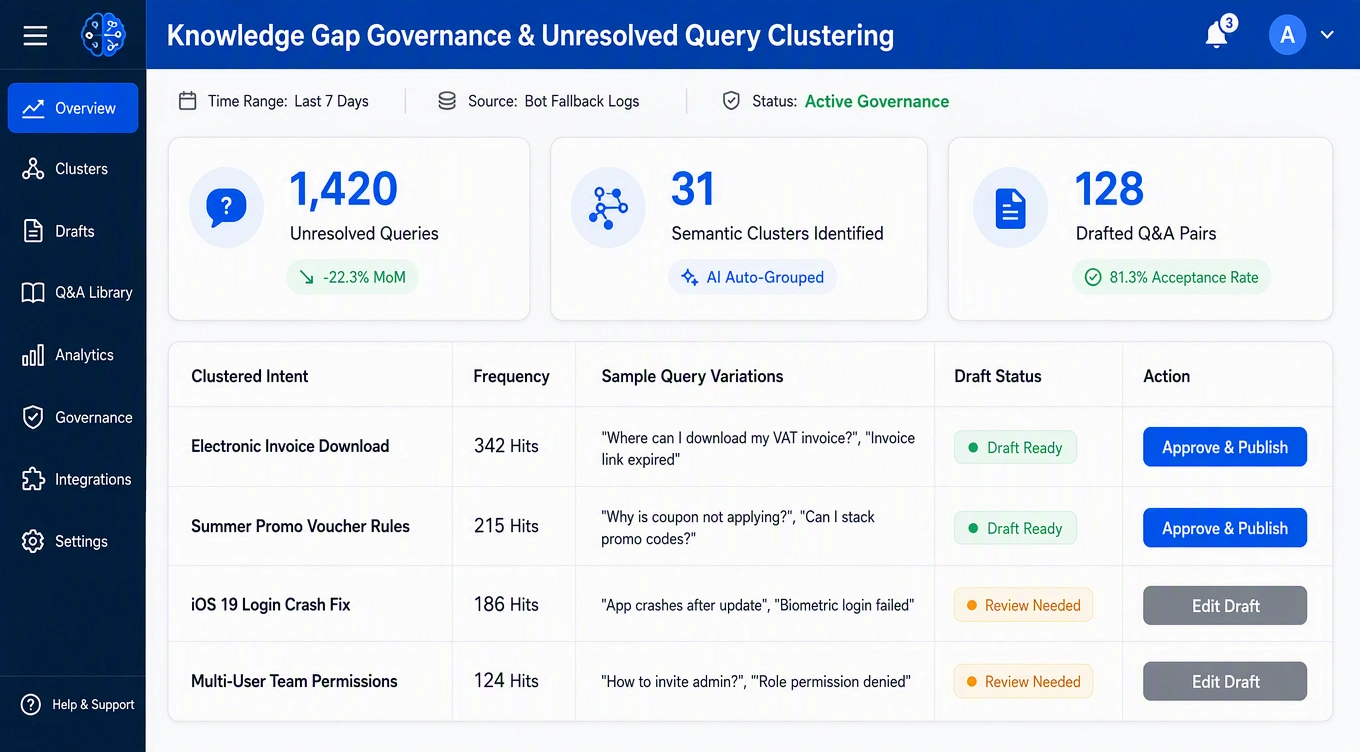
Capability 2: Unresolved Query Clustering and Knowledge Gap Governance
Customer inquiries evolve constantly due to marketing campaigns, software version updates, policy revisions, and seasonal promotions. When bots fail to match new customer intents, they trigger fallback responses or route calls to expensive human queues.
Traditional gap analysis relies on scanning static "unmatched question" error logs, which often present thousands of disjointed query snippets without semantic context.
The ADP Agent aggregates bot fallback logs, human transfer triggers, low-CSAT bot sessions, and high-frequency agent canned responses over a specified time window. It performs semantic clustering to surface distinct missing knowledge domains and drafts comprehensive remediation proposals.
Operator Prompt: "Analyze all unresolved bot queries from the past 7 days, cluster the failure root causes, and propose prioritized knowledge base updates."
Four-Step Governance Lifecycle
- Aggregation: Ingests all unmatched questions, fallback trigger events, and explicit human transfer requests from Qidian Customer Service.
- Clustering & Attribution: Groups queries by business domain (e.g., Summer Campaign Voucher Rules, iOS 19 Compatibility, Invoice Redirection).
- Draft Generation: Proposes new standard question titles, 5–10 real-world customer phrase variations, and initial draft answers based on agent resolutions.
- Publishing & Validation: Once approved, updates are pushed to the live bot, and subsequent resolution rates are tracked automatically.
Capability 3: Low CSAT Score Attribution and Customer Risk Mitigation
Customer satisfaction scores (CSAT) are a core operational KPI, yet an aggregate score (e.g., 4.3/5.0) provides zero actionable insight into why customers are dissatisfied. Operations leaders need to know: Which product lines generate the most friction? Are low ratings caused by agent response lag, policy rigidity, or bot misunderstanding? Which key accounts require immediate executive outreach?
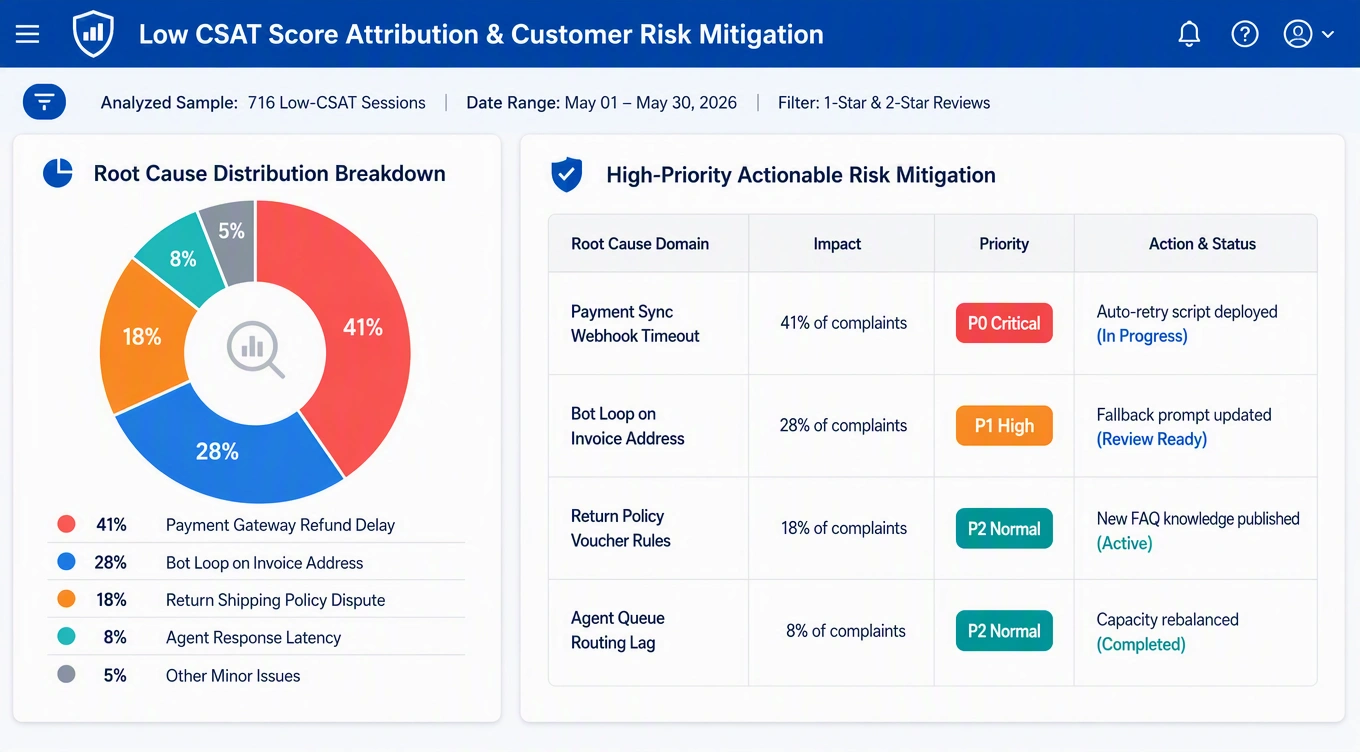
The ADP Agent scans negative CSAT evaluations (1-star and 2-star ratings), reviews full multi-turn conversational transcripts, and extracts causal factors across five operational dimensions:
- System Response Latency: Long queue hold times or delayed agent replies.
- Knowledge Inadequacy: Inaccurate answers, repetitive bot loops, or lack of documentation.
- Process & Policy Friction: Rigid return policies, cumbersome verification steps, or refund delays.
- Agent Service Demeanor: Unhelpful tone, abrupt session closures, or inadequate empathy.
- Product Defect / Outage: External service interruptions or software bugs.
Operator Prompt: "Analyze all 1-star and 2-star CSAT sessions from the past 7 days. Identify primary root causes and generate an executive risk mitigation checklist."
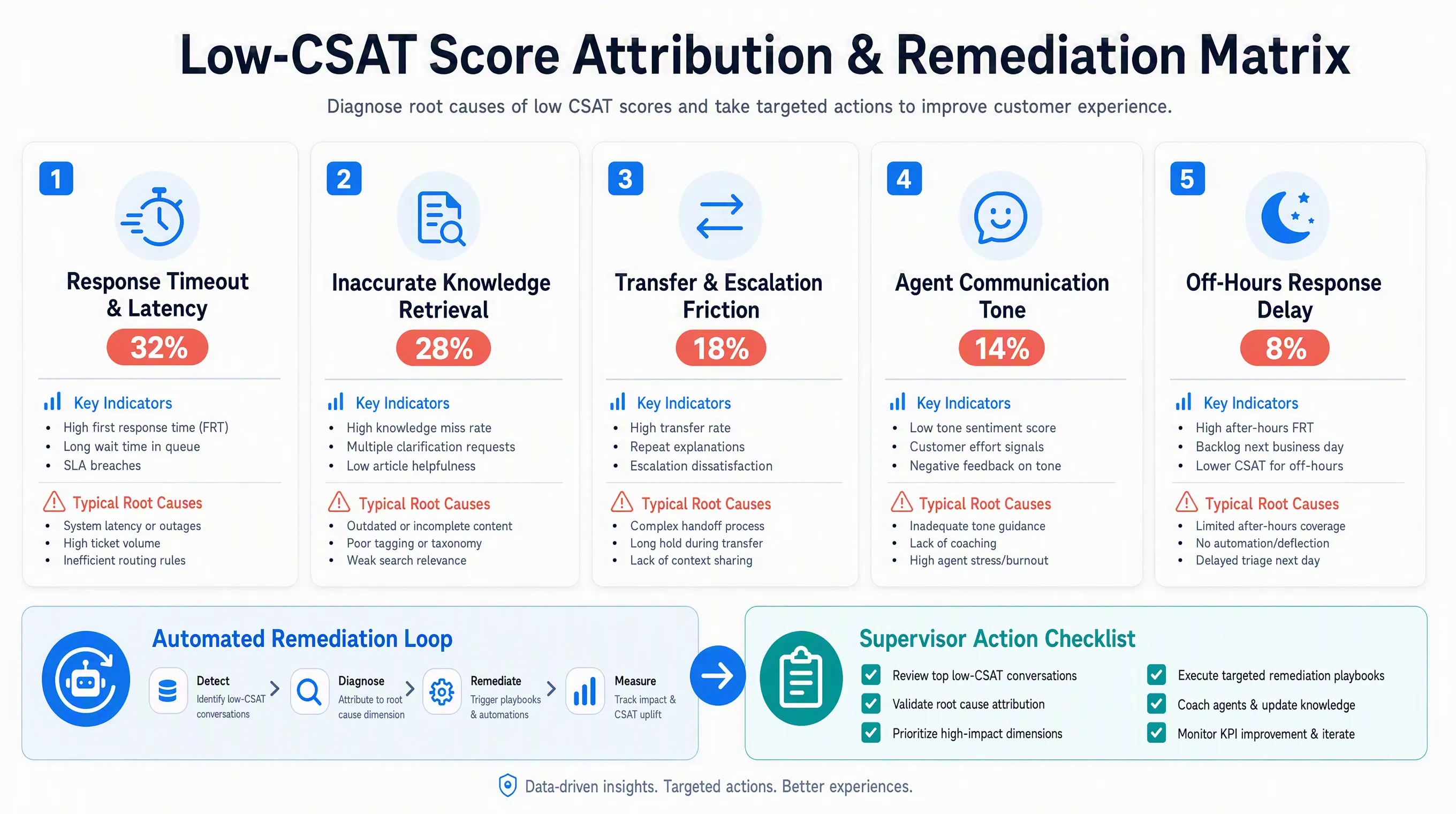
Actionable Risk Mitigation Output
========================================================================================
LOW CSAT ATTRIBUTION & SUPERVISOR INTERVENTION DISPATCH
Time Range: Last 7 Days | Analyzed Sessions: 142 Low-CSAT Conversations
========================================================================================

Top Root-Cause Distribution:
1. [41%] Delayed Refund Verification (Payment Gateway Sync Delay)
2. [28%] Bot Infinite Loop on "Invoice Address Modification"
3. [18%] Queue Timeout during Friday Peak Traffic (18:00 - 20:00)
4. [13%] Other / Incomplete Issue Resolution

Priority Customer Outreach Dispatch:
----------------------------------------------------------------------------------------
[URGENT] Account: Apex Logistics (VIP Tier 1) | Session ID: #88219
• Issue Summary: Customer requested emergency API quota boost; bot looped 3 times before
  transferring to an offline night queue.
• Suggested Outreach Script: "Dear Apex Team, our operations director noticed your urgent
  API quota request last night. We have temporarily expanded your quota limit and assigned
  a dedicated enterprise technical manager to review your cluster configuration."
• Action Assigned To: Enterprise VIP Support Lead
----------------------------------------------------------------------------------------
Capability 4: Ticket Backlog and Timeout Risk Checklist Generation
In high-volume service centers, tickets link customer support with engineering, billing, product, and field operations. When tickets stall or cross-department handoffs delay resolution, customer churn risks spike and SLA compliance plummets.
Traditional ticket management requires supervisors to manually apply multi-parameter filters in ticket dashboards, export CSVs, and cross-reference agent shift rosters.
The ADP Agent connects directly to the Qidian Ticketing API, categorizes active backlogs, identifies tickets nearing SLA breach thresholds, and formats role-specific action checklists for team leads during daily standup meetings.
Operator Prompt: "Audit all open support tickets. Group them by owner and risk tier, highlighting any ticket within 4 hours of SLA breach."
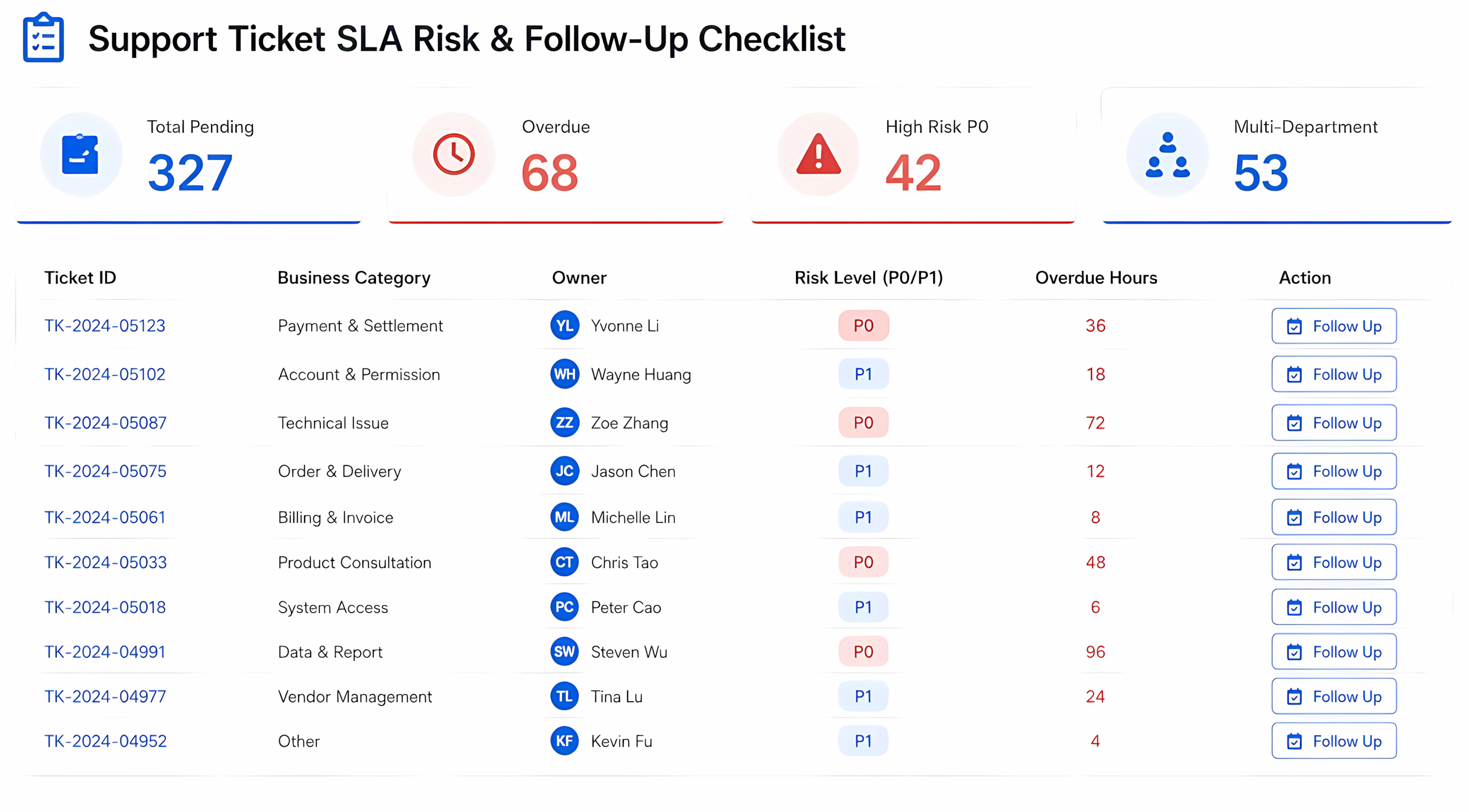
Standup Dispatch Matrix
| Risk Tier | Ticket ID | Category | Current Assignee | Time to SLA Breach | Recommended Action |
|---|---|---|---|---|---|
| CRITICAL | #TK-9042 | Payment Gateway Timeout | Devops_Oncall | 45 minutes | Immediate escalation to tier-2 payment engineering |
| HIGH | #TK-9011 | Enterprise SAML Login Fail | Identity_Support | 2 hours 15 mins | Push temporary bypass cert and schedule customer call |
| MEDIUM | #TK-8975 | Custom Invoice Split | Billing_Finance | 5 hours | Batch process in afternoon billing review cycle |
Capability 5: Periodic Executive Reporting and Service Hotspot Trend Discovery
Operations leaders must routinely report operational performance to executive stakeholders, product teams, and customer success directors. Compiling weekly, monthly, and quarterly reports requires gathering raw metrics across multiple systems, calculating percentage variances, identifying anomalies, and writing contextual summaries.
The ADP Agent automates the end-to-end report generation pipeline. It retrieves service metrics over specified time windows, evaluates week-over-week (WoW) trends, highlights operational anomalies, and packages findings into executive-ready markdown briefs.
Operator Prompt: "Generate the Comprehensive Monthly Customer Support Operations Report for July 2026, comparing key metrics against June."
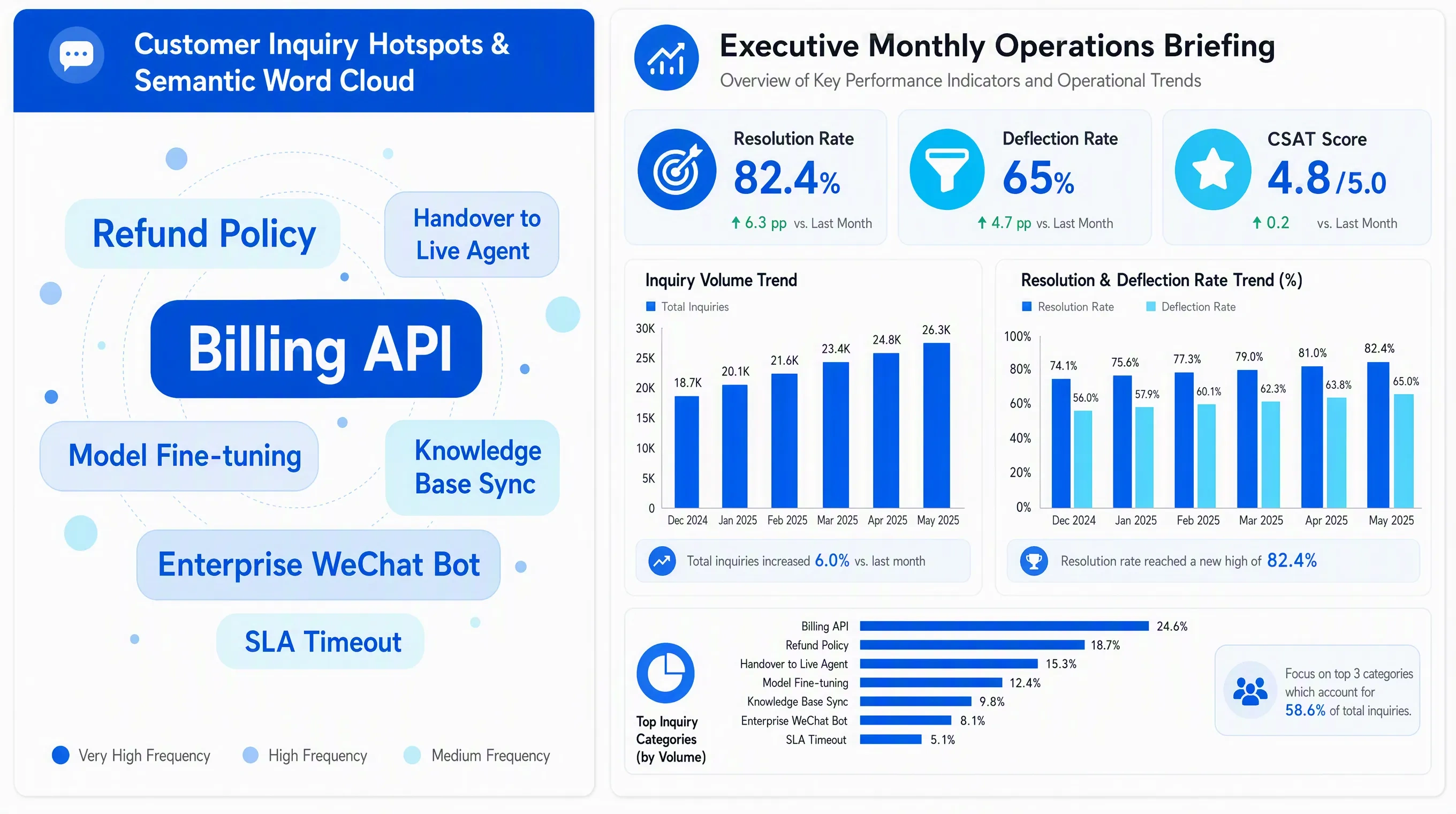
Real-Time Service Hotspot and Keyword Discovery
In addition to scheduled reporting, customer conversation logs represent the fastest indicator of emerging product anomalies. The ADP Agent performs continuous keyword frequency and semantic clustering across chat transcripts to detect unexpected conversational surges (e.g., sudden spikes in "error 502", "login timeout", or "delivery delay").
Operator Prompt: "Analyze customer conversation logs from the past 48 hours and identify emerging service hotspots with keyword growth rates."
Capability 6: Automated Recurring Scheduled Tasks (Cron Workflows)
Operational excellence requires consistency. High-performing support organizations do not wait for managers to remember to run analysis prompts; they establish automated, predictable governance cadences.
Tencent Cloud ADP allows operations teams to convert any natural language instruction or skill into an automated scheduled task (Cron Agent Routine). Once configured, ADP autonomously executes data pulls, runs analytical reasoning models, formats reports, and delivers alerts to designated enterprise collaboration channels (such as WeCom, Feishu, or email).
Operator Prompt: "Run every Monday at 09:00 AM: Compile last week's knowledge base gap optimization suggestions and generate the priority open ticket risk checklist for team leads."
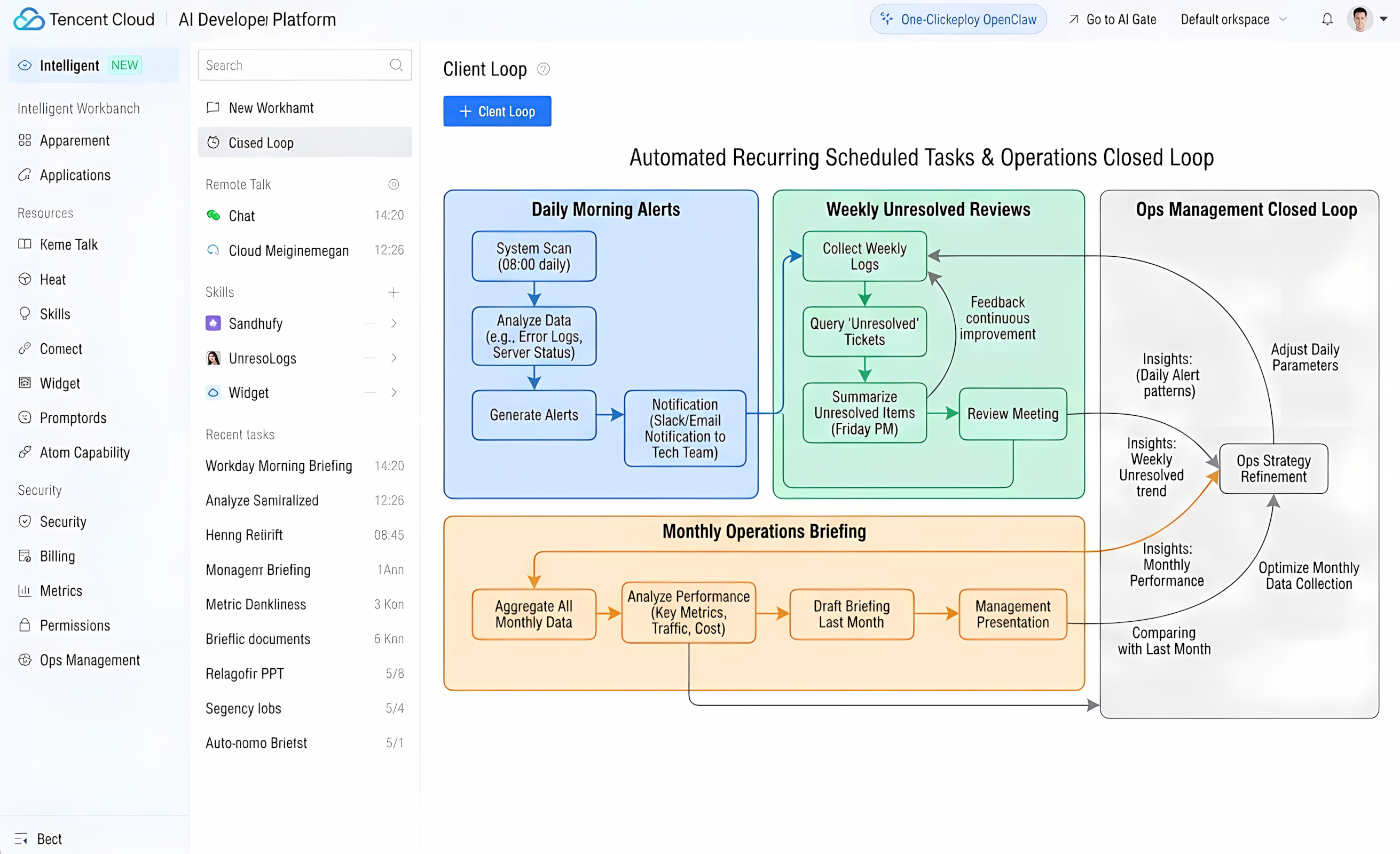
Standard Enterprise Cadence Schedule
3. Step-by-Step Onboarding & Light-Touch Integration Roadmap
Implementing Tencent Cloud ADP for customer service operations is designed as a non-invasive, progressive rollout. Because ADP integrates via secure API connections to Qidian Customer Service, organizations do not need to replace existing systems or migrate historical chat archives.
Step 1: Install Qidian Customer Service Skill in ADP Workspace
Within the Tencent Cloud ADP Console, navigate to your enterprise Space (空间), select or create an App (应用), and enable the built-in Qidian Customer Service Skill from the platform skill catalog.
Step 2: Configure Enterprise Authentication Credentials
Provide the necessary API credentials generated from your Qidian administrative console:
Enterprise IDApplication IDAppSecret
Step 3: Enforce Access Control & Data Boundaries
Configure tenant data access policies. Specify which chat queues, ticket categories, and agent groups the ADP Agent can inspect. Ensure sensitive customer PII fields (credit cards, national IDs, passwords) are masked by default.
Step 4: Select 1–2 High-Value Pilot Scenarios
Avoid attempting to automate all operations simultaneously. Choose one or two well-defined scenarios with immediate visibility:
Step 5: Validate Output Accuracy with Operations Supervisors
Review initial drafts of extracted Q&As, CSAT summaries, and ticket lists with senior team leaders. Calibrate prompt instructions, categorization rules, and confidence thresholds.
Step 6: Convert Validated Workflows into Reusable Skills
Once output quality reaches enterprise production standards, encapsulate the prompt logic and output schemas into permanent ADP Skills for one-click team invocation.
Step 7: Activate Automated Recurring Scheduled Tasks
Transition routine analyses (morning ticket standup lists, weekly gap reports, monthly executive briefings) into autonomous Cron routines delivered directly to team collaboration channels.
4. Measurable KPI Framework for AI Customer Service Operations
To objectively track the business impact of deploying Tencent Cloud ADP in support operations, organizations should evaluate performance across four key dimensions:
5. Enterprise FAQ
Q1: Does deploying Tencent Cloud ADP require changing our existing customer service routing or ticketing systems?
No. For organizations utilizing Qidian Customer Service, ADP acts as an intelligent overlay. Frontline agent routing, customer-facing chat widgets, telephony queues, and core ticketing databases remain completely unchanged. ADP connects via authorized API connectors to read records, perform analytics, and push updates, ensuring zero disruption to live customer interactions.
Q2: Can AI-generated knowledge base entries be published directly to customer-facing bots without review?
While technically possible, Tencent Cloud strongly recommends a Human-in-the-Loop workflow. The ADP Agent generates high-quality standard questions, semantic variations, draft answers, and category tags into a staging environment. Knowledge engineers or operations managers perform quick verification before one-click publishing to live Qidian bot repositories. This guarantees 100% brand consistency and compliance with pricing or legal policies.
Q3: What is the recommended starting scenario for a 2-week pilot?
We recommend starting with Transcript QA Mining and Weekly Bot Miss Clustering. These two scenarios utilize existing historical chat logs, require zero real-time system writes, and provide immediate, easily quantifiable ROI: operations teams can directly measure how many hours of manual transcript reading were eliminated and see immediate improvements in bot coverage.
Q4: How does ADP maintain enterprise data privacy and security?
Tencent Cloud ADP operates under strict enterprise multi-tenant isolation. All API calls between ADP and Qidian Customer Service utilize encrypted transport (TLS 1.3) and tokenized authentication. Fine-grained Role-Based Access Control (RBAC) ensures operators only analyze data within their authorized departmental space, and automated PII masking filters sensitive customer data prior to model inference.
Q5: Is this solution only suitable for massive contact centers with hundreds of agents?
No. While large contact centers benefit enormously from automated ticket triage and multi-queue CSAT attribution, mid-sized support teams (10–50 agents) often experience the highest relative productivity gains. In smaller teams where operations managers wear multiple hats, ADP automates reporting, FAQ maintenance, and hotspot tracking, effectively multiplying operational capacity without adding headcount.
Q6: Can we integrate our internal CRM or ERP data alongside Qidian Customer Service?
Yes. Tencent Cloud ADP provides robust Connectors and MCP (Model Context Protocol) support. Organizations can configure additional enterprise connectors to query internal order management systems, SAP ERP, or proprietary user databases. This enables the Agent to correlate low CSAT scores or ticket backlogs with specific product batches, subscription tiers, or regional fulfillment hubs.
6. Summary: Moving from Reactive Support to Continuous Operational Governance
The future of enterprise customer service is not merely faster query responses—it is intelligent, closed-loop operational governance.
By uniting Tencent Cloud ADP's flexible agent orchestration engine with Qidian Customer Service's comprehensive service assets, enterprises eliminate the manual drudgery of support management. From automated knowledge base extraction and bot miss-rate clustering to proactive SLA risk prevention and executive reporting, customer service operations transform into a strategic driver of product quality and customer retention.
Accelerate Your Support Operations with Tencent Cloud ADP
- Explore the Global Portal: Tencent Cloud ADP International
- Official Product Overview: Tencent Cloud ADP Overview
- Schedule an Architecture Consultation: Reach out to Tencent Cloud technical specialists to evaluate pilot scenarios and configure Qidian Customer Service integration skills for your enterprise support organization.
Related Articles & Deep Dives
- From DeepSeek Harness to Enterprise Production: Why Agent Governance and Runtime Reliability Matter
- 100 Steps from Demo to Production: Medical Device After-Sales Agent Practice
- Smart Retail AI Agent Solutions: From In-Store Sales Guides to Enterprise Operations Efficiency
- IDC Ranks Tencent Cloud ADP Number 1 in Media and Healthcare Agent Platform Markets

Start building today
If you need more support, please contact us