
Tencent Cloud ADP for AOI: Reshaping Industrial Visual Inspection
How Tencent Cloud ADP Claw Mode transforms Automated Optical Inspection by automating defect training pipelines, dataset quality gates, and inference latency triage.
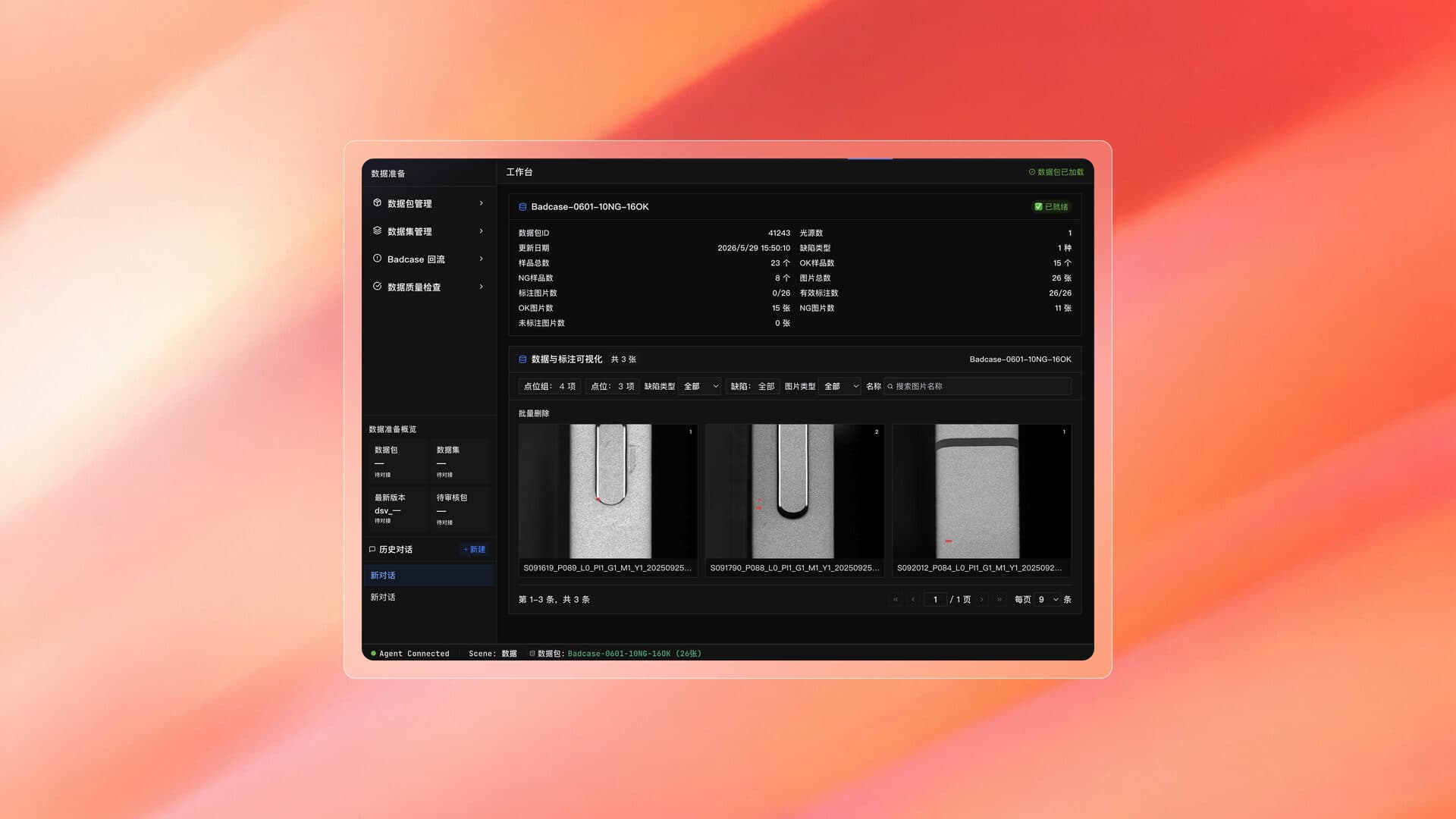
Executive Summary
Industrial Automated Optical Inspection (AOI) has reached an inflection point. Over the past decade, high-resolution line-scan cameras, multi-spectral lighting, and deep learning defect classifiers have achieved remarkable detection accuracy in semiconductor fabrication, PCB surface mounting, automotive manufacturing, and consumer electronics assembly.
However, as AOI platforms grow more sophisticated, operational complexity has skyrocketed. Quality engineers and line operators must manually configure inspection optical points, curate unbalanced non-good (NG) sample sets, tune delicate model hyper-parameters across disparate menus, decode cryptic runtime logs, and troubleshoot millisecond-level cycle-time bottlenecks on edge GPU inference engines. The limiting factor in manufacturing yield is no longer the vision model’s theoretical precision—it is the human engineering overhead required to maintain, calibrate, and orchestrate the inspection lifecycle.
To bridge this operational chasm, Tencent Cloud introduces the ADP for AOI (Agent Development Platform for Automated Optical Inspection) solution. Built on ADP’s native Claw Mode, this architecture overlays an intelligent, autonomous action layer atop existing AOI software systems. Rather than merely answering user queries like a conversational chatbot, the industrial inspection agent directly perceives platform states, audits training data health, orchestrates deep learning workflows, performs automated triage on edge inference latencies, and provides closed-loop system remediation.
Key Takeaways
- Non-Invasive Architecture Modernization: ADP for AOI deploys via Claw Mode, overlaying an autonomous agent action layer directly on existing computer vision platforms without requiring invasive backend redesigns or risky legacy system migrations.
- Closed-Loop Action Capabilities: Progressing far beyond standard conversational chatbots, the inspection agent reads platform logs, manipulates GUI parameters, audits dataset completeness, triggers distributed model retraining, and validates edge deployment.
- Pre-Training Data Quality Gates: Automated validation prevents costly model retraining failures by auditing NG sample distribution, field consistency, and annotation completion prior to training initiation.
- Dynamic Training Strategy Orchestration: Industrial domain expertise is codified into executable ADP Skills, enabling the agent to recommend optimal loss weights, augmentation pipelines, and backbone architectures tailored to specific defect categories.
- Edge Inference Cycle-Time (CT) Optimization: The agent correlates runtime GPU metrics, batching pipelines, and edge sensor triggers to pinpoint inference bottlenecks, autonomously recommending model quantization (FP16/INT8) or version rollbacks to meet strict line-beat takt times.
- Enterprise-Grade AgentOps: End-to-end audit logs, deterministic tool boundaries, and human-in-the-loop approval gates ensure that all agent operations remain fully observable, explainable, and compliant with production safety standards.
1. The Dilemma of Modern Industrial AOI: High Capability, High Cognitive Overhead
State-of-the-art industrial AI vision systems encompass extensive capabilities: multi-angle photometric stereo capture, CAD-to-inspection alignment, real-time defect segmentation, and cloud-edge synchronization. Yet, operating these platforms requires significant specialized expertise across multiple disjointed disciplines.
In standard electronics manufacturing lines handling High-Mix, Low-Volume (HMLV) batches or rapid product changeovers (NPI - New Product Introduction), process engineers encounter four severe operational bottlenecks:
| Operational Bottleneck | Root Cause | Line Impact |
|---|---|---|
| High Onboarding & Skill Threshold | Complex GUIs with hundreds of parameter switches across defect configuration, lighting recipes, and model parameters. | New line technicians require months of specialized vendor training; expert engineers are tied down by routine setups. |
| Fragmented Cross-Module Workflows | Defect sample management, annotation tools, model training clusters, and runtime inference logs reside in siloed sub-systems. | Diagnosing a single over-kill (false reject) or under-kill (defect escape) requires manual navigation across 6+ disparate software tabs. |
| Tacit Knowledge Silos | Veteran vision engineers know intuitively how to handle low-contrast scratches or specular reflections, but their methodology is not codified. | Inspection tuning quality varies wildly across shifts; best practices fail to scale across manufacturing plants. |
| Post-Facto Failure Discovery | Corrupted image bounding boxes, class imbalance, or uncalibrated inference pipelines are discovered only after multi-hour model training fails. | Significant GPU compute waste, delayed product lot sign-offs, and critical downtime on high-takt SMT lines. |
To resolve this operational deadlock, manufacturing platforms must transition from passive GUI tools to proactive, autonomous workflows.
2. Architectural Blueprint: Overlaying Claw Mode on Legacy Visual Inspection Platforms
The fundamental architectural principle of Tencent Cloud ADP for AOI is non-invasive operational enablement. Rather than replacing the customer's validated vision algorithms, optical calibration pipelines, or edge IPCs (Industrial Personal Computers), ADP deploys an intelligent action layer via Claw Mode.
In ADP architecture, Claw Mode provides an isolated containerized sandbox execution workspace for every active conversation session. Unlike standard stateless LLM wrappers, an agent in Claw Mode maintains execution context, handles multi-turn system states, directly executes diagnostic code, inspects raw structured payloads, and invokes platform APIs or Model Context Protocol (MCP) connectors.
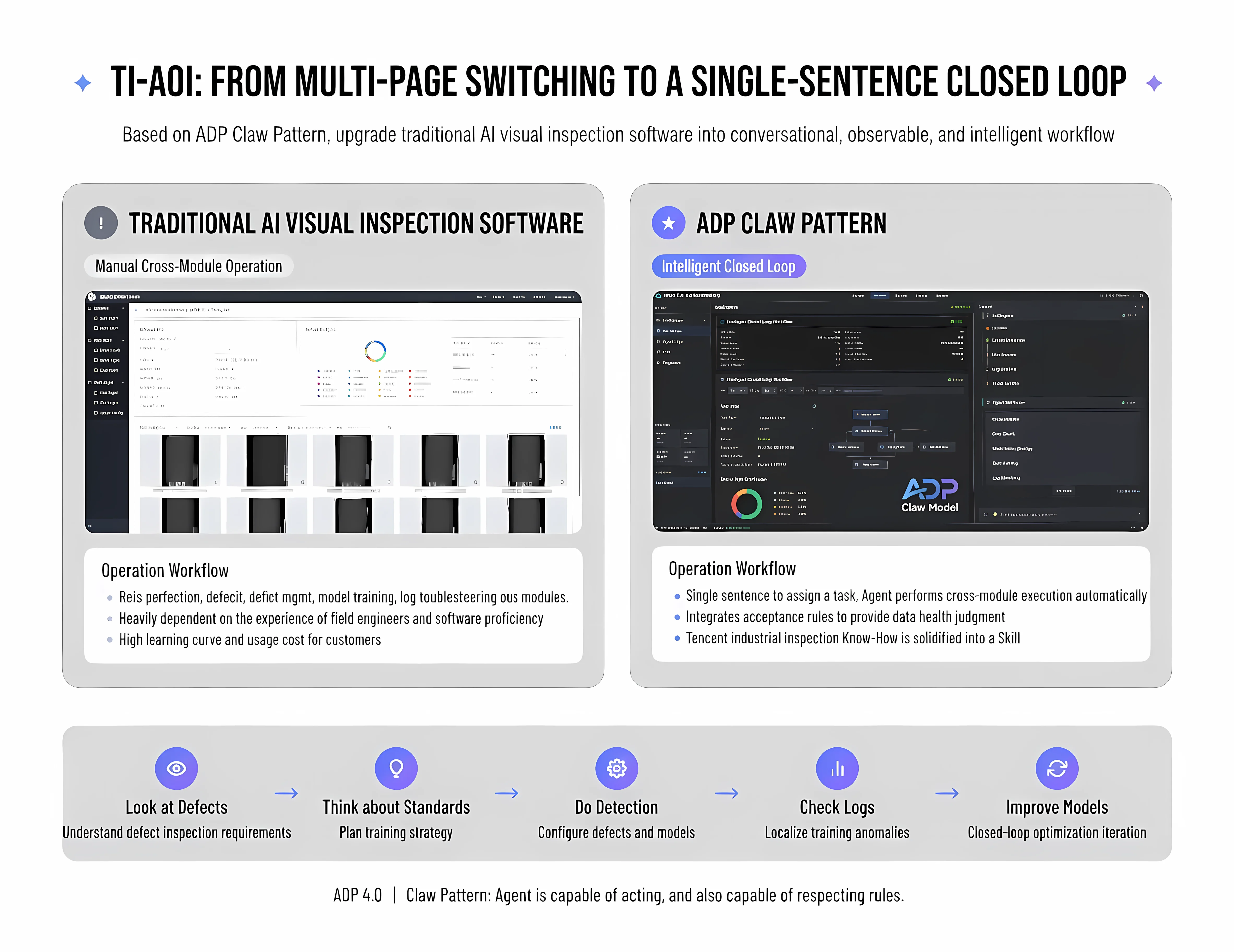
This architecture equips the AOI agent with five primary closed-loop capabilities:
- State Perception: Autonomously parses inspection dataset metadata, optical station parameters, GPU utilization graphs, and line event logs.
- Intent Translation: Translates high-level natural language instructions from line engineers (e.g., "Prepare SMT line 4 for batch BGA-0805 inspection") into structured API sequences.
- Stepwise Planning & Routing: Automatically decomposes tasks into ordered steps: verifying defect distributions, launching data pre-checks, triggering training jobs, and profiling inference speeds.
- Automated Verification: Rigorously audits intermediate system responses against production acceptance criteria before committing parameter updates.
- Exception Remediation: Pinpoints the exact root cause of training divergence or edge inference timeouts and provides actionable remediation paths.
3. From Intent to Closed-Loop Execution: The AOI Agent Action Flow
When an engineer interacts with the AOI platform, the agent does not merely output text advice. It executes a deterministic, multi-phase action loop that interfaces directly with underlying vision microservices.
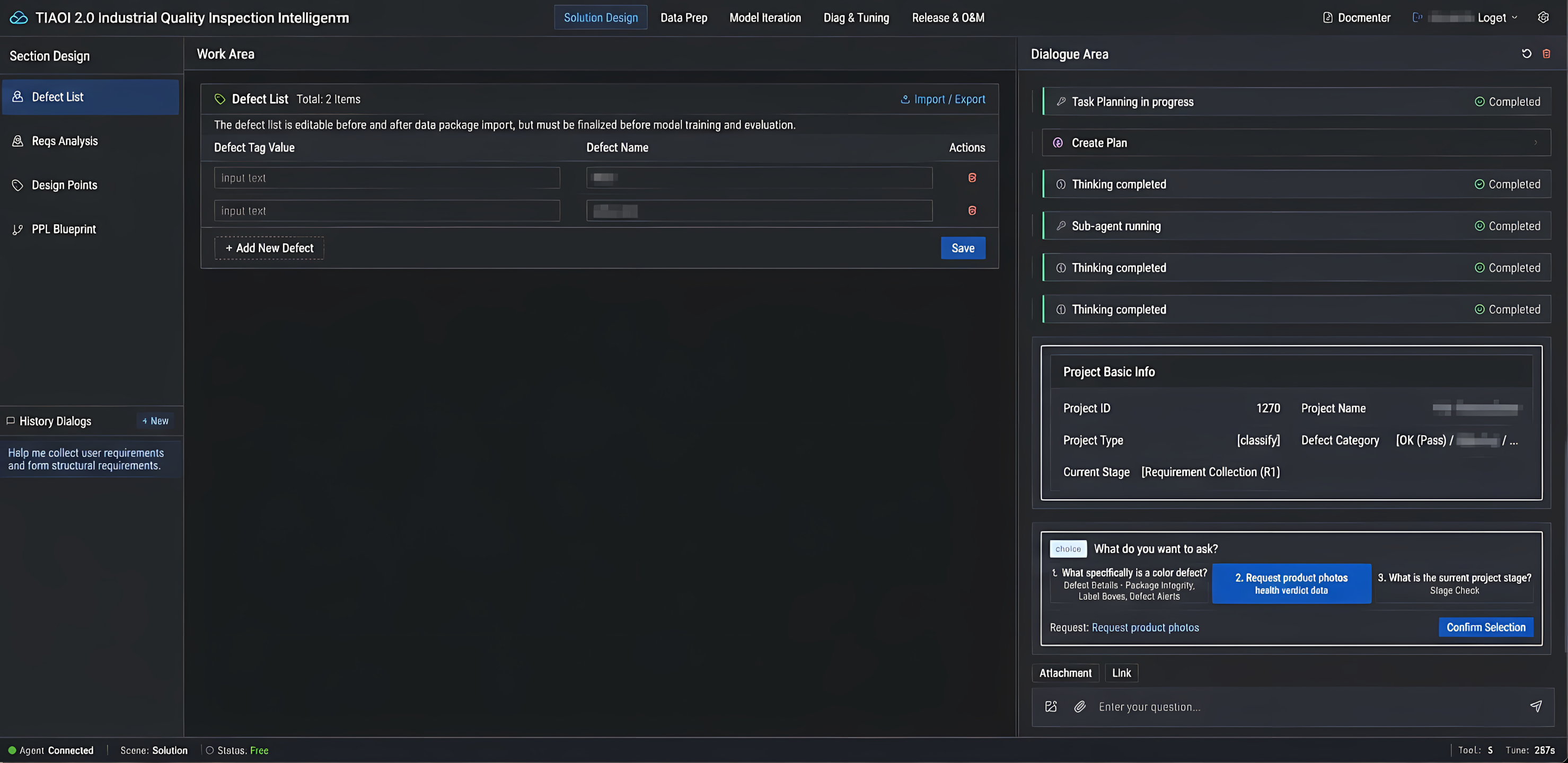
The Step-by-Step Execution Lifecycle
- Natural Language Task Ingestion: The operator inputs a task via the ADP web interface, desktop client, or enterprise chat channel (e.g., "Audit current wafer defect dataset and set up an optimized retraining run for micro-crack detection").
- Context Enrichment & SOP Retrieval: The agent pulls relevant manufacturing SOPs from Tencent Cloud ADP's Dynamic Knowledge Base, verifying customer-specific yield thresholds and defect classification rules.
- Tool Invocation via Enterprise Connectors: The agent issues authorized REST or MCP calls to query the defect database, inspect label densities, and check GPU cluster availability.
- Execution & Anomaly Trapping: During data retrieval or training compilation, the agent actively monitors execution streams, intercepting schema mismatches, corrupt files, or memory overflow warnings.
- Structured Reporting & Confirmation: The agent aggregates findings into a structured summary report, presenting risk indicators and awaiting engineer sign-off for critical operations.
{
  "agent_action": "ExecutePreTrainingAudit",
  "task_id": "AOI-SMT-20260814-009",
  "parameters": {
    "line_id": "SMT_LINE_04",
    "defect_classes": ["solder_bridge", "tombstoning", "insufficient_solder"],
    "target_model_architecture": "Tencent-YOLO-Industrial-v4",
    "acceptance_criteria": {
      "min_samples_per_class": 150,
      "min_annotation_ratio": 0.98,
      "max_inference_latency_ms": 12.0
    }
  },
  "execution_mode": "Claw_Sandbox_Safe_Run"
}
4. Scenario 1: Model Training Strategy Intelligent Orchestration
The Challenge
Training deep learning vision models for manufacturing defects (such as solder voids, semiconductor micro-cracks, or optical display blemishes) requires precise hyper-parameter tuning. Factors including sample count, class imbalance ratio, bounding box scale distribution, and customer escape-rate tolerances dictate the training configuration.
When non-specialist line operators handle model training, they often rely on default presets. This leads to severe model over-fitting, high false-alarm rates (over-kill), or catastrophic failure to detect rare, high-severity defects (under-kill).
The ADP Solution
Using Tencent Cloud ADP's Skill Hub, the collective expertise of Tencent’s senior industrial vision architects is encoded into standard, reusable agent skills. When a new training task is initiated, the agent:
- Quantifies defect class distributions and flags severe tail-class imbalances;
- Selects optimal loss functions (e.g., dynamically adjusting Focal Loss $\gamma$ and class weights $\alpha$ based on defect rarity);
- Configures physics-informed data augmentations (e.g., controlling brightness and contrast shifts to mimic production lighting drift while suppressing destructive rotations on oriented components);
- Generates a transparent, human-readable training plan outlining risk factors prior to execution.
# Sample ADP Agent Action: Automated Training Recipe Formulation
def formulate_training_strategy(dataset_meta: dict, target_yield_sla: float) -> dict:
    """
    Evaluates dataset statistics and codifies vision expert rules into an optimal training config.
    """
    imbalance_ratio = dataset_meta["max_class_count"] / max(dataset_meta["min_class_count"], 1)

    strategy = {
        "backbone": "Tencent_Industrial_ResNet50_FPN",
        "batch_size": 32,
        "base_lr": 0.001,
        "warmup_epochs": 5,
        "loss_function": "FocalLoss" if imbalance_ratio > 10.0 else "CrossEntropyLoss",
        "loss_weights": calculate_dynamic_weights(dataset_meta["class_histogram"]),
        "augmentation_pipeline": [
            {"type": "RandomGaussianNoise", "p": 0.3},
            {"type": "LightingIlluminationJitter", "p": 0.4, "brightness_limit": 0.15}
        ],
        "early_stopping_patience": 12,
        "validation_metric": "Mean_Average_Precision_IoU_0.75"
    }
    return strategy
Quantified Business Value
By replacing manual guesswork with agent-driven strategy orchestration, industrial customers achieve an 80% reduction in training configuration time and a 35% reduction in trial-and-error retraining iterations, ensuring high-precision models are delivered on the first training pass.
5. Scenario 2: Pre-Training Defect Dataset Quality Gate
The Challenge
In industrial computer vision, the adage "garbage in, garbage out" is absolute. A deep learning training cycle can run for 6 to 18 hours across high-end GPU clusters. If training proceeds on a dataset containing corrupted image files, missing coordinate tags, incomplete annotations, or empty defect categories, the entire compute run is wasted.
Historically, identifying dataset anomalies required engineers to open defect repositories, manually inspect individual bounding boxes, and cross-reference spreadsheet manifests.
The ADP Solution
ADP for AOI establishes an automated Pre-Training Quality Gate. The agent acts as an autonomous digital dataset auditor, verifying data integrity before submitting tasks to the training scheduler.
Automated Audit Check Matrix
The agent systematically validates four crucial quality dimensions:
| Quality Dimension | Inspection Criteria | Agent Action on Violation |
|---|---|---|
| Package Integrity | Check image file headers, check sums, and detect truncated or corrupted pixel buffers. | Rejects dataset; isolates damaged image IDs into a recovery folder. |
| Annotation Completeness | Verify that every registered NG image contains valid polygon/bounding-box metadata with non-zero area. | Flags unannotated NG samples; calculates net annotation completion rate ($R_{annot}$). |
| Defect Class Coverage | Ensure all mandatory inspection classes defined in the product specification exist in the training partition. | Halts training initiation if critical safety defect categories (e.g., "crack", "short") have zero samples. |
| Label Consistency & Boundary Check | Verify bounding coordinates lie strictly within image dimensions ($0 \le x \le W$, $0 \le y \le H$) and check for duplicate overlapping boxes. | Automatically clips out-of-bounds coordinates and merges redundant annotations with IoU $> 0.95$. |
Quantified Business Value
By catching dataset anomalies prior to training, the quality gate eliminates 92% of preventable training aborts, saving hundreds of GPU compute hours monthly and accelerating model delivery cycles.
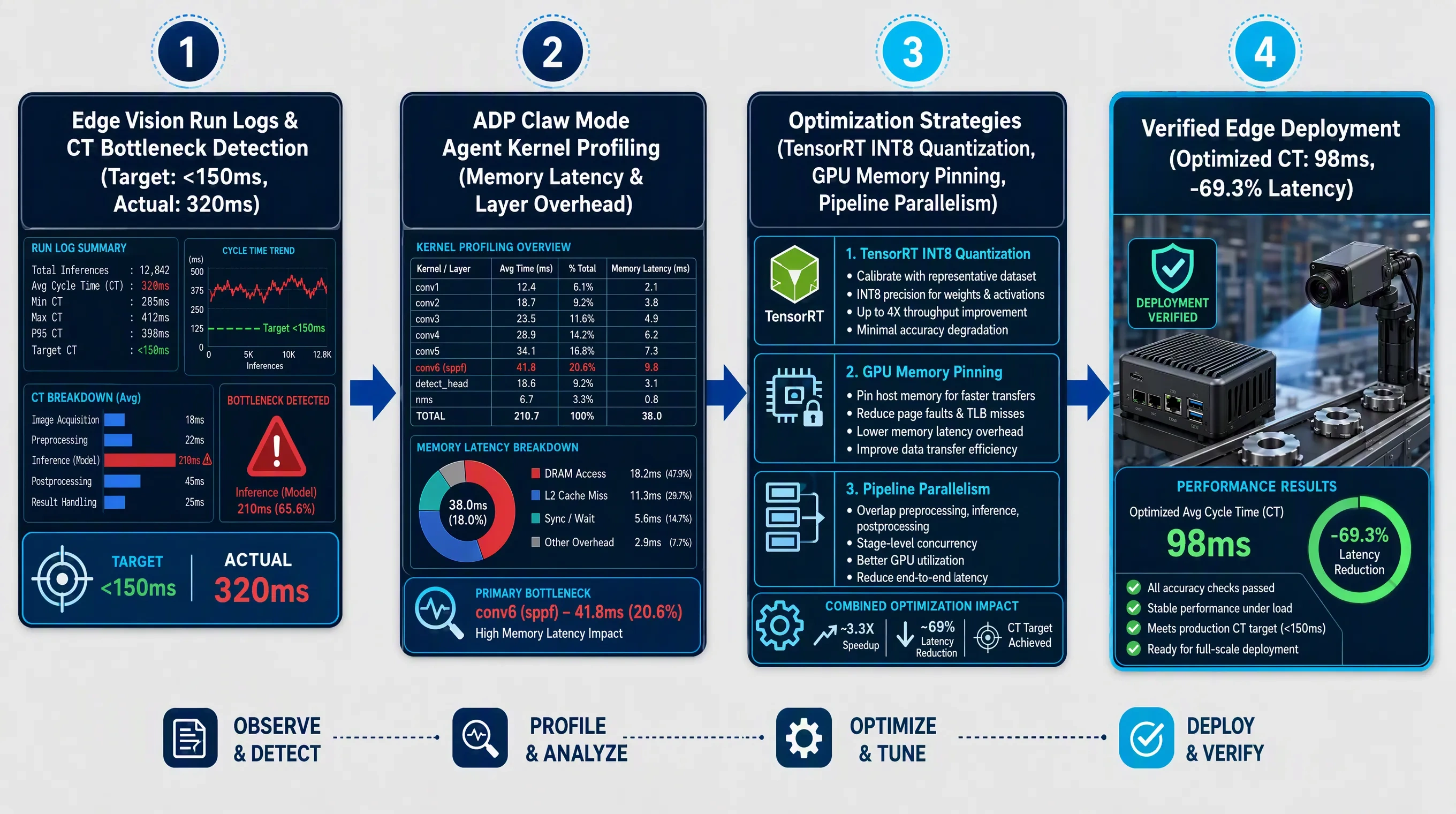
6. Scenario 3: Real-Time Inference Cycle Time (CT) Optimization & Edge Diagnostics
The Challenge
In high-speed manufacturing lines (such as smartphone glass inspection or battery electrode coating), production lines operate under strict takt times—often requiring optical inspection and classification within 10 to 25 milliseconds per frame.
When an updated deep learning model is deployed to edge IPCs, inference cycle times can unexpectedly exceed the line's cycle-time budget due to suboptimal layer operations, unoptimized tensor memory layouts, or GPU resource contention. Diagnosing these performance regressions requires deep profiling expertise across TensorRT, CUDA streams, IPC bus bandwidth, and hardware driver revisions.
The ADP Solution
The ADP AOI agent operates as an edge diagnostic specialist. By collecting live inference telemetry from edge IPCs—including per-layer kernel execution durations, GPU memory bandwidth, PCIe transfer latencies, and host CPU utilization—the agent diagnoses performance bottlenecks and delivers actionable remediation strategies.
Diagnostic Decision Tree & Optimization Playbook
When an edge station reports a cycle-time breach ($CT_{actual} > CT_{target}$):
- Kernel-Level Profiling: The agent inspects TensorRT engine execution logs. If latency is dominated by un-fused activation layers or non-standard convolutions, it generates optimized engine compilation scripts.
- Quantization & Pruning Recommendation: If the floating-point model (FP32) exceeds memory bandwidth, the agent executes calibration routines on representative OK/NG samples to produce an INT8/FP16 quantized engine, verifying that precision degradation remains $< 0.1\%$.
- Safe Rollback Execution: If immediate on-line optimization fails to meet the takt time, the agent autonomously triggers a zero-downtime version rollback to the previously validated model version, notifying the shift supervisor via enterprise messaging (e.g., Teams/Slack webhook).
# Agent-Generated Edge Compilation Command (TensorRT INT8 Precision Calibration)
trtexec \
  --onnx=model_defect_v4_2.onnx \
  --saveEngine=model_defect_v4_2_int8.engine \
  --int8 \
  --calib=calibration_dataset_manifest.json \
  --dynamicStyles=images:1x3x1024x1024 \
  --workspace=4096 \
  --fp16
Quantified Business Value
Edge diagnostics cut cycle-time troubleshooting duration from hours to under 3 minutes, preventing line stoppages and ensuring 100% synchronization with high-speed manufacturing lines.
7. Industrial AgentOps: Observability, Traceability, and Continuous Governance
Industrial automation demands absolute determinism and accountability. An AI agent operating in a factory environment cannot function as an unconstrained black box. Tencent Cloud ADP provides robust AgentOps infrastructure to guarantee system safety, auditability, and governance.
Key Pillars of ADP AgentOps for Manufacturing
- Full Traceability & Execution Replay: Every decision step, tool invocation parameter, intermediate payload, and model reasoning trace is permanently logged in ADP’s audit stream. Quality compliance teams can inspect the complete execution trace for any historical lot inspection.
- Deterministic Tool & Sandbox Boundaries: Agents in Claw Mode execute within containerized workspaces with strict permission boundaries. The agent can only invoke whitelisted inspection APIs; unauthorized operating system modifications or unverified binary executions are strictly blocked at the sandbox perimeter.
- Human-in-the-Loop (HITL) Gateways: For high-risk actions—such as flashing edge IPC firmware, deploying newly compiled models to active production lines, or purging training datasets—the agent pauses execution, compiles a structured impact analysis, and requires dual-key human authorization before proceeding.
- Continuous Skill Evolution: Post-shift analysis data is continually fed back into ADP's Skill Hub. As new optical defects or anomalous lighting conditions are resolved, engineers codify the resolution steps into the agent’s shared skill library, permanently upgrading the entire facility's troubleshooting capability.
8. Quantified ROI & Business Value: Comparative Benchmark
The deployment of Tencent Cloud ADP for AOI delivers substantial, quantifiable improvements across every stage of the industrial visual inspection lifecycle:
| Metric Dimension | Traditional Manual AOI Operations | Tencent Cloud ADP for AOI Agents | Improvement |
|---|---|---|---|
| New Line / Project Onboarding | 10–14 days per station (manual calibration, training, testing) | 2–3 days (automated strategy orchestration & quality gates) | ~75% Faster Deployment |
| Pre-Training Data Failure Rate | 18% of training jobs aborted due to corrupted or missing labels | $< 1.5\%$ (blocked and remediated by automated Quality Gate) | 92% Reduction in Wasted Runs |
| Model Retraining Iterations | Average 4.2 trial-and-error training cycles to meet accuracy targets | Average 1.3 cycles (guided by domain-expert Skill recipes) | 69% Fewer Retraining Cycles |
| Inference Latency Triage | 2–4 hours (multi-department hardware & algorithm debugging) | $< 3$ minutes (automated per-layer profiling & INT8 tuning) | 95% Faster Incident Resolution |
| Line False Alarm Rate (Over-Kill) | 3.5% – 5.0% on complex textured surfaces | 0.8% – 1.2% (optimized feature weighting & boundary checks) | > 70% Over-Kill Reduction |
| Expert Engineering Hours | 35 hours / week spent on routine configuration & troubleshooting | 6 hours / week (engineers focus strictly on complex NPI cases) | 82% Engineering Effort Saved |
Enterprise FAQ
1. Does implementing ADP for AOI require rewriting our existing computer vision algorithms or replacing our optical cameras?
No. Tencent Cloud ADP for AOI uses non-invasive integration via Claw Mode and standard API/MCP connectors. Your validated vision backbones, optical illumination hardware, and edge inference runtimes remain untouched. The ADP agent acts as an intelligent supervisor and operational layer above your existing software suite.
2. How does ADP ensure the agent does not trigger unintended parameter changes during active manufacturing?
ADP enforces strict role-based access control (RBAC) and Human-in-the-Loop (HITL) governance. Read-only diagnostic operations (such as auditing datasets or profiling cycle times) can run autonomously. However, any mutating action (such as modifying line inspection parameters or pushing new model weights to live IPCs) requires explicit approval from authorized line supervisors.
3. Can the agent operate in private or hybrid manufacturing cloud environments?
Yes. While Tencent Cloud ADP provides global multi-region cloud hosting with Hunyuan foundation models, the agent architecture supports hybrid topologies. Edge IPC connectors and local model training clusters communicate securely with ADP via dedicated private VPC endpoints or encrypted API gateways, ensuring raw product imagery and proprietary CAD files remain within your enterprise security perimeter.
4. How does the agent handle rare or novel defect types that have very few sample images?
The agent leverages few-shot learning SOPs from the ADP Skill Hub. When it detects a defect category with fewer than 20 samples, it autonomously switches the training recipe to few-shot transfer learning, configures synthetic defect blending augmentations, and alerts data collection teams with specific lighting recommendations to capture supplementary samples.
5. What foundation models power the ADP for AOI solution?
ADP integrates Tencent's state-of-the-art Hunyuan model series (including multimodal vision-language models for visual reasoning and dense code-generation models for pipeline orchestration), alongside leading models (Tencent Hunyuan Series, DeepSeek-V4/V3.2, GLM-5.3, Kimi) deployed within the enterprise environment, ensuring high reasoning speed, deep domain comprehension, and cost-efficient token utilization.
Conclusion & Next Steps
The future of industrial manufacturing belongs to autonomous, intelligent workflows. By combining the cognitive power of foundation models with the operational rigor of Tencent Cloud ADP Claw Mode, industrial enterprises can transform legacy AOI platforms into self-auditing, self-optimizing, and observable visual inspection ecosystems.
Eliminate configuration bottlenecks, protect GPU compute budgets, and maintain relentless production takt times with enterprise-grade industrial agents.
Ready to Upgrade Your Industrial Visual Inspection Systems?
- 🌐 Global Platform Portal: Explore Tencent Cloud ADP International to experience enterprise agent workflows.
- 📖 Official Product Documentation: Review API references and Claw Mode specifications at the Tencent Cloud ADP Product Center.
- 💬 Schedule a Solution Workshop: Contact our industrial solutions architecture team at
adp@tencentcloud.comto schedule a personalized technical demonstration on your manufacturing dataset.

Start building today
If you need more support, please contact us