
Tencent Cloud ADP 4.0 International Edition Helps Enterprises Operationalize AI Transformation
Launched during the 2026 WAIC, Tencent Cloud ADP 4.0 International Edition has been upgraded into an enterprise-grade AgentOps platform for global organizations.


Introduction
On July 20, 2026, during the 2026 World Artificial Intelligence Conference (WAIC) in Shanghai, Tencent Cloud announced the 4.0 upgrade of Tencent Cloud Agent Development Platform (ADP) International Edition. With this release, ADP has officially evolved into an AgentOps platform built for enterprise-grade production environments. The new version is now available to global customers, helping enterprises move AI Agents from experimentation to scaled production.
As AI Agents are increasingly applied in customer service, knowledge management, office collaboration, marketing content generation, business analytics, and process automation, overseas enterprises are placing higher requirements on multilingual support, multi-time-zone operations, global channels, international SaaS integrations, and enterprise-grade security governance. ADP 4.0 International Edition upgrades core capabilities including Smart Desk, Claw Mode, Connectors, Skill Marketplace, Knowledge Base, MCP, and Agent Portal, covering the full lifecycle of AI Agent creation, connection, deployment, distribution, and governance.
For business leaders and CTOs advancing enterprise AI transformation, the key to AI Agent adoption has shifted from “whether a standalone use case can be built” to “whether AI Agents can enter real business systems in a stable, secure, and controllable way.” ADP 4.0 International Edition provides a more complete path to production: lowering the build barrier with natural language, connecting enterprise systems through Connectors and Skills, handling complex long-chain tasks with Claw Mode, and ensuring post-launch security, cost control, and operational quality through full-lifecycle governance.
Key Takeaways
- ADP 4.0 International Edition is upgraded into an enterprise-grade AgentOps platform: It covers AI Agent creation, connection, deployment, distribution, and governance, helping enterprises move AI Agent applications from pilots to scaled production.
- Smart Desk becomes the unified entry point: Enterprises can build scalable Agents through natural language, while employees can complete daily tasks with a single sentence. Agent capabilities can also be embedded into existing workflows such as office software, ERP, CRM, and customer service systems.
- Claw Mode supports complex long-chain tasks: Agents can autonomously write and run code in a cloud sandbox, invoke enterprise Skills, execute long-running tasks, and reach employees and customers through channels such as API/Web, LINE, and Telegram.
- Connect enterprise systems and capability assets: The first batch of nearly 40 Connectors covers CRM, ERP, ticketing, customer service, Knowledge Bases, document systems, and widely used overseas applications such as Google Workspace, Confluence, and Jira. The Skill Marketplace now supports 150+ Skills.
- Governance is shifted left to the source of development: ADP builds an end-to-end security control system around permission management, Skill governance, runtime observability, and deployment compliance, helping enterprises manage risk and cost in production environments.
- International capabilities are enhanced for overseas business: ADP supports publishing channels including Web, API, LINE, and Telegram, multi-time-zone task configuration, automatic response language alignment based on user input, an international model ecosystem, and connectivity with overseas enterprise applications.
- Proven across multiple industries: Tencent Cloud ADP has been deployed in retail, finance, government, manufacturing, and other industries, supporting scenarios such as intelligent Q&A, customer service, marketing content generation, and business analytics.
From Pilot to Production: Three Challenges in AI Agent Adoption for Overseas Enterprises
When enterprises begin applying AI Agents, pilots can often be launched quickly: a knowledge Q&A bot, a customer service assistant, or a content generation tool can all validate AI value within a short period. However, when enterprises seek to extend these capabilities across multiple business units, countries, and channels, implementation becomes significantly more complex.
【Figure 1:Comparison of AI agent pilots and production adoption across scale, integration, governance, and cost needs】
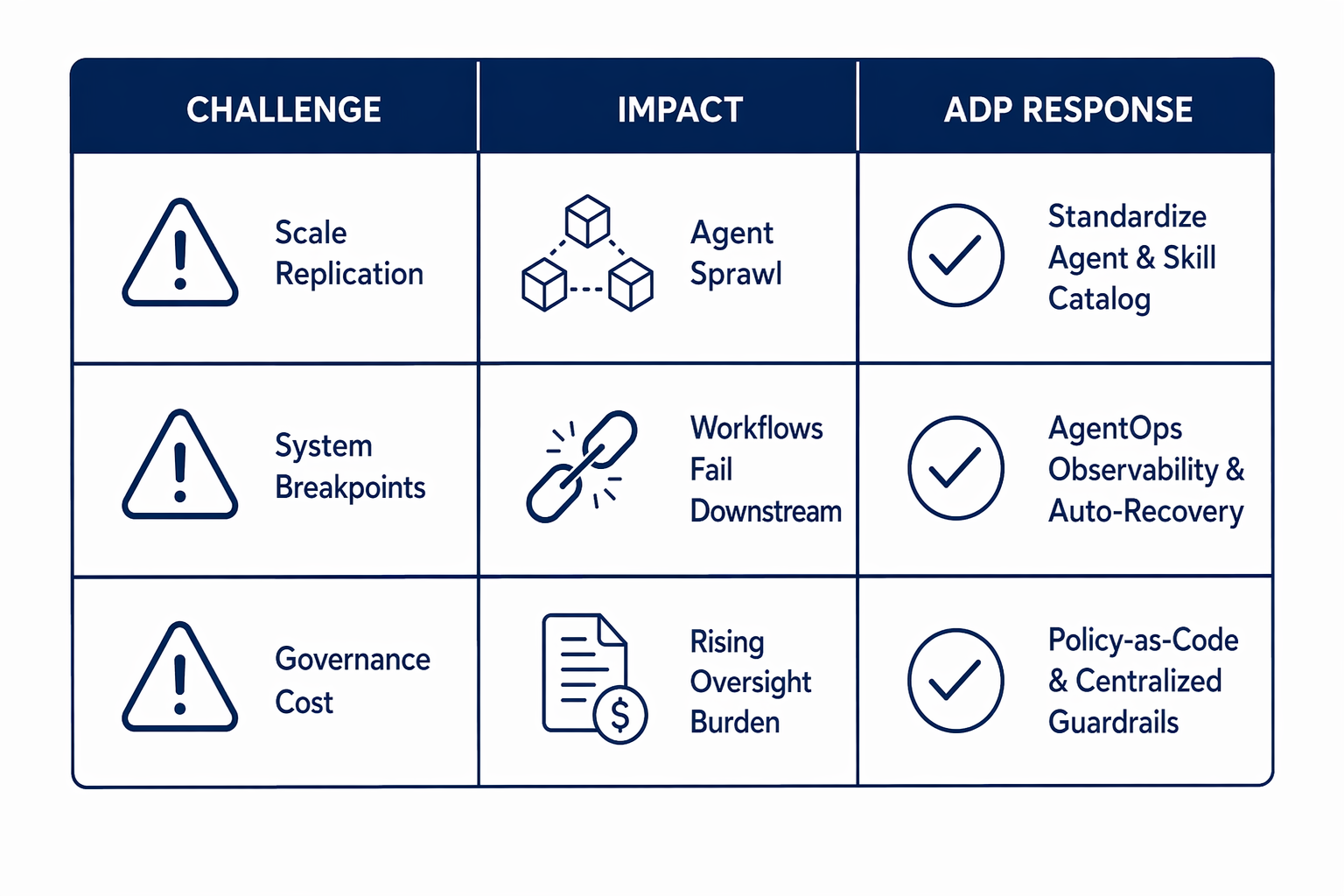
The core challenges addressed by Tencent Cloud ADP 4.0 International Edition can be summarized into three categories.
First, standalone pilots are easy to launch, but hard to replicate at scale. Early-stage enterprise projects usually rely on a small number of technical teams for configuration and debugging, making it costly for business teams to participate. As the number of applications grows, reusing capabilities, centrally managing Agents, and launching new scenarios quickly become efficiency bottlenecks.
Second, powerful models are difficult to connect with existing business systems. Real enterprise processes are distributed across CRM, ERP, ticketing, customer service, Knowledge Bases, document systems, and other platforms. If an AI Agent cannot access data, invoke tools, or execute actions, it is difficult to move from “answering questions” to “completing tasks.”
Third, post-launch security governance and cost control become more complex. Once Agents enter production environments, enterprises must address permission isolation, data access, external network access, code dependencies, approval workflows, operational quality, and model invocation costs. Without governance capabilities, enterprises will struggle to confidently expand Agents into mission-critical business scenarios.
ADP 4.0 International Edition has been systematically upgraded around these challenges: Smart Desk lowers the build barrier, Claw Mode unlocks complex task execution, nearly 40 Connectors and 150+ Skills connect enterprise assets, and security governance is shifted left to the source of development. Together, these capabilities help enterprises implement AI Agents in a more stable, secure, and controllable way.
Smart Desk: The Unified Entry Point for Enterprise AI Agents
Smart Desk, newly introduced in ADP 4.0 International Edition, is a unified Agent entry point for users. It serves two types of needs: enterprises can build Agents at scale within the same workspace, while employees can complete personal tasks with a single sentence, just like using an everyday office assistant.
【Figure 2:Smart Desk flow from natural language request to agent creation, orchestration, skills, and workflow embedding】
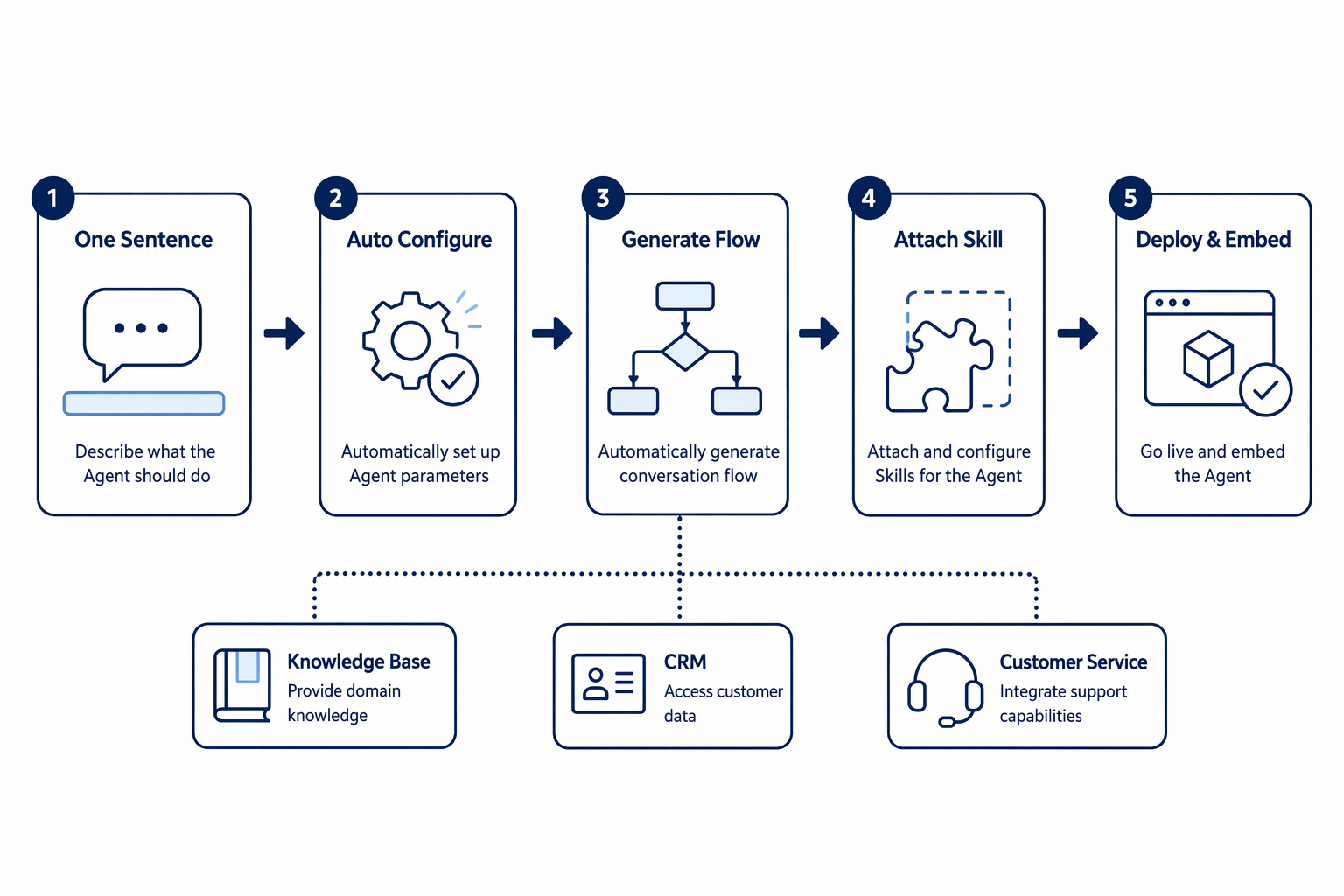
In enterprise scenarios, Smart Desk supports the creation of scalable Agents through natural language. Agent capabilities can also be integrated into existing enterprise systems, including office software, ERP, CRM, and customer service systems, enabling AI Agent applications to be embedded into existing workflows and reducing the pressure to modify legacy system architectures.
Smart Desk significantly reduces build costs. Take a knowledge-based intelligent Q&A assistant as an example: in the past, users might have needed to manually configure more than a dozen parameters. Now, they only need to describe the requirement in one sentence, and the platform can automatically complete the configuration and launch the assistant within minutes. For more complex processes such as multi-intent customer service, after users describe the business logic, the system can automatically generate a complete process, including intent routing, Knowledge Base Q&A, handoff to human agents, and packaged import.
When a single Agent cannot cover a complex task, Smart Desk also supports orchestrating a collaborative team of multiple Agents through a single instruction. The system can automatically assign responsibilities, prompts, and task handoff methods. At the same time, Smart Desk integrates with the Skill Marketplace, packaging mature capabilities such as contract review, financial analysis, and invoice entry into reusable enterprise-grade Skills for internal sharing and continuous optimization.
For business leaders, this means business teams can participate in AI Agent development more quickly. For CTOs, the platform improves ease of use while preserving the foundation for enterprise-grade centralized management and capability reuse.
Claw Mode: Handling Complex, Long-Chain, Open-Ended Tasks
In real enterprise operations, many tasks do not follow fixed rules, involve long process chains, and are difficult to fully express through form-based configuration. Claw Mode, the fourth build mode newly added in ADP 4.0 International Edition, is designed precisely for these complex tasks.
【Figure 3:Claw Mode execution path from open-ended goal to sandbox coding, skill invocation, and channel delivery】
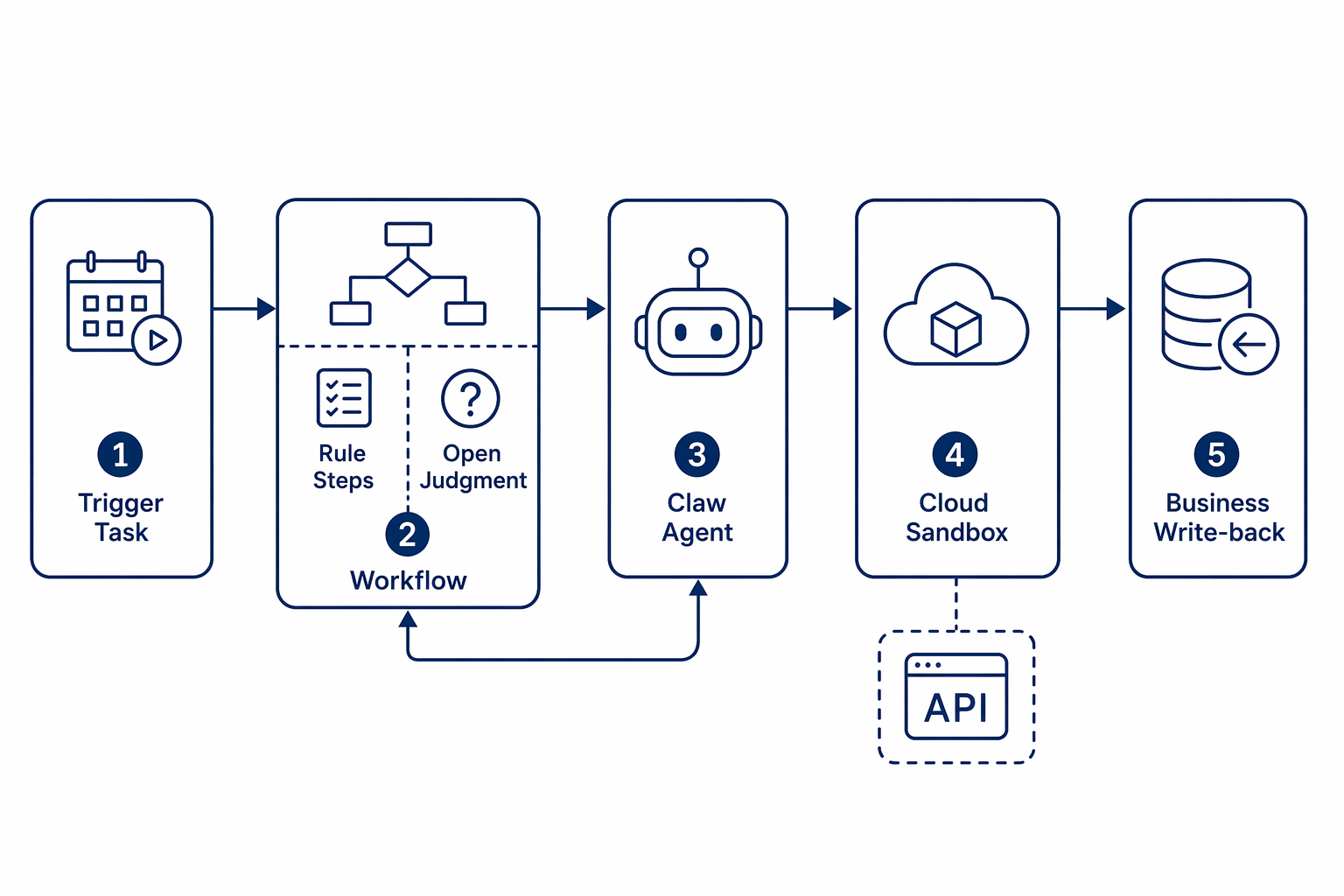
Claw Mode can create Agents that autonomously write and run code in a cloud sandbox. These Agents can invoke enterprise Skills, execute long-running tasks, and, once created, be integrated into business systems through API/Web interfaces. They can also reach employees and customers through channels such as LINE and Telegram.
For creators, Claw Mode eliminates the need to fill out complex forms. After users describe requirements in natural language, the platform automatically generates prompts, mounts Knowledge Bases, configures tools, and orchestrates Workflows. This lowers the barrier to building complex Agents and allows business teams to express task objectives more clearly.
ADP 4.0 also supports bidirectional invocation between Agents and Workflows. Steps with clear rules can be handled by Workflows to maintain process stability and make token consumption more predictable. When a task involves unstructured judgment or open-ended processing, the Workflow can invoke a Claw Mode Agent to fully leverage model capabilities.
This combined approach allows enterprises to bring deterministic processes and intelligent decision-making into the same business flow. For example, identity verification, ticket routing, and fixed approval nodes in customer service can be handled by Workflows, while complex issue understanding, cross-Knowledge-Base analysis, and open-ended content generation can be handled by Claw Mode Agents.
Connecting Enterprise Systems, Knowledge, and Tools: Bringing Agents into Business Processes
A core obstacle many enterprises encounter when implementing AI Agents is the gap between model capabilities and production systems. ADP 4.0 International Edition uses Connectors, Skills, plugins, Knowledge Bases, and MCP to transform distributed enterprise business resources into callable and reusable AI assets.
【Figure 4:Simplified ADP connection architecture linking agents with connectors, skills, knowledge bases, systems, and channels】
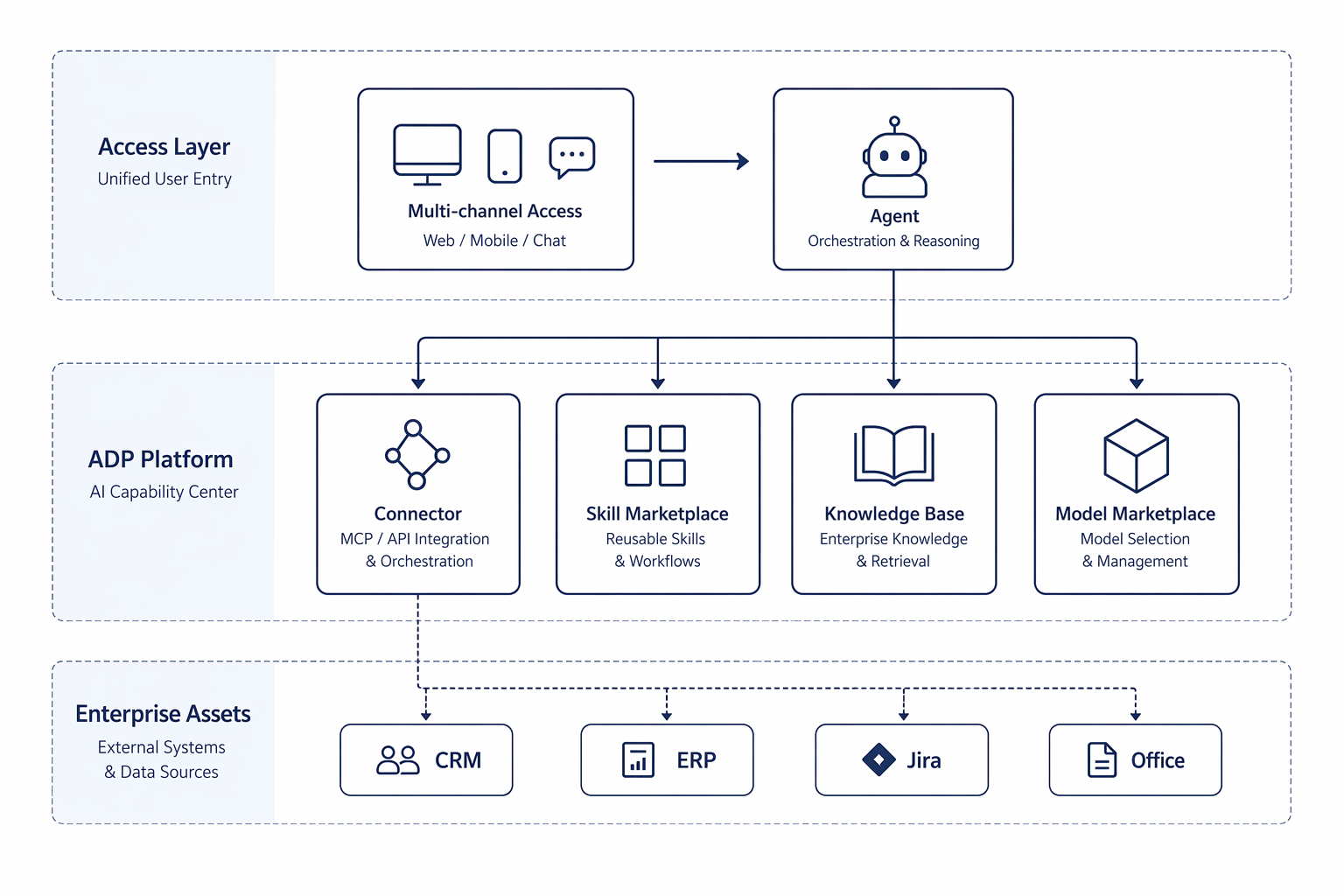
For connectivity, ADP 4.0 provides an initial batch of nearly 40 selected Connectors, supporting high-frequency enterprise systems such as CRM, ERP, ticketing, customer service, Knowledge Bases, and document systems, while also covering mainstream international SaaS applications including Google Workspace, Confluence, and Jira. Within authorized scopes, Agents can read, retrieve, and perform operations such as querying, analysis, generation, and routing.
For capability reuse, the upgraded Skill Marketplace now supports 150+ Skills. Enterprise business teams can also package custom capabilities as shared enterprise plugins. After passing security checks and approvals, these plugins can enter the enterprise zone for internal use. This mechanism helps enterprises turn capabilities scattered across different teams into reusable assets and reduce duplicate development.
ADP 4.0 also provides 50+ scenario-based templates and curated industry applications, helping enterprises shorten the journey from zero to one. The upgraded Model Marketplace supports international mainstream models, self-hosted models, and native compatibility with the OpenAI standard protocol.
In terms of access points, ADP 4.0 supports multiple channels including the platform itself, browsers, Office, chat channels, and API/SDK, allowing Agents to be embedded more naturally into employees’ daily work scenarios. For overseas enterprises, this helps unify AI Agent deployment across countries, departments, and channels.
End-to-End Governance: Shifting Security Controls Left to the Source of Development
Once Agents enter production environments, one of the top enterprise concerns is whether they can run securely, compliantly, observably, and controllably. ADP 4.0 International Edition shifts governance capabilities left to the source of development, building a security control system across the full Agent lifecycle around permission management, Skill governance, runtime observability, and deployment compliance.
【Figure 5:Minimal shift-left governance concept showing security guardrails applied before agents enter production runtime】
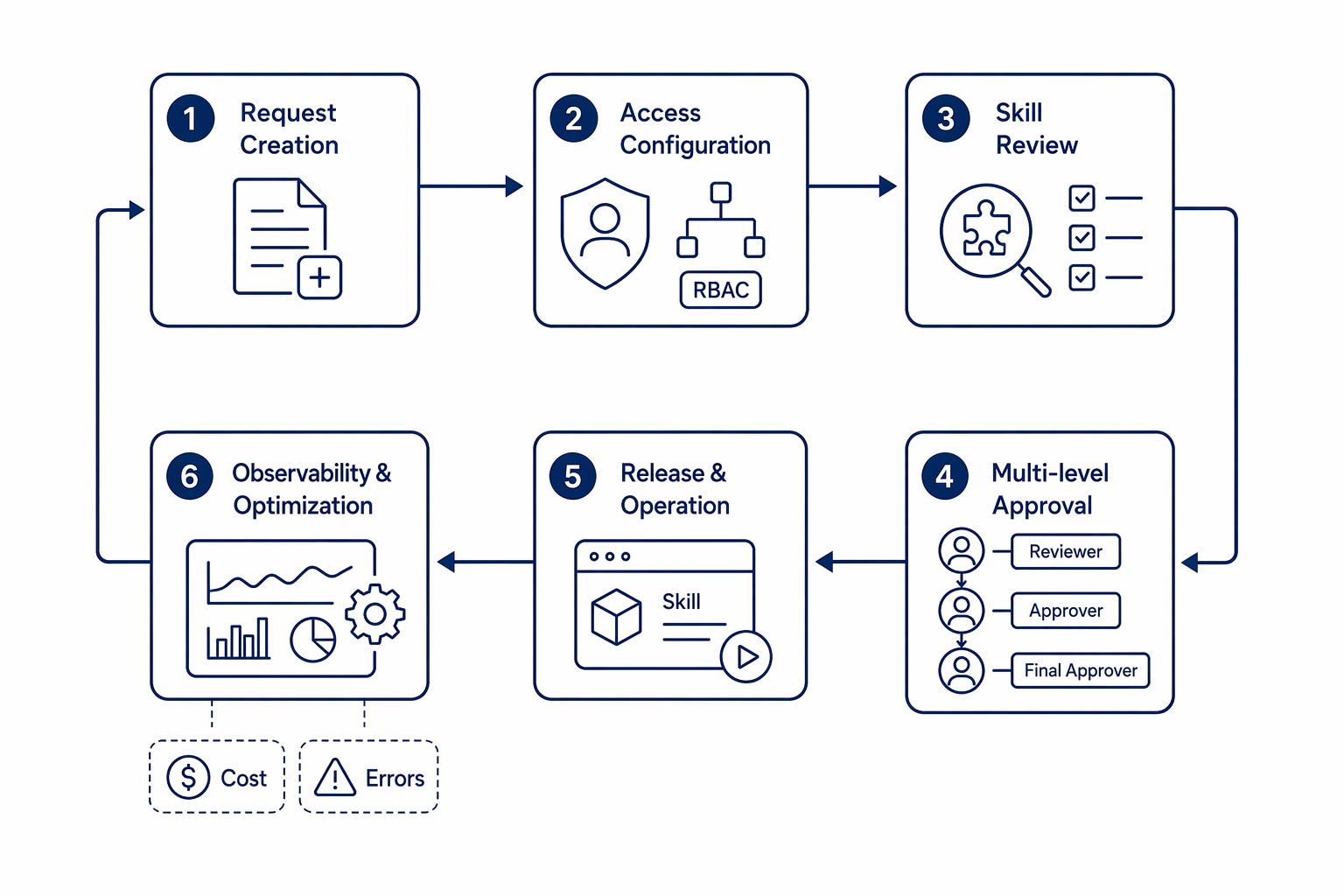
For permission management, ADP 4.0 supports a layered architecture at the enterprise, workspace, and application levels. Combined with a role-based access control (RBAC) permission matrix, it enables two-dimensional isolation of functional permissions and data permissions. Enterprises can perform fine-grained management of different users and Agents based on organizational structure, business departments, and application scenarios.
For Skill governance, custom Skills must pass security checks and multi-level approvals before entering the enterprise zone. Checks include static code scanning, data access review, external network access review, and dependency allowlists. Only approved Skills can become shared and schedulable enterprise assets.
For observability and operations management, enterprises can centrally manage cross-platform and cross-scenario Agents through Agent Portal, and use business and resource dashboards to view key metrics in real time, including call volume, response quality, operating cost, and errors. This helps enterprises quickly identify issues, optimize user experience, and control resource consumption.
For CTOs and platform teams, governance capabilities determine whether AI Agents can move beyond individual projects and become an enterprise-grade platform. ADP 4.0 embeds governance mechanisms into development, release, and runtime processes, providing a more robust foundation for scaled enterprise deployment.
International Capability Upgrades for Overseas Business
While maintaining consistency with the core capabilities of the domestic version, ADP 4.0 International Edition further enhances product capabilities around the practical needs of overseas enterprises, with a focus on global channel publishing, multilingual interaction, the international model ecosystem, and enterprise system connectivity.
【Figure 6:Capability snapshot showing connectors, skills, publishing channels, multilingual support, and time-zone readiness for global operations】
For global reach, ADP 4.0 supports publishing AI Agents to Web, API, and mainstream overseas social platforms such as LINE and Telegram, helping enterprises centrally manage multi-channel AI services. This is especially important for enterprises serving customers across multiple countries, distributed employees, and cross-region partners.
For globalized interaction, Smart Desk supports scheduled task configuration across multiple time zones and can automatically generate responses in the language used by the user’s input, making it suitable for global customer service and cross-region team collaboration. For example, when an enterprise needs to push tasks across time zones, handle customer inquiries, or coordinate internal work, Agents can interact in a way that better matches local user habits.
For the open ecosystem, the Model Marketplace integrates multiple international mainstream foundation models, while the Skill Marketplace provides internationalized Skill capabilities, allowing enterprises to flexibly combine models and tools based on business needs. For enterprises that have already built their own model capabilities, the platform also supports self-hosted model integration and is compatible with the OpenAI standard protocol.
For deep connectivity, Connectors support widely used overseas enterprise applications such as Google Workspace, Confluence, and Jira, helping AI Agents integrate deeply with enterprise knowledge, office systems, and business processes. This enables Agents to enter real work chains more quickly instead of remaining in standalone chat windows.
Industry Applications and Customer Outcomes: From Customer Service to Operational Analytics
Tencent Cloud ADP has been deployed across industries such as retail, finance, government, and manufacturing. Enterprise teams use AI Agents to support tasks including intelligent Q&A, customer service, marketing content generation, and business analytics. ADP has also continued to receive attention from international research institutions. It has been recognized as a representative vendor in Gartner Magic Quadrant research and as a leader in IDC Asia-Pacific conversational AI and China generative AI infrastructure-related research, reflecting its maturity and market recognition in the enterprise AI platform space.
In an overseas healthcare scenario, a large healthcare group sought to upgrade its patient service system and optimize outpatient appointments, hospital inquiries, and patient service experience. The customer’s existing AI chatbot was built on LLM and RAG, but stability and task completion rates in multi-step business processes still had room for improvement. The customer therefore introduced ADP to build an enterprise-grade Agent service platform.
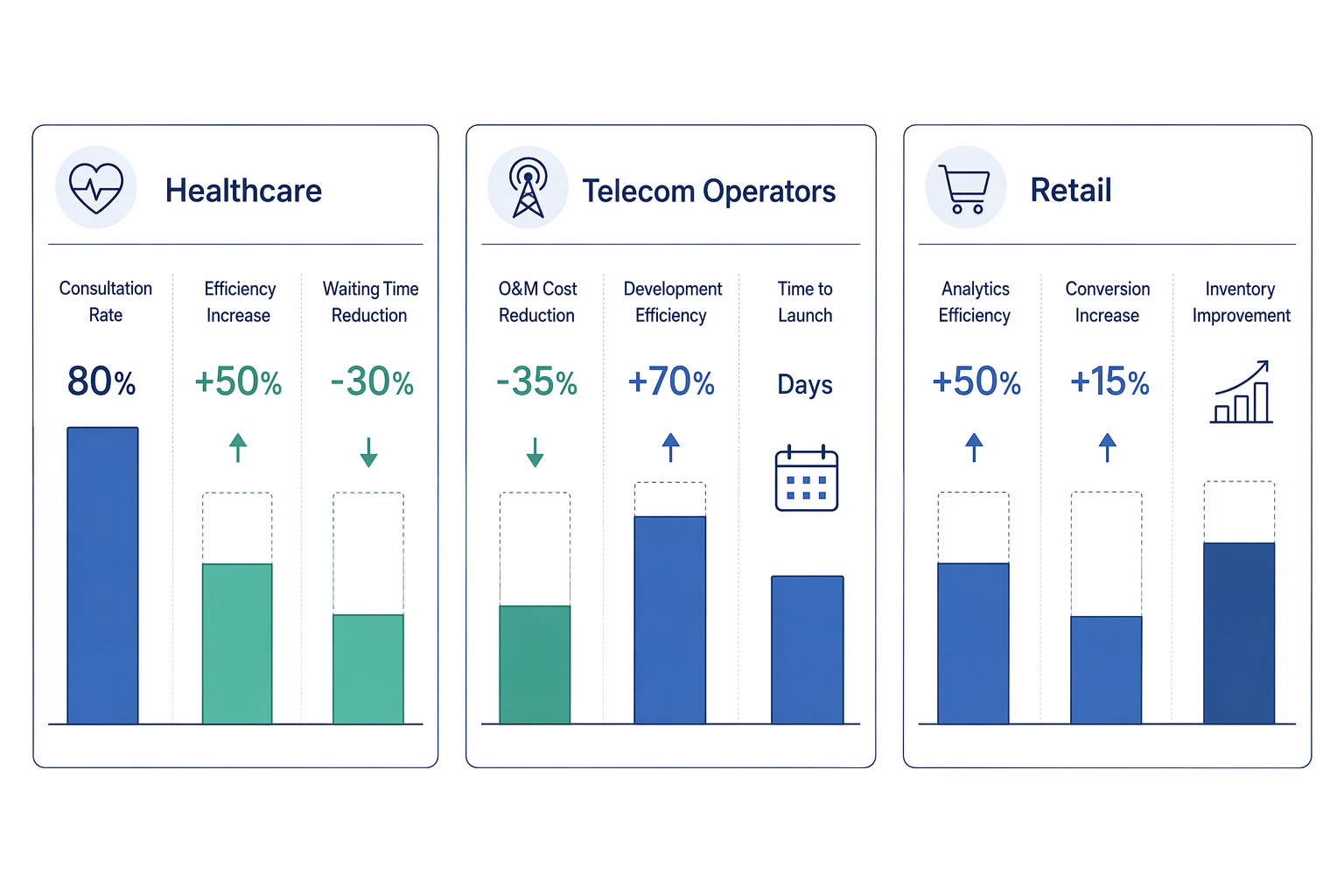
Based on ADP, the customer can build an AI medical assistant covering the full patient journey, including intelligent triage and outpatient appointments, hospital information inquiries, emergency risk identification, and patient feedback collection. Multi-step business processing can be implemented through unified Workflows. The project is expected to enable AI to independently handle more than 80% of routine inquiries and appointment requests, providing 24/7 online patient service. With Agent Workflow orchestration and task execution capabilities, overall appointment processing efficiency is expected to improve by more than 50%, while average patient waiting time is expected to decrease by 30%.
In an overseas telecom scenario, a leading operator had two intelligent customer service systems deployed on different cloud platforms and maintained by multiple vendors. The environment involved multiple Agent platforms and third-party components, resulting in a complex system architecture, high maintenance costs, and limited support for future business expansion and AI capability upgrades. The customer rebuilt a unified intelligent customer service platform based on ADP, covering customer inquiries, service handling, multilingual support, and knowledge Q&A. With Smart Desk, Claw Mode, Connectors, and other capabilities, the customer implemented Agent creation, knowledge connection, Workflow orchestration, and unified operations management.
The project is expected to significantly reduce system maintenance costs and platform management complexity, with overall operations and maintenance costs expected to decrease by 30%–40%. The launch cycle for new services is expected to shorten from weeks to days. With natural-language Agent creation capabilities, business teams can participate in AI application development more quickly, with application development efficiency expected to improve by more than 70%. At the same time, while preserving existing business capabilities, the platform introduces new intelligent interaction capabilities such as automatic language alignment and further reduces model invocation costs.
In a Hong Kong retail scenario, a local Tencent Cloud partner used ADP to build an AI-powered intelligent operations assistant for a large retail group in Hong Kong. The assistant helps the enterprise integrate business systems such as CRM, POS, and ERP, enabling unified data management and intelligent analysis to improve store operations efficiency. It supports scenarios including financial analysis, member operations, sales assistance, and inventory forecasting, providing store employees and operations teams with real-time data analysis, business insights, and intelligent decision-making recommendations.
By unifying enterprise data and AI capabilities, the project is expected to improve operational analysis efficiency by more than 50%, reduce data preparation work for store employees, and help operations teams complete business analysis and decision-making faster. Combined with capabilities such as member operations, sales recommendations, and inventory forecasting, member marketing conversion rates are expected to increase by 10%–20%, while inventory management efficiency is also expected to further improve.
FAQ
1. What types of enterprises is ADP 4.0 International Edition suitable for?
ADP 4.0 International Edition is suitable for enterprises advancing AI transformation and looking to scale AI Agents from pilots to production environments. It is especially applicable to scenarios such as customer service, knowledge management, office collaboration, business automation, marketing content generation, and business analytics. For overseas enterprises with requirements for multilingual support, multiple time zones, multiple channels, and international SaaS integrations, ADP 4.0 International Edition provides capabilities better aligned with global business needs.
2. How is ADP 4.0 different from a typical AI Agent development platform?
ADP 4.0 International Edition is positioned as an enterprise-grade AgentOps platform covering the full lifecycle of AI Agent creation, connection, deployment, distribution, and governance. It not only supports natural-language Agent creation, but also provides Connectors, Skill Marketplace, Knowledge Base, MCP, Agent Portal, permission management, runtime observability, and deployment governance, helping enterprises operate AI Agent applications reliably in real business environments.
3. What problems does Smart Desk solve?
Smart Desk is the unified user entry point of ADP 4.0. Enterprises can build Agents through natural language within the same workspace, while employees can complete daily tasks with a single sentence. It supports the rapid creation of knowledge Q&A assistants, multi-intent customer service flows, and Multi-Agent collaboration teams. It can also work with the Skill Marketplace to package mature capabilities into reusable enterprise-grade Skills.
4. What types of tasks is Claw Mode suitable for?
Claw Mode is suitable for complex tasks that lack fixed rules, involve long process chains, and are difficult to configure through forms. It can create Agents that autonomously write and run code in a cloud sandbox and invoke enterprise Skills to execute long-running tasks. For scenarios requiring open-ended judgment, cross-system analysis, and complex process execution, Claw Mode can be used together with Workflows.
5. How does ADP 4.0 connect to existing enterprise systems?
ADP 4.0 connects enterprise systems, knowledge, and tools through Connectors, Skills, plugins, Knowledge Bases, and MCP. The first batch of nearly 40 Connectors covers high-frequency systems such as CRM, ERP, ticketing, customer service, Knowledge Bases, and document systems, and also supports widely used overseas enterprise applications such as Google Workspace, Confluence, and Jira. Agents can read, retrieve, and perform related operations within authorized scopes.
6. How can enterprises control Agent security and costs?
ADP 4.0 shifts governance left to the source of development. It supports multi-level permission management across enterprises, workspaces, and applications, and uses RBAC to isolate functional and data permissions. Before custom Skills enter the enterprise zone, they must pass static code scanning, data access review, external network access review, dependency allowlists, and multi-level approvals. Enterprises can also use Agent Portal and dashboards to monitor metrics such as call volume, response quality, operating cost, and errors.
Summary and CTA
The release of ADP 4.0 International Edition marks Tencent Cloud ADP’s evolution from an AI Agent development platform into an AgentOps platform built for enterprise-grade production environments. Addressing the real challenges overseas enterprises face in scaled implementation, system connectivity, security governance, cost control, and global operations, it provides a complete capability path from creation to operations.
For business leaders, ADP 4.0 helps teams introduce AI Agent applications into scenarios such as customer service, knowledge management, office collaboration, and business analytics more quickly, while evaluating efficiency gains and experience improvements in a measurable way. For CTOs and technical teams, ADP 4.0 provides connectivity, orchestration, governance, observability, and multi-channel publishing capabilities, helping AI Agents enter real production systems more reliably.
Learn more about Tencent Cloud ADP 4.0 International Edition, schedule a product demo, and assess your enterprise’s path from AI Agent pilot to scaled production.

Start building today
If you need more support, please contact us