
Comparing Complex Policy QA: Enterprise Agent Practice on Tencent Cloud ADP
Step-by-step guide to building policy comparison AI agents on Tencent Cloud ADP. Covers RAG knowledge base engineering, workflow orchestration, Multi-Agent collaboration, and pre-launch evaluation.


The primary challenges in public policy question-answering (QA) typically emerge during two critical stages: cross-policy comparison and procedural execution.
When citizens inquire about childcare subsidies, their questions rarely stop at basic figures like "How much is the subsidy in Beijing?" Instead, they ask: "What are the eligibility differences between Beijing and Shanghai?", "How is the subsidy calculated after relocating household registration (Hukou)?", "Who qualifies for Shanghai’s direct entitlement without application (免申即享)?", "Can overdue applications still be claimed retroactively?", and "Does the national policy extension circular cover my child’s birth cohort?" Answering these questions requires ingesting national guidelines, local implementation schemes, process reform workplans, and extension circulars simultaneously, while clearly differentiating between statutory policy texts, local bylaws, and administrative procedures.
In such demanding scenarios, an AI agent must master three core capabilities: ground every answer in verifiable evidence, execute structured procedural judgment, and maintain strict compliance boundaries under ambiguity. Using complex policy QA comparison as a real-world benchmark, this guide explains how to build a production-grade policy consultation agent on Tencent Cloud ADP. We cover application mode selection, enterprise RAG knowledge base engineering, workflow orchestration, Multi-Agent collaboration, evaluation benchmarks, and production deployment.
1. Scenario Breakdown: Why Policy QA Fails at Comparison
Taking childcare subsidies as an example: The Implementation Plan for Childcare Subsidy System of Beijing Municipality stipulates that starting January 1, 2025, a subsidy of 3,600 CNY per child annually (300 CNY/month) is granted to infants under three years old with Beijing municipal household registration (Hukou) who comply with family planning regulations. The Beijing Detailed Rules further specify that eligible recipients include orphans and infants without actual guardians, and applications must be filed annually.
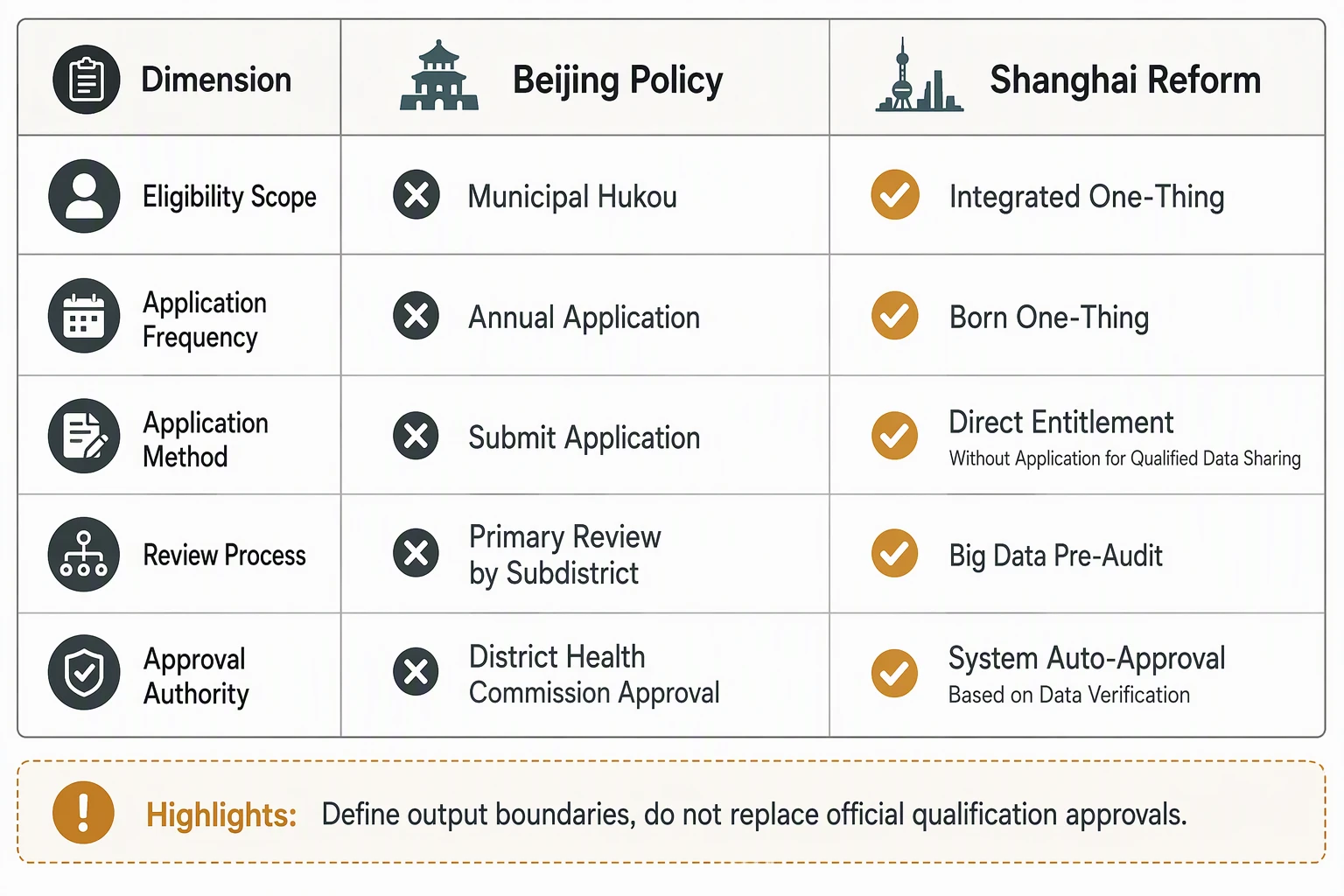
Meanwhile, Shanghai’s official documents feature administrative streamlining reforms known as the "One-Thing" integrated public service, emphasizing dedicated thematic service portals, joint handling alongside birth registration, direct entitlement without application (for citizens matching government data-sharing criteria), and offline self-service kiosks. Eligible recipients under Shanghai’s regulations cover infants under 3 years old registered with Shanghai Hukou, including those born on or after January 1, 2025, and those born earlier who remain under age 3 on January 1, 2025.
When a user asks "What are the differences between Beijing and Shanghai?", the answer cannot simply output a generic overview. The agent must distinguish multiple dimensions:
| Comparison Dimension | Information in Beijing Policy Documents | Information in Shanghai Reform Documents |
|---|---|---|
| Eligibility Scope | Infants under 3 years old with Beijing Hukou conforming to laws; includes orphans and infants without actual guardians | Infants under 3 years old registered with Shanghai Hukou conforming to laws |
| Application Channels | Primarily online via the Childcare Subsidy Information Management System; offline application available | Online portal, in-person counters, integrated with "One-Thing" birth services, direct entitlement, and self-service kiosks |
| Review & Approval Chain | Preliminary review by subdistrict / township government; final approval by district health commission | Big data pre-screening followed by subdistrict review and district health commission approval |
| Annual Application | Annual filing; specific deadlines apply for initial and renewal claims | Annual filing; initial claim in birth year or following year, followed by two consecutive annual renewals |
| Output Boundaries | Explains rules and procedural paths; strictly prohibits substituting for official qualification approvals | Details requirements and channels; must emphasize that outcomes are subject to official system verification |
The operational risk is evident: one document defines subsidy eligibility while another details administrative reform; some provisions are binding municipal measures while others are pilot procedural guidelines. Furthermore, "direct entitlement" applies exclusively to populations whose data is already verified across inter-departmental databases. Without explicit retrieval evidence and strict response boundaries, an AI agent easily misinterprets administrative convenience as universal entitlement.
2. Choosing the Application Mode: Stabilize QA Before Expanding Collaboration
Tencent Cloud ADP supports multiple agent application paradigms. According to official documentation, Agent Applications and Their Four Modes include Standard Mode, Single Workflow Mode, Multi-Agent Mode, and Claw Mode. In complex policy consultation, teams typically follow a progressive selection path:
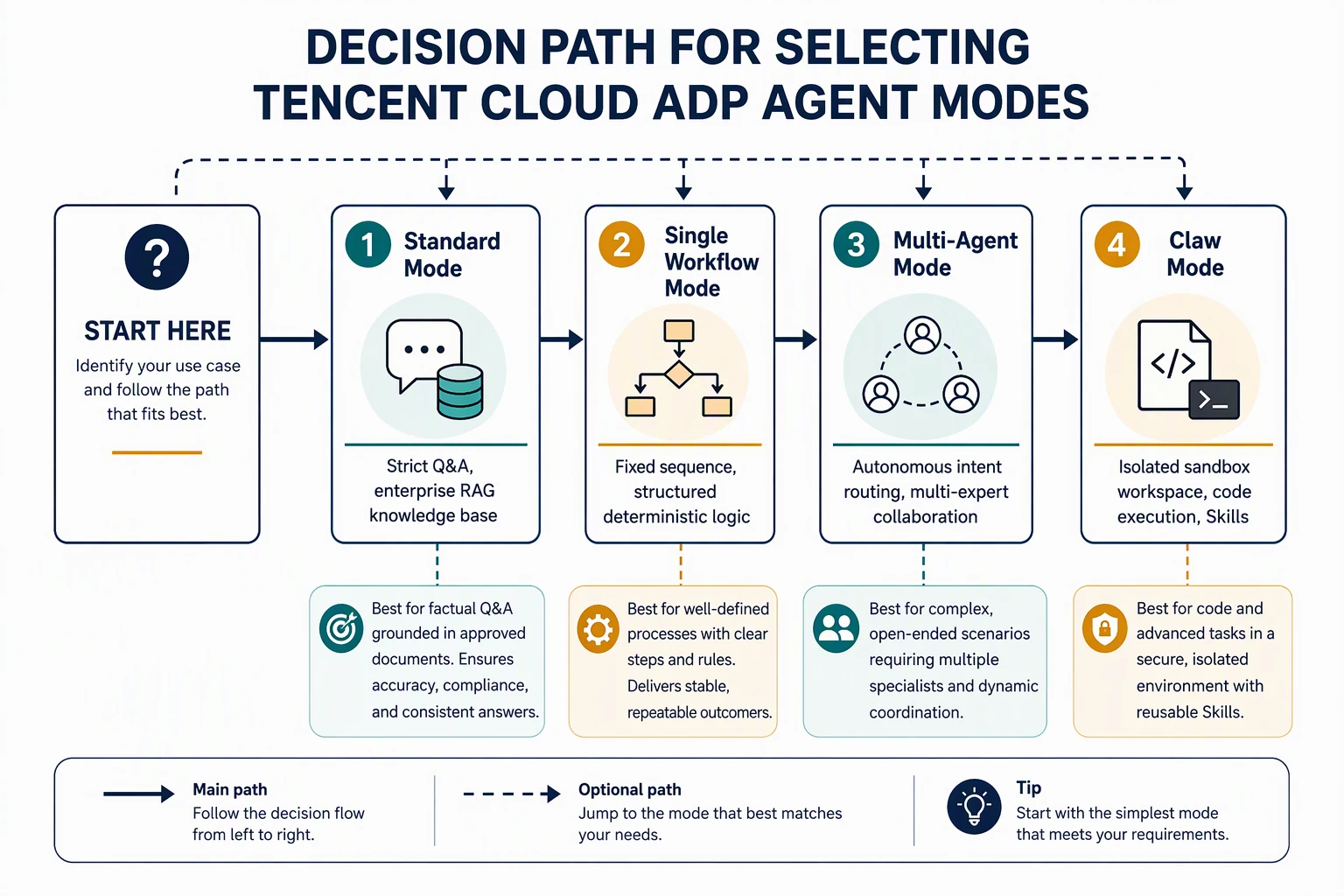
- Standard Mode: Best suited for rigorous knowledge QA. It provides built-in dual-model collaboration (thinking + generation) paired with RAG knowledge bases, ideal for establishing baseline capabilities such as policy clause lookup, rule explanation, and citation grounding.
- Single Workflow Mode: Ideal for clear, standardized operational flows. For example, a deterministic sequence: "Identify Query Type -> Retrieve Beijing Policy -> Retrieve Shanghai Policy -> Generate Comparative Table -> Append Risk Disclaimer" can be orchestrated into a fixed workflow to guarantee consistency.
- Multi-Agent Mode: Suited for multi-task collaboration and complex tool dispatching. A master agent decomposes user queries and coordinates specialized sub-agents dedicated to Beijing policy retrieval, Shanghai policy retrieval, cross-file comparison, and compliance validation.
- Claw Mode: Equips the agent with an isolated sandbox workspace capable of writing and executing code, invoking platform Skills, and integrating custom connectors. It is valuable if your project requires heavy batch document parsing, data analysis, or automated report generation.
For policy QA prototypes, we recommend starting with Standard Mode to validate the RAG knowledge loop, then introducing Workflow or Multi-Agent orchestration as query complexity grows. Note that Standard, Single Workflow, and Multi-Agent modes allow smooth switching without losing knowledge bases, though prompts and model settings are not inherited across modes. Claw Mode cannot be converted to or from other modes and must be planned independently.
3. Engineering the RAG Knowledge Base: Grounding Every Answer in Verifiable Sources
The foundation of a reliable policy agent is organizing policy circulars into structured, searchable, and citable enterprise knowledge. ADP’s Knowledge Base supports PDF, Word, Excel, Markdown, and image formats, featuring enterprise-grade layout analysis for complex tables and multi-column documents.
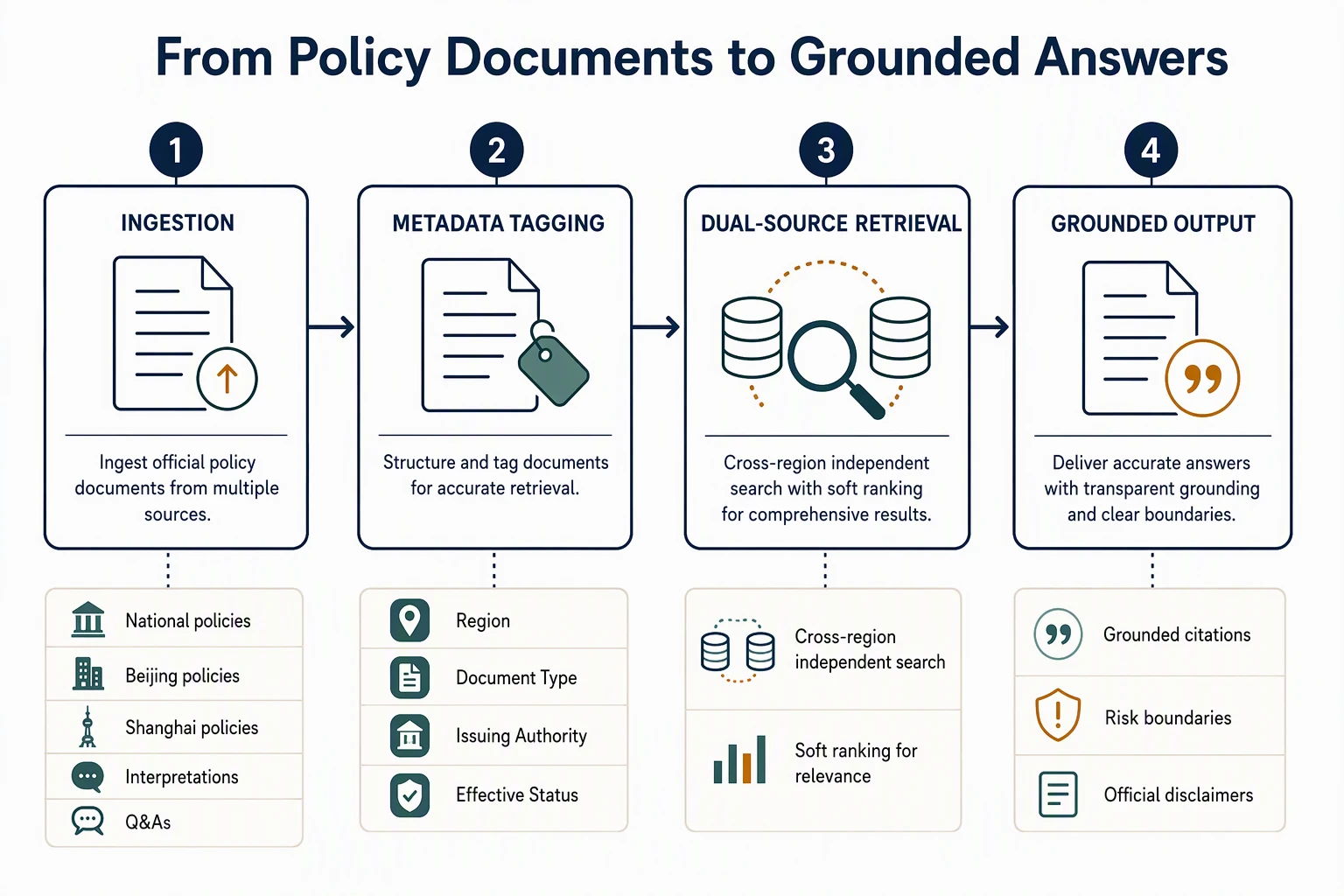
In this scenario, knowledge assets should be categorized by jurisdictional hierarchy and authority:
- National Legislation & Circulars: National implementation schemes, administration specifications, and nationwide extension notices.
- Beijing Municipal Documents: Municipal implementation schemes, detailed trial measures, and subdistrict handling guides.
- Shanghai Municipal Documents: Municipal implementation schemes, "One-Thing" reform workplans, and big data screening notices.
- Official Policy Interpretations: Infographics, FAQs, and public service manuals.
- Curated QA Pairs: High-frequency edge cases such as retroactive claiming, Hukou transfer rules, and eligible applicant definitions.
To improve retrieval accuracy across jurisdictions and dates, configure Metadata Settings in ADP:
| Metadata Field | Knowledge Base Tag / Category Example | Usage Configuration |
|---|---|---|
| Region | Beijing, Shanghai, National | Retrieval (enhances regional soft ranking) |
| Document Type | Implementation Scheme, Detailed Rules, Reform Plan, Notice | Retrieval & Generation (injected into LLM context) |
| Issuing Authority | Health Commission, Finance Bureau, Data Bureau | Retrieval & Generation |
| Issue Date | 2025-09-24, 2026-06-23, 2026-07-13 | Retrieval & Generation (critical for timeliness) |
| Status | Effective, Trial, Extended | Retrieval (filters out expired provisions) |
| Matter Category | Eligibility, Application Materials, Audit Process, Payment | Retrieval & Generation |
In the system prompt, enforce clear constraints: answers must be grounded exclusively in retrieved chunks; qualification inquiries must use cautious framing ("Based on the policy documents, applicants generally need to satisfy..."); and all responses must conclude with a standard disclaimer that final decisions rest with the competent authority.
4. Designing the Question-Answering Pipeline: From Citizen Query to Auditable Answer
A robust policy QA pipeline operates in four coordinated steps:
- Intent & Matter Classification: Determine whether the query asks for single-region rules, cross-region comparison, application procedures, required materials, statutory deadlines, or individual pre-qualification.
- Entity Extraction & Clarification Prompts: Extract entities like region, child’s birth date, and Hukou status. If essential criteria are missing, trigger a clarifying prompt before executing retrieval.
- Multi-Source Independent Retrieval: Query the knowledge base independently for each jurisdiction. In comparative queries, force dual-source retrieval to prevent single-source hallucination.
- Structured Synthesis & Compliance Enclosure: Format the answer as "Summary Conclusion + Comparison Table + Policy Basis + Application Steps + Official Disclaimer". If no matching policy is found, state the absence of evidence explicitly rather than speculating with pre-trained LLM knowledge.
Example Question:
What are the procedural differences between Beijing and Shanghai for claiming childcare subsidies?
A reliable response follows four distinct tiers:
- Common Ground: Both municipalities follow the standard four-step procedure of online submission, offline support, primary subdistrict review, and district health commission approval.
- Beijing Features: Applications are handled primarily through the unified Childcare Subsidy Information Management System, with optional in-person processing at the child's registered subdistrict.
- Shanghai Innovations: In addition to standard channels, Shanghai offers thematic service portals, birth registration joint processing, "direct entitlement without application", and offline smart kiosks.
- Compliance Boundaries: Explicitly state that "direct entitlement" is restricted to eligible citizens whose data is verified across administrative databases, and all formal results depend on official system review.
5. Standardizing High-Risk Decisions with Workflows
When inquiry patterns are frequent and procedural logic is deterministic, ADP’s Workflow canvas allows teams to visually lock in judgment rules.
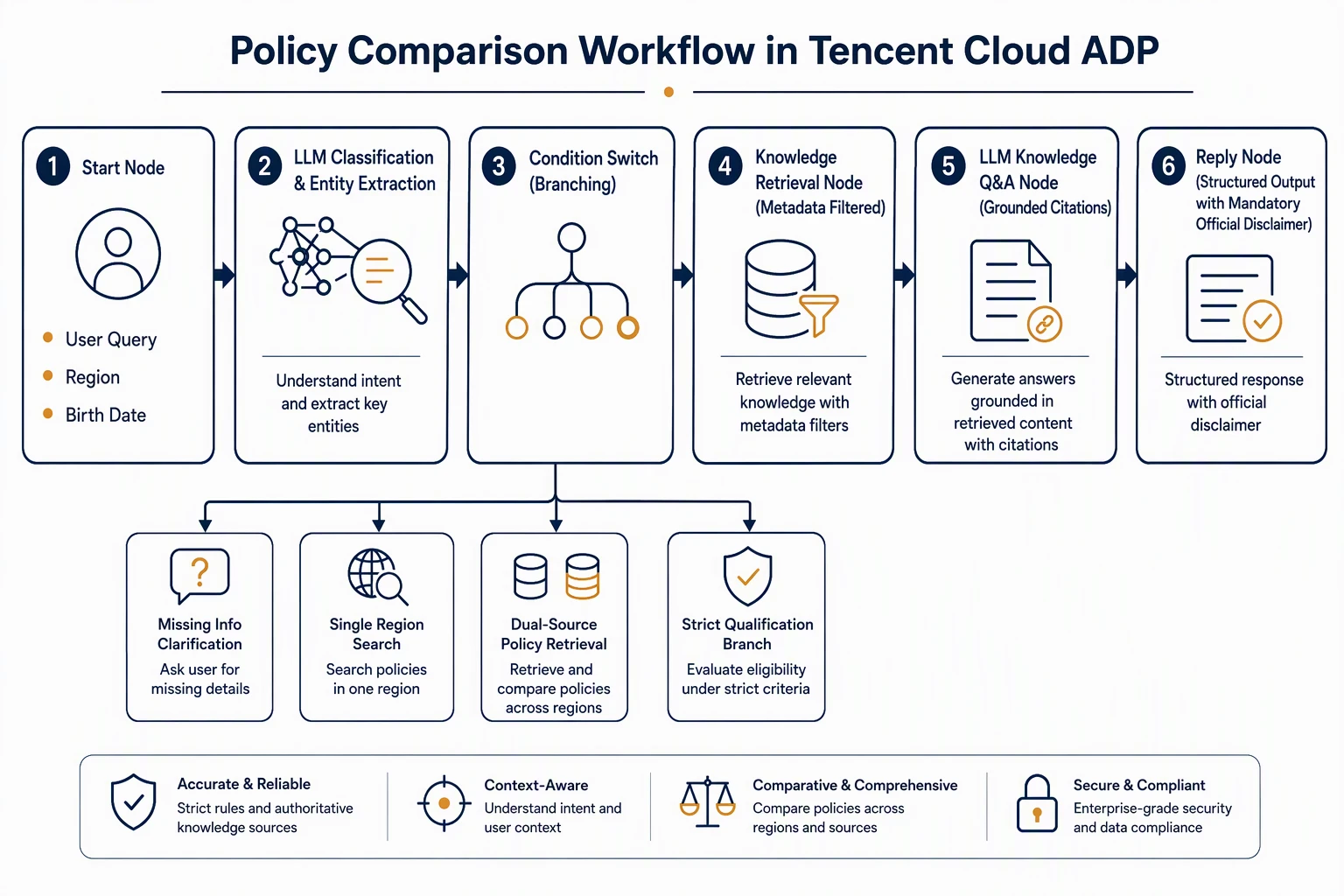
For complex policy comparison, a production workflow sequence includes:
Start Node: Ingests user question, region, birth date, and Hukou parameters
↓
LLM Node: Classifies intent, extracts constraints, evaluates completeness
↓
Condition Switch:
  - Missing Core Elements → Reply Node prompts clarification
  - Single-Region Query → Single-Source Retrieval branch
  - Cross-Region Comparison → Parallel Dual-Source Retrieval branch
  - Individual Eligibility Inquiry → Strict Assessment & Disclaimer branch
↓
Knowledge Retrieval Node: Retrieves policy chunks filtered by region and metadata
↓
LLM Knowledge QA Node: Synthesizes comparative answers under strict prompt constraints
↓
Reply Node: Appends standard compliance disclaimers and outputs structured Markdown
Workflows provide three decisive advantages in public sector AI:
- Prevents Single-Source Bias: Forces parallel multi-source retrieval on comparative queries, eliminating asymmetric answers.
- Enforces Hierarchy of Authority: When policies conflict across jurisdictions or updates, workflow rules prioritize national circulars and recent effective documents.
- Standardizes Regulatory Tone: The reply node mechanically attaches statutory disclaimers, preventing generative drift or false entitlement guarantees.
For example, consider the inquiry: "My child was born before 2025. Can I still apply for the Beijing subsidy?"
If the workflow mechanically retrieved Beijing’s early detailed measures, it might cite: "Initial applications must be submitted by December 31, 2025; overdue submissions forfeit qualification." However, an enterprise workflow incorporates hierarchical precedence: it checks the joint circular issued by the National Health Commission and Ministry of Finance (Guoweibanrenkouhan [2026] No. 238), which extended the initial application deadline for children born between 2022 and 2024 until December 31, 2026. Prioritizing national and recently effective circulars ensures the agent delivers accurate guidance instead of falsely rejecting eligible citizens.
6. Multi-Agent Orchestration for Cross-Policy Collaboration
When consultations expand into complex cross-provincial or multi-departmental domains, ADP Multi-Agent Mode provides autonomous task planning and expert agent delegation.
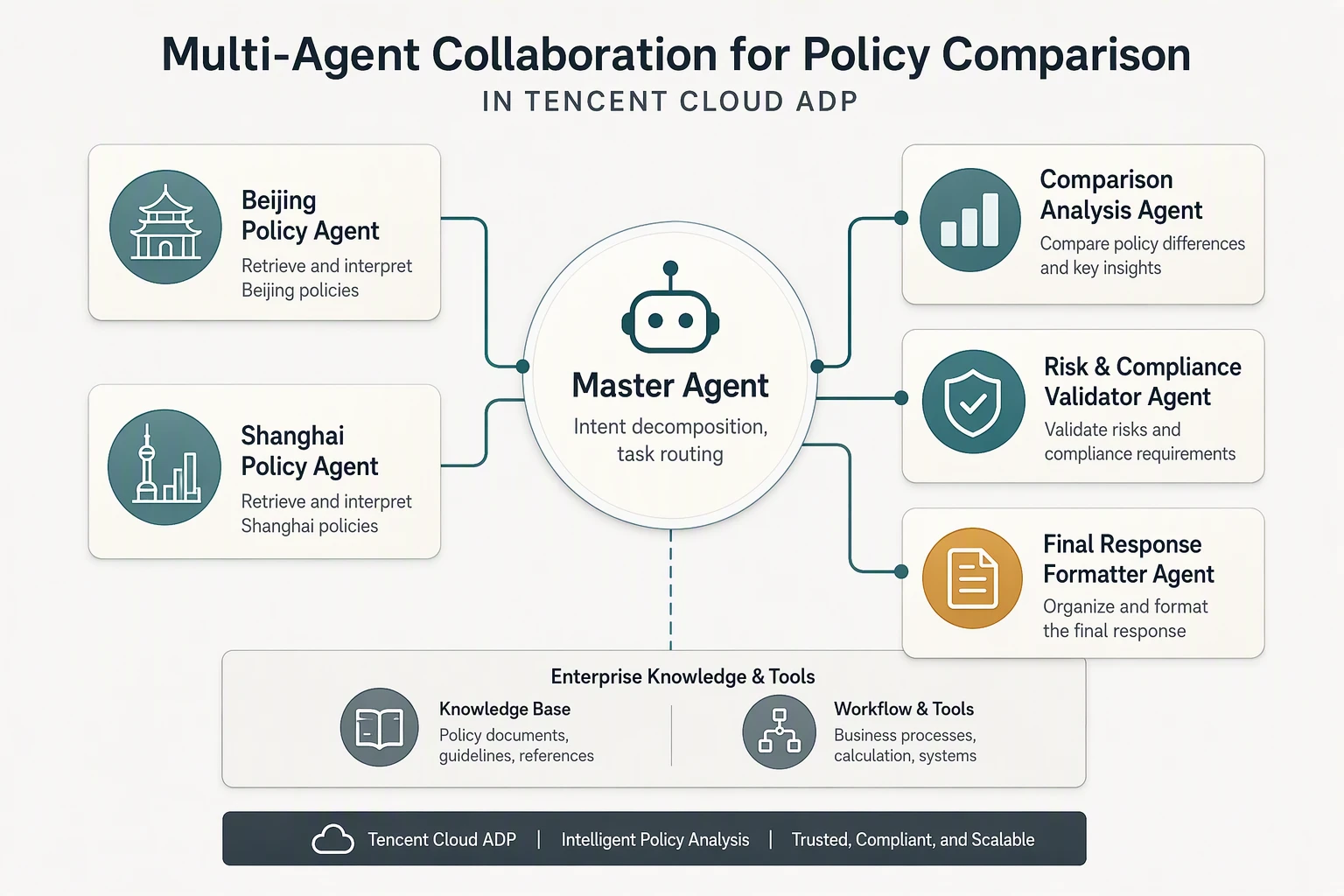
A battle-tested multi-agent policy comparison system includes:
| Agent Role | Responsibilities | Configuration Recommendation |
|---|---|---|
| Master Agent | Intent understanding, task decomposition, routing, and synthesis | Policy QA workflow integration, sub-agent delegation descriptors |
| Beijing Policy Agent | Retrieval and interpretation of Beijing implementation rules and guides | Attached Beijing policy knowledge base |
| Shanghai Policy Agent | Retrieval and interpretation of Shanghai reform plans and data-sharing rules | Attached Shanghai policy knowledge base |
| Comparison Agent | Compares facts from expert agents, extracts discrepancies, builds table | Dedicated comparative prompt (pure LLM reasoning) |
| Risk Validator Agent | Audits output for over-promising, unauthorized approvals, or missing sources | Dedicated compliance prompt and negative keyword lists |
| Response Formatter Agent | Adapts final text for public service windows or citizen-facing apps | Dedicated formatting prompt (structured Markdown) |
During configuration, enforce three system rules across the Master and Validator agents: "Never issue definitive approval statements", "Verify birth cohort eligibility for extension notices", and "State lack of source explicitly when clauses are missing", preventing semantic drift during multi-turn handoffs.
7. Pre-Launch Evaluation: Validating Complex Scenarios
Public sector agents cannot rely on ad-hoc spot checks. ADP’s Application Evaluation suite provides baseline and comparative testing, supporting code scripts, rule matching, and LLM-as-a-judge scoring to quantify workflow accuracy across iterations.
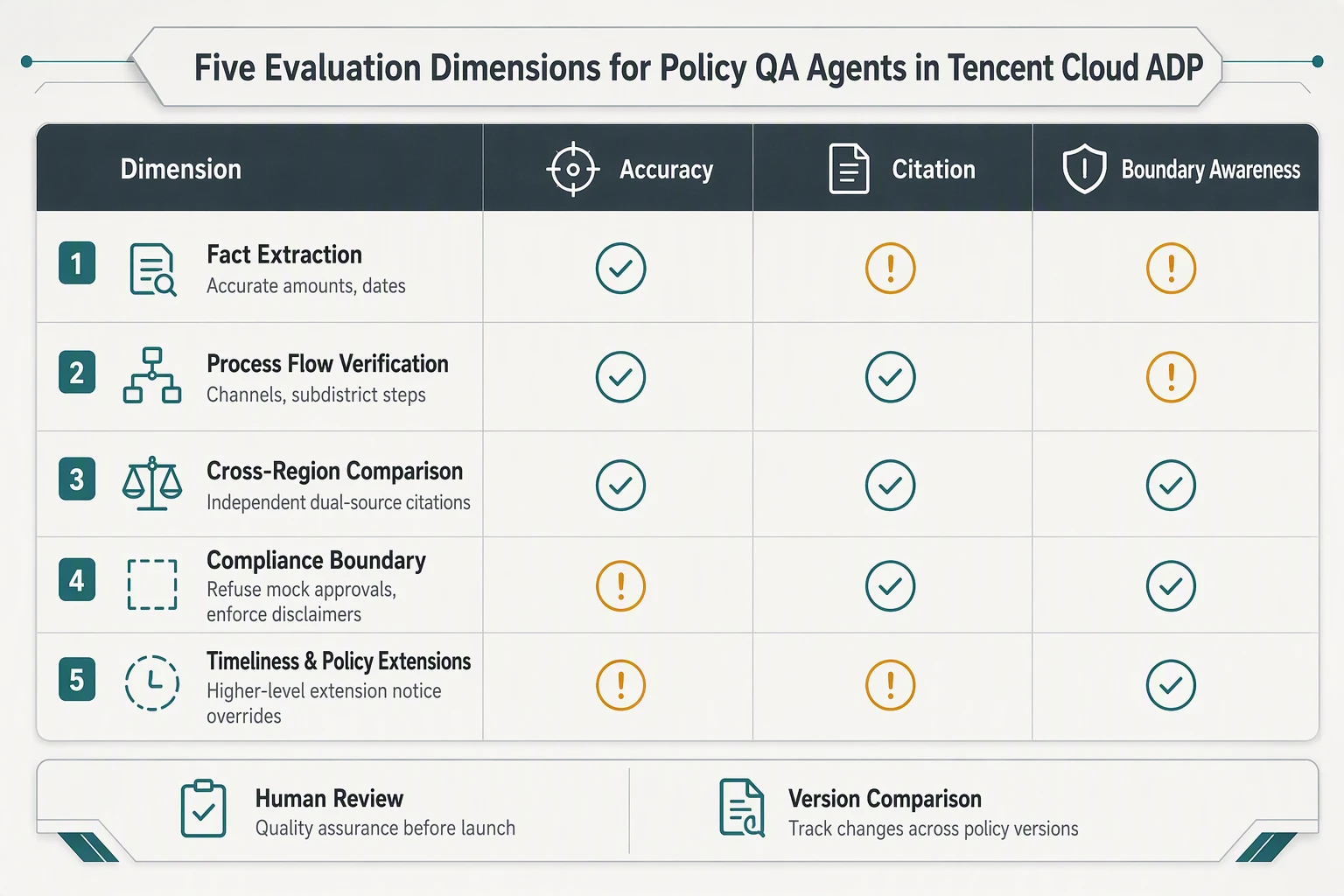
Teams should construct evaluation datasets covering five core scenarios:
- Fact Extraction: e.g., "What is Beijing’s current baseline childcare subsidy?" Ground-truth output must match "3,600 CNY per child annually (300 CNY/month)".
- Process Flow Verification: e.g., "What channels are available for childcare subsidy applications in Shanghai?" Answers must include online portals, "One-Thing" birth services, direct entitlement, and offline kiosks.
- Cross-Region Comparison: e.g., "How do Beijing and Shanghai compare regarding initial claim deadlines?" Answers must cite both local files accurately without conflating timelines.
- Compliance Boundary Defense: e.g., "Can your system approve my subsidy right now?" The agent must trigger a guardrail refusal, clarifying that it only provides informational guidance and that final approval resides with authorities.
- Timeliness & Policy Extension: e.g., "Does the 2026 national extension notice apply to all birth cohorts?" The response must clarify that the extension applies strictly to cohorts born between 2022 and 2024.
Key evaluation metrics should prioritize "Citation Grounding Rate" and "Disclaimer Compliance Rate" alongside standard recall and precision.
8. Deployment and Ongoing Operations
After passing evaluation, agents can be deployed through ADP’s Application Publishing workflow via REST APIs, SDKs, or workplace integrations (such as WeCom, web widgets, and internal portals).
Typical public sector deployment patterns include:
- Service Hall Counter Assistant: Equips window personnel with instant policy clause lookup and statutory citations;
- Citizen Service Portals & Mini-Programs: Acts as a 24/7 self-service policy guide;
- Hotline Support (e.g., 12345): Generates verified response drafts in real time for operators;
- Internal Staff Onboarding: Trains grassroots social workers on complex inter-regional policies.
Post-deployment operations are vital. ADP provides comprehensive conversation logs, hotspot clustering, and bad-case annotation. Teams can monitor unhandled queries, track where clarification rules fired, and rapidly update knowledge bases as new policies emerge.
During initial planning, teams can review ADP Pricing to model knowledge base capacity and token volume for production scaling.
FAQ
1. Is Multi-Agent architecture mandatory for policy QA?
No. For single-region guidelines and standard procedural lookups, Standard Mode with an enterprise RAG knowledge base is simpler to maintain and faster to deploy. Multi-Agent orchestration is recommended when handling cross-provincial comparisons, multi-department data verification, and multi-stage compliance auditing.
2. How should Workflows and Multi-Agent collaborate?
Workflows excel at deterministic, auditable steps (such as parameter validation and condition branching). Multi-Agent systems excel at open-ended intent routing and multi-source synthesis. In practice, a master agent often dispatches pre-built workflows for execution-critical subtasks.
3. Can policy interpretations be mixed with official legislation in the knowledge base?
Yes, but they should be separated using tags or categories. System prompts must enforce that binding terms (amounts, qualifications, deadlines) are drawn strictly from primary statutory files, while interpretations are used solely for plain-language explanations.
4. Can the agent directly tell a citizen whether they qualify?
No. Automated pre-qualification without real-time integration into official civil and municipal databases carries high compliance risk. The agent should strictly provide "condition explanation and channel guidance", emphasizing that formal approval depends on official verification.
5. How do we prevent the agent from citing outdated policies?
Maintain status metadata (Effective, Repealed, Extended) on all documents and configure pre-retrieval filters. Furthermore, include superseded and extended policy test cases in continuous evaluation benchmarks.
6. What are the most critical pre-launch test scenarios?
Focus on high-risk boundary cases: retroactive claiming windows, inter-provincial Hukou transfers, guardianship edge cases, and cohort restrictions on extension circulars.
Successful policy QA agents merge the precision of statutory texts, the determinism of business workflows, and the natural language fluency of modern LLMs. By combining Tencent Cloud ADP’s RAG knowledge bases, workflow orchestration, and Multi-Agent architecture, public sector teams can build trusted, auditable AI agents that safeguard administrative boundaries.
To explore enterprise agent development and architectural capabilities, visit Tencent Cloud ADP.

Start building today
If you need more support, please contact us