
How Education Groups Build Standardized AI Question Assistants on ADP
How large educational institutions eliminate manual drafting friction and curriculum drift by building standardized AI question generation assistants on Tencent Cloud ADP.

Executive Summary
Standardized assessment generation across large education groups is inherently complex. Multi-campus K-12 networks and higher-education consortia struggle with fragmented curriculum standards, wide variations in question quality, and heavy teacher workloads. Educators routinely spend 35 to 45 hours per semester drafting formative quizzes, midterms, and standardized question banks—often yielding inconsistent difficulty curves and unaligned distractors.
- Manual Item Drafting: 40+ hours per term spent by each educator on drafting, formatting, and proofreading.
- Campus Curriculum Drift: 28% variance in tested cognitive depth across affiliated regional campuses.
- Mathematical & Scientific Errors: 15–22% hallucinated formulas and broken LaTeX syntax in generic LLM outputs.
- Export & Integration Friction: 12+ manual hours required to convert raw text into LMS-ready QTI 2.1, LaTeX, and Word formats.
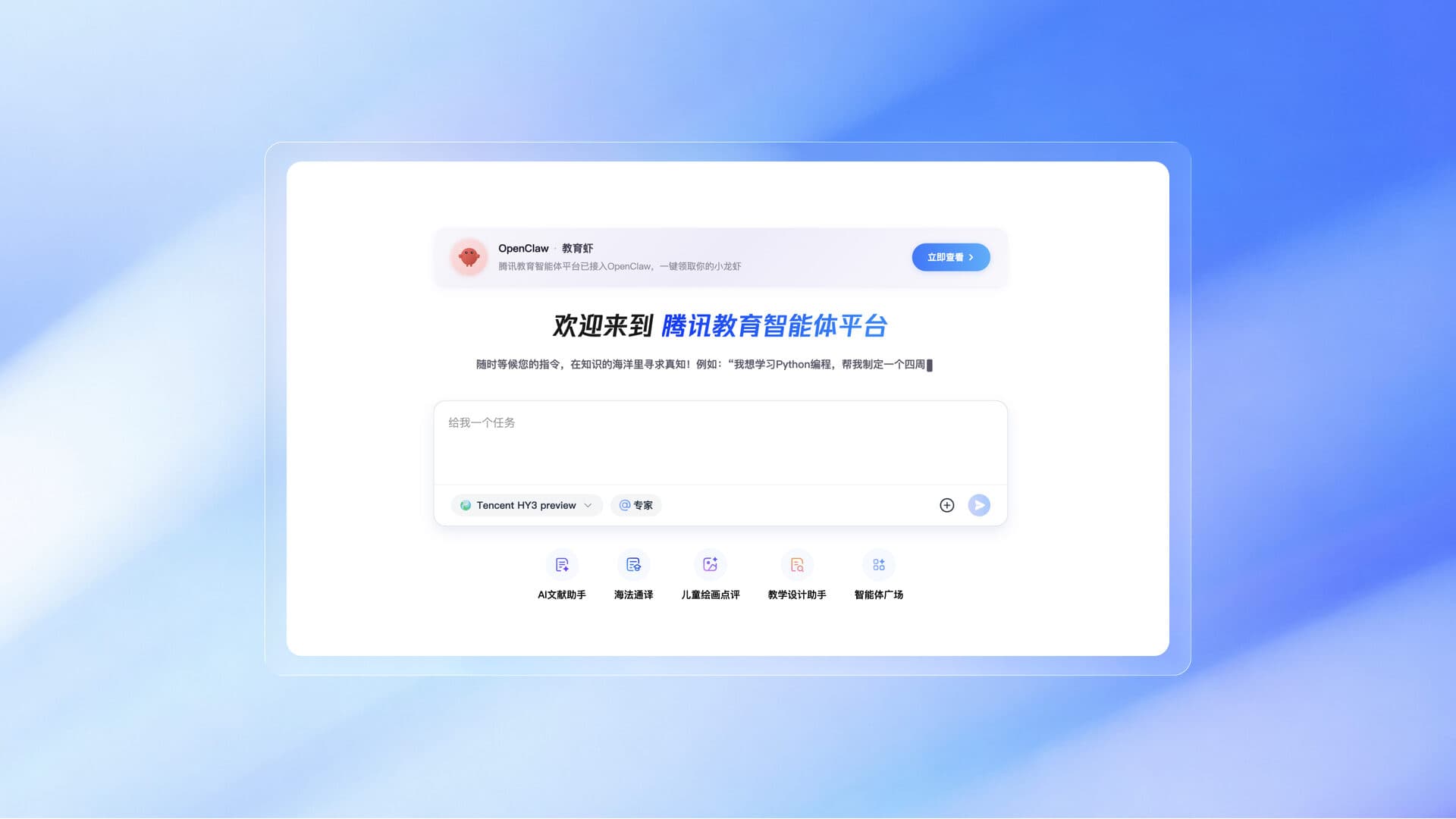
Using Tencent Cloud Agent Development Platform (ADP), education groups build centralized, syllabus-governed AI question generation assistants. By uniting multi-space dynamic knowledge retrieval (RAG), composable Skill Hub modules, Claw sandbox execution, and multi-agent peer evaluation, institutions transform raw pedagogical repositories into high-precision assessment generation engines.
Key Takeaways
- Multi-Campus Curriculum Governance: Partition shared curriculum standards and campus-specific teaching pacing using Tencent Cloud ADP Space-level isolation with zero cross-tenant data leakage.
- Pedagogical Skill Modules: Route item drafting across specialized STEM equation formatters, Bloom's Taxonomy calibrators, and reading comprehension extractors via ADP Skill Hub.
- Deterministic Rendering & Sandbox Compilation: Use Claw Sandbox runtime environments to validate, solve, and export assessments into LaTeX, Word (
.docx), and LMS-standard QTI 2.1 packages. - Multi-Agent Dual-Blind Review: Deploy an automated Author-Reviewer agent loop that verifies factual accuracy, calculates distractor plausibility, and validates pedagogical alignment before human sign-off.
- Measurable Institutional ROI: Reduce assessment preparation time from 4 hours per exam paper to under 25 minutes, achieving a 99.4% curriculum alignment rate across 18 regional campuses.
1. The Assessment Dilemma in Multi-Campus Education
Educational groups managing multiple campuses face three fundamental challenges when modernizing assessment pipelines:
- Decentralized Knowledge Silos: While the group headquarters defines standardized course syllabi, individual campuses develop distinct supplementary materials, past exam repositories, and regional pacing guides. Without dynamic retrieval, generic generative AI tools hallucinate non-syllabus concepts.
- Cognitive Taxonomy Drift: Off-the-shelf LLM prompts generate questions clustered around low-level recall (Bloom's Level 1 & 2). Creating application, analysis, and evaluation questions (Bloom's Level 4 & 5) requires multi-turn reasoning and domain-specific distractor generation.
- Mathematical Formatting & Schema Debt: Mathematical formulas, chemical structures, and structured assessment exports require strict syntactic validation. Unchecked LLM outputs break LaTeX notation, mangle tabular data, and fail LMS import specifications.
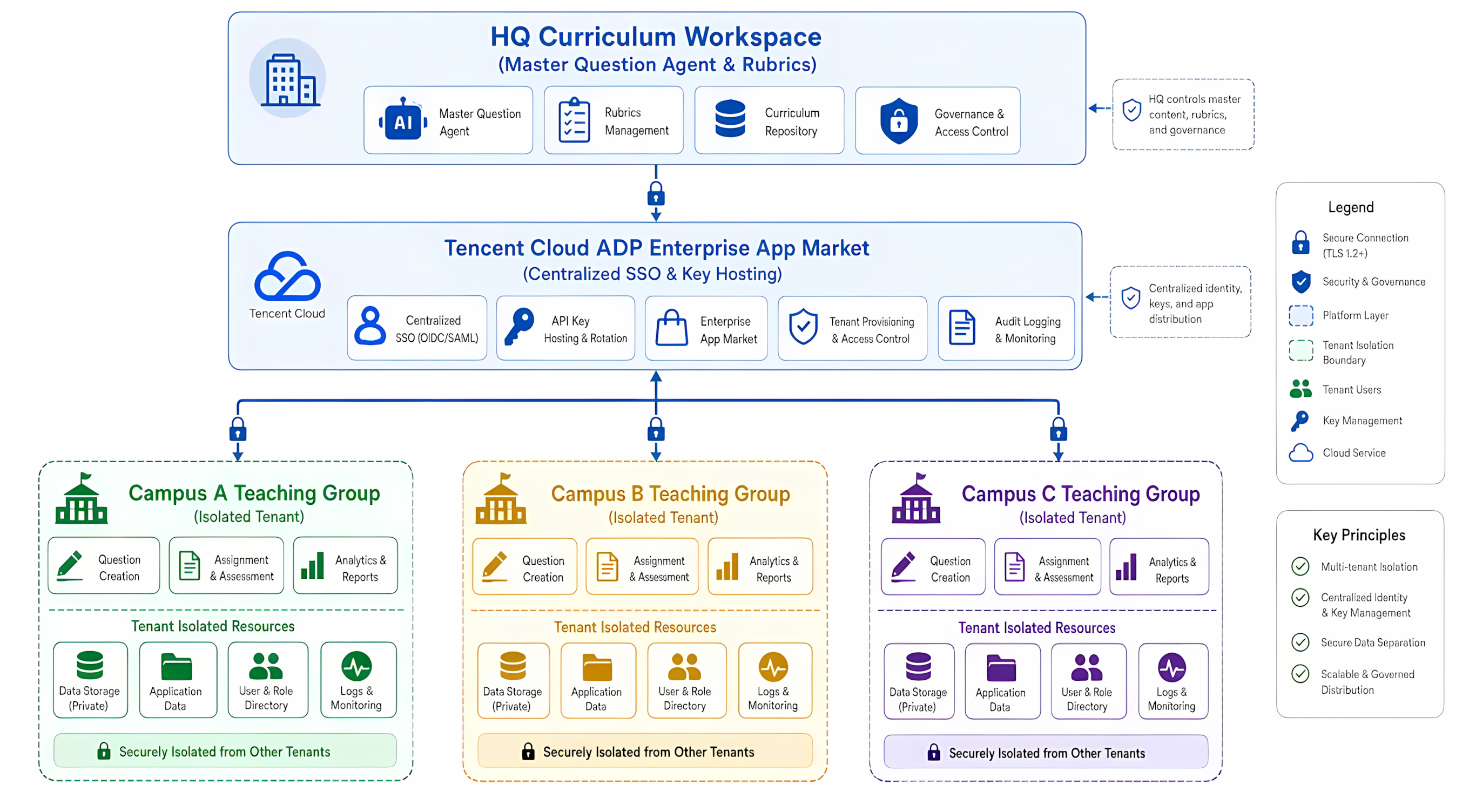
2. High-Level Architecture: The ADP Education Blueprint
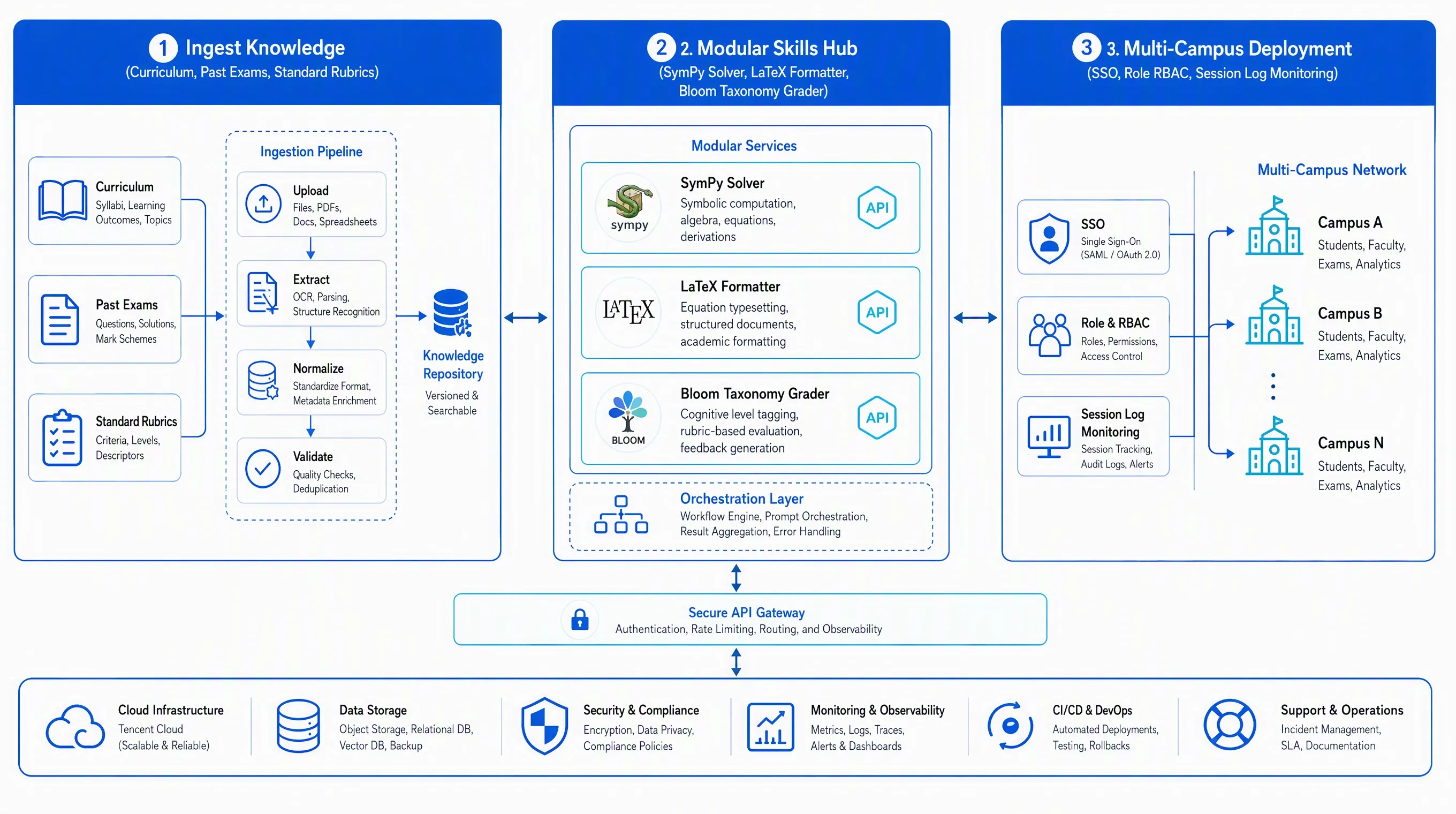
Tencent Cloud ADP provides an end-to-end framework spanning workspace data governance, model execution, sandbox processing, and enterprise downstream delivery:
3. Multi-Campus Dynamic Knowledge Base Architecture
To prevent curriculum drift while respecting regional variations, Tencent Cloud ADP organizes institutional knowledge through hierarchical Workspaces (Spaces) and role-governed document collections:
Knowledge Ingestion & Chunking Strategy
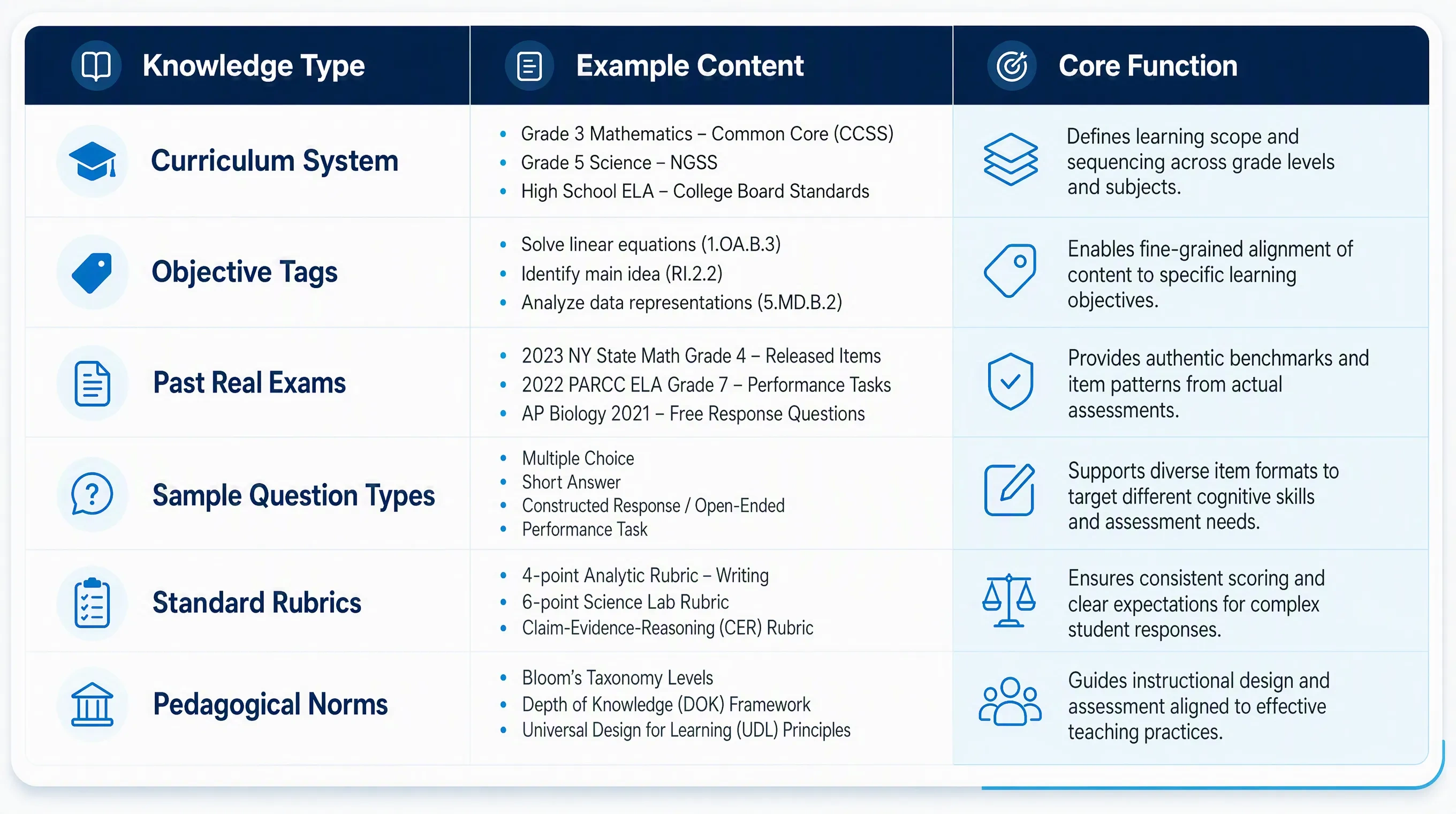
Assessment generation requires granular retrieval. ADP segments pedagogical documents using specialized semantic chunking rules:
| Content Type | File Formats | Chunking Strategy | Target Retrieval Entity |
|---|---|---|---|
| Syllabus Standards | PDF, Markdown, DOCX | Hierarchy-Aware (Header 1-3) | Individual Learning Objective (LO) |
| Historical Exam Items | JSON, QTI, Excel, PDF | Problem-Solution-Pair (Q&A Chunking) | Full item + Distractor Rationales |
| STEM Textbooks | LaTeX, PDF, EPUB | Semantic Section + Formula Block | Concept Proof + Theorem + Sample |
| Reading Passages | DOCX, TXT | Complete Text + Metadata Index | Lexile-Scored Narrative Chunk |
Teachers pass dynamic tags at runtime (Subject: Physics, Grade: 10, Standard: AP-Physics-1, Topic: Rotational-Kinematics) to retrieve the exact learning objectives and boundary constraints for that unit.
4. Composable Skill Hub: Routing Pedagogical Intent
Generic system prompts fail to capture diverse pedagogical workflows. ADP uses modular Skills attached to the assessment agent to handle specialized subtasks:
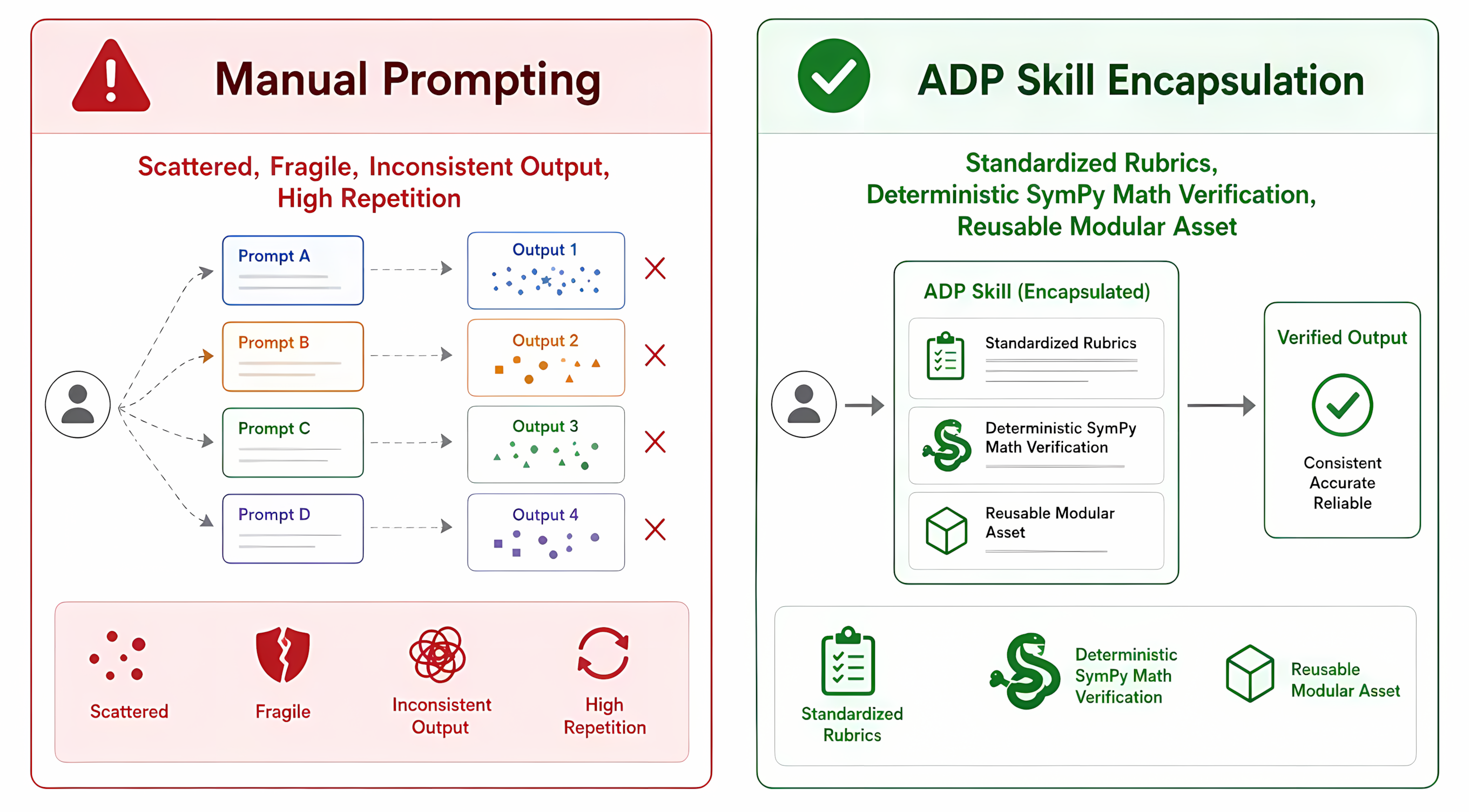
Skill 1: Bloom's Taxonomy Cognitive Calibrator
Calibrates prompt instructions based on target cognitive tiers:
- Remember / Understand: Focuses on direct definitions, unit conversions, and conceptual classification.
- Apply / Analyze: Generates multi-step scenario calculations, comparative tables, and error-identification questions.
- Evaluate / Create: Formulates experimental design prompts, hypothesis testing, and multi-variable synthesis problems.
Skill 2: STEM Equation & Proof Engine
Validates mathematical syntax before final generation. It outputs formulas formatted in valid LaTeX ($ ... $ for inline math and $$ ... $$ for display math) and computes the exact numerical step-by-step solution to ensure question solvability.
Skill 3: Distractor & Diagnostic Misconception Engine
Generates distractors (wrong answer choices) mapped directly to known student learning fallacies:
{
  "question_stem": "A 2.0 kg block accelerates down a frictionless 30° incline. What is its acceleration? (g = 9.8 m/s²)",
  "options": {
    "A": "4.9 m/s²",
    "B": "8.5 m/s²",
    "C": "9.8 m/s²",
    "D": "2.45 m/s²"
  },
  "correct_answer": "A",
  "diagnostic_rubric": {
    "A": "Correct application: a = g * sin(30°) = 4.9 m/s².",
    "B": "Misconception: Used cosine instead of sine (a = g * cos(30°)).",
    "C": "Misconception: Assumed free-fall acceleration ignoring the incline.",
    "D": "Misconception: Divided by mass twice or misapplied trigonometric ratio."
  }
}
5. Standardized Output Templating & Claw Sandbox Rendering
Education platforms require structured outputs ready for grading engines and print production. Tencent Cloud ADP provides Claw Mode, giving agents an isolated, secure Python execution sandbox to compile and validate assessment assets.
Sandbox Execution Workflow
- Deterministic Solution Verification: The agent writes a lightweight Python script in the sandbox using libraries like
sympyandnumpyto calculate the answer independently. If the code output does not match the LLM's initial answer key, the item is automatically corrected. - Dynamic Format Exporters: The sandbox converts validated JSON items into target formats: - Canvas / Moodle / Blackboard: Packaged into standard IMS QTI 2.1 XML archives. - Printable Exam Papers: Rendered into clean Microsoft Word (
.docx) files with standard institutional headers and space-allocated answer fields. - Online Testing Systems: Emitted as clean JSON schemas for direct REST API database insertion.
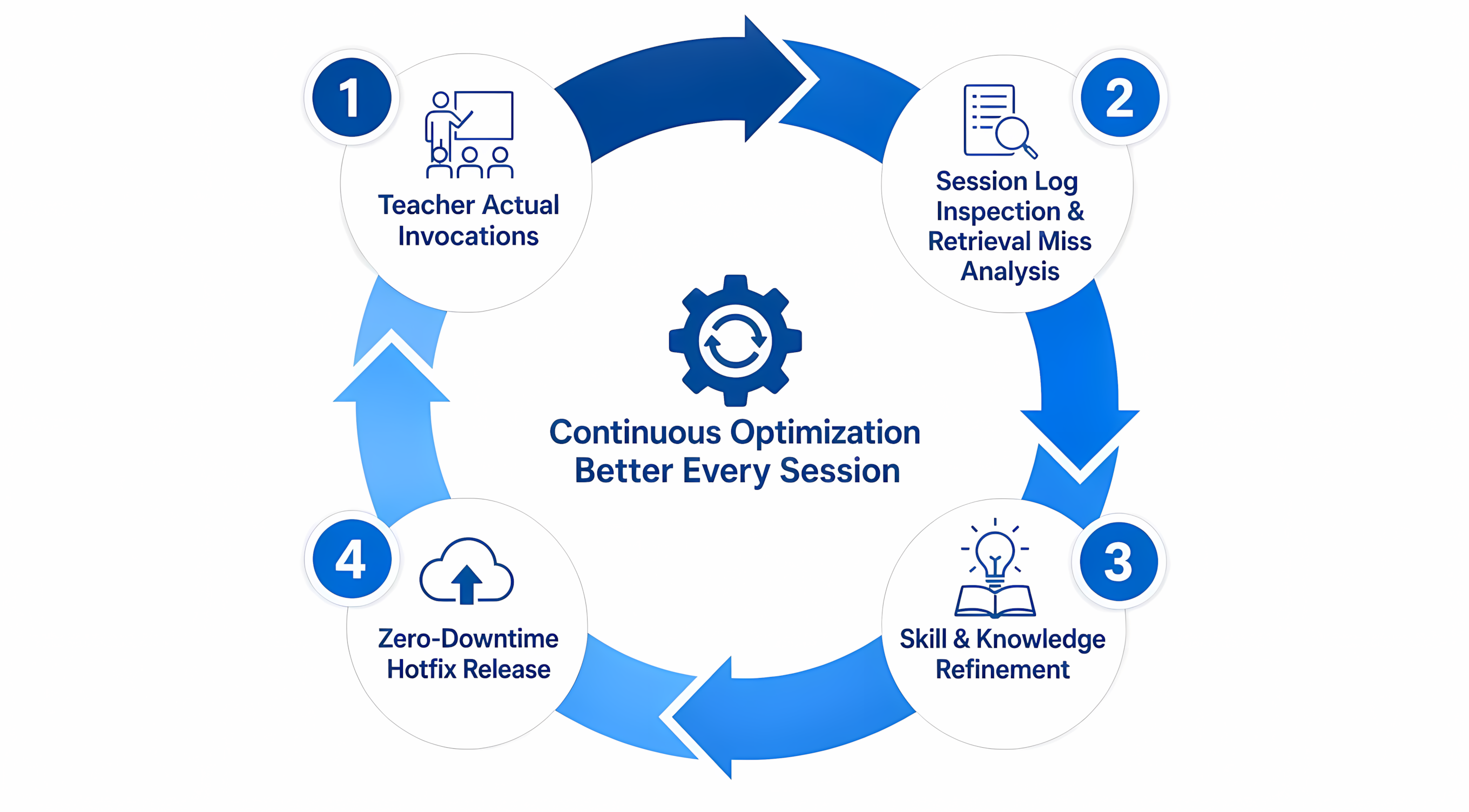
6. AgentOps, Multi-Agent Dual-Blind Evaluation & Guardrails
To prevent hallucinations, biased scenarios, or formatting errors in exams, ADP orchestrates a Dual-Agent Review Pipeline:
Reviewer Agent Audit Criteria
| Criterion | Evaluation Logic | Action on Fail |
|---|---|---|
| 1. Syllabus Alignment | Item tags must match retrieved curriculum standards and LO definitions. | Reject & Re-tag |
| 2. Solvability & Logic | Sandbox Python execution (SymPy) must confirm unique, deterministic solution. | Reject & Re-solve |
| 3. Distractor Balance | All 3 distractors must represent valid student misconceptions. | Flag & Refine |
| 4. Content Safety | Strict PII and bias filtering via Tencent Cloud Guardrails. | Drop & Alert |
| 5. Lexile / Grade Reading | Vocabulary and syntactic complexity verified against target grade level. | Adjust Text |
7. Production Implementation Guide & API Integration
Educational organizations integrate the question generation assistant with their Learning Management Systems (LMS) or internal teacher portals via Tencent Cloud ADP OpenAPI.
- Provision Workspaces: Set up isolated Spaces for group headquarters and regional campus clusters.
- Ingest Curricula: Upload core syllabi, pacing guides, and historical item taxonomies into enterprise RAG.
- Configure Agent & Skills: Create a Claw Mode App and bind Bloom's Taxonomy and STEM Math Skills.
- Activate Sandbox Exporters: Mount Python compilation scripts for QTI 2.1, Word (
.docx), and LaTeX exports. - Deploy Dual-Blind Pipeline: Set up the automated Reviewer Agent prompt and verification scoring criteria.
- Integrate Downstream: Connect Canvas/Moodle LMS and teacher portals via SSE streaming chat APIs.
Backend Integration Example (Python FastAPI / Async Streaming)
Below is an enterprise-ready implementation connecting a school portal to Tencent Cloud ADP's streaming chat endpoint:
import httpx
import json
from typing import AsyncGenerator

ADP_CHAT_ENDPOINT = "https://adp.tencentcloud.com/adp/v2/chat"
APP_KEY = "app-edu-question-assistant-xxxxxx"

async def stream_question_generation(
    subject: str,
    grade: str,
    topic: str,
    bloom_level: str,
    num_questions: int,
    user_id: str
) -> AsyncGenerator[str, None]:
    """
    Streams assessment generation requests to Tencent Cloud ADP runtime.
    """
    headers = {
        "Content-Type": "application/json",
        "Authorization": f"Bearer {APP_KEY}"
    }

    payload = {
        "user_id": user_id,
        "content": (
            f"Generate a {grade} {subject} assessment on '{topic}'. "
            f"Target Bloom's Level: {bloom_level}. Quantity: {num_questions}. "
            f"Include complete rubrics and diagnostic distractor rationales."
        ),
        "custom_variables": {
            "subject": subject,
            "grade_level": grade,
            "target_standard": "NGSS-2026",
            "output_format": "QTI-JSON"
        },
        "streaming": True
    }

    async with httpx.AsyncClient(timeout=60.0) as client:
        async with client.stream("POST", ADP_CHAT_ENDPOINT, json=payload, headers=headers) as response:
            if response.status_code != 200:
                yield json.dumps({"error": f"ADP Gateway Error: {response.status_code}"})
                return

            async for chunk in response.aiter_lines():
                if chunk.startswith("data:"):
                    raw_data = chunk[5:].strip()
                    if raw_data == "[DONE]":
                        break
                    yield raw_data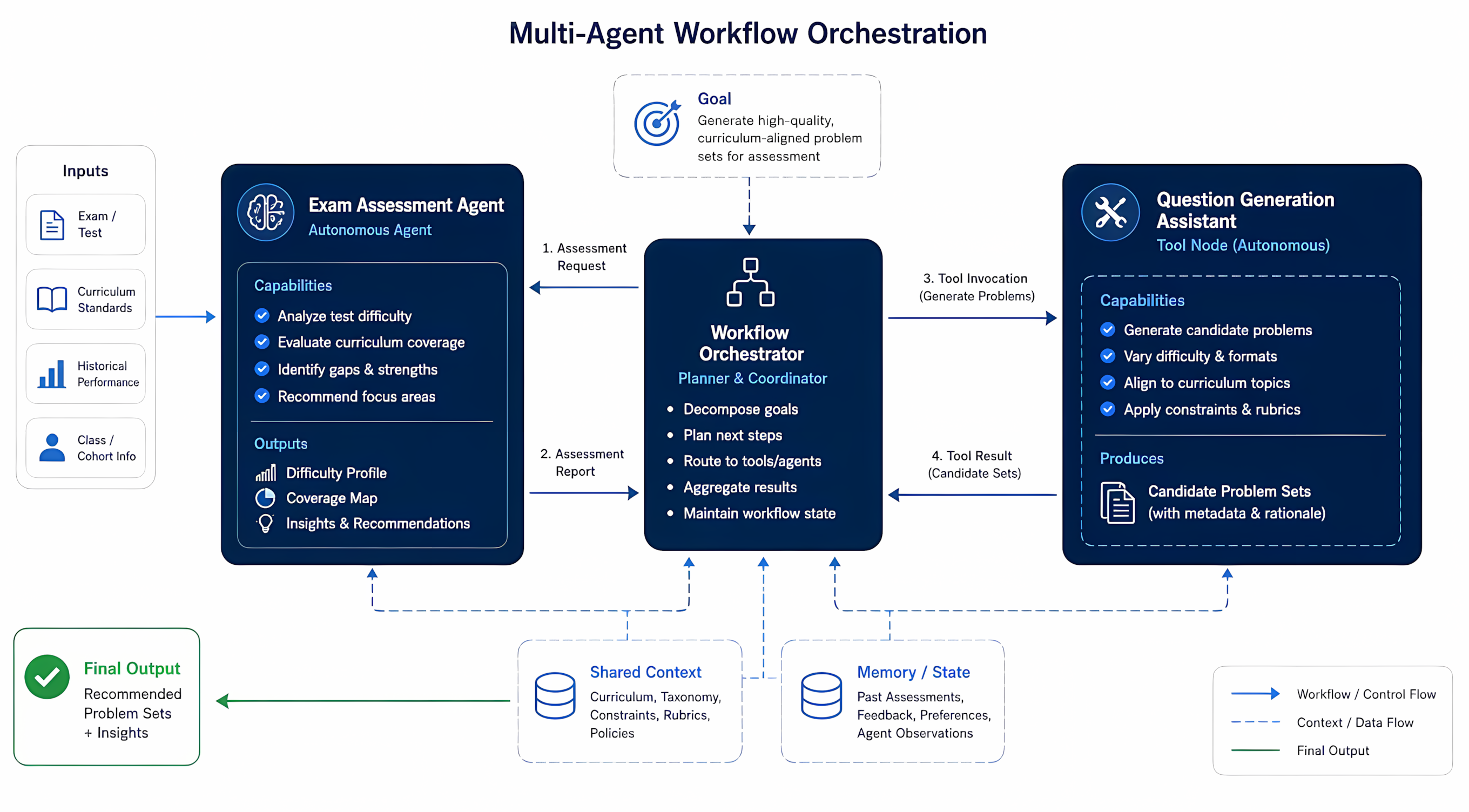
8. Real-World Case Study: Beacon Education Group
Institutional Profile
- Institution: Beacon International Education Group (18 K-12 campuses, 24,000+ students).
- Core Challenge: Preparing bi-weekly unified formative quizzes across campuses produced inconsistent difficulty, frequent mathematical formatting errors, and consumed over 700 aggregate teacher hours per cycle.
| Metric | Before ADP Deployment | With Tencent Cloud ADP |
|---|---|---|
| Standardized Exam Drafting Time | 4.2 hours per paper | 22 minutes per paper |
| Curriculum Standard Alignment Rate | 71.4% (Campus variance) | 99.4% (Strict RAG match) |
| Mathematical Formula Hallucination | 18.6% of generated stems | < 0.1% (Claw sandbox verification) |
| Format Conversion to LMS (QTI 2.1) | 45 mins manual entry/paper | Instant Automated Export |
| Educator Satisfaction Score | 52 / 100 | 94 / 100 |
| Annual Assessment Operational Savings | Baseline | $128,000 USD / year |
"The ability to produce an entire multi-tiered physics quiz with validated equations, complete distractor analysis, and direct QTI export in under twenty minutes transformed our curriculum team's weekly workflow."
— Senior Assessment Coordinator, Beacon Education Group
Enterprise FAQ
1. How does Tencent Cloud ADP ensure multi-campus student data privacy and compliance?
Tencent Cloud ADP supports strict tenant isolation via Workspaces (Spaces). The knowledge retrieval layer operates exclusively on instructional materials (syllabi, rubrics, item banks) without ingesting personally identifiable student information (PII). All API transactions use TLS 1.3 encryption and comply with global educational compliance standards.
2. Can individual campus branches customize their local exams without altering the group's global knowledge repository?
Yes. Campus-level teams operate within their own allocated Spaces with read permissions for the global curriculum repository and write permissions for campus-specific pacing documents. By setting the Allow Dynamic Configuration in Conversations option, individual teachers can toggle specialized skills and reference local pacing guides without triggering a platform-wide release cycle.
3. How does the system handle complex diagrams, chemical molecules, and geometric figures?
Tencent Cloud ADP Claw Sandbox includes automated rendering libraries. The agent generates structured geometric code (e.g., Python matplotlib or TikZ) within the sandbox, compiles the code into high-resolution SVG/PNG assets, and embeds them directly into the exported document or QTI package.
4. What models power the generation pipeline, and can we switch models dynamically?
The platform natively supports modern enterprise foundation models including the Tencent Hunyuan series (Hunyuan-Pro, Hunyuan-Turbo, Hunyuan Hy4 Preview) alongside advanced reasoning and coding models such as DeepSeek V4 Pro and GLM 5.3. Using ADP dynamic runtime variables, applications can route complex mathematical proof problems to high-parameter reasoning models while routing simple vocabulary quizzes to cost-efficient models.
5. How are teacher reviews incorporated before exams go live to students?
Tencent Cloud ADP implements a "Human-in-the-Loop" architecture. The dual-agent pipeline generates and verifies candidate item sets, which are then delivered to the teacher's portal dashboard. Teachers retain full editorial control to modify question stems, swap distractors, or approve final exports with a single click.
Conclusion & Next Steps
Building standardized, high-quality assessments no longer requires hundreds of manual authoring hours. By combining multi-campus dynamic knowledge bases, specialized pedagogical skills, sandbox execution, and automated multi-agent review, Tencent Cloud ADP provides educational institutions with an enterprise-ready AI assessment engine.
- Start Building on ADP: Visit the global platform at adp.tencentcloud.com
- Explore Enterprise Capabilities: Learn more at Tencent Cloud ADP Official Product Page
- Developer Documentation: Review the ADP Technical Documentation to launch your first assessment workflow.

Start building today
If you need more support, please contact us