
IDC Ranks Tencent Cloud ADP #1 in Media and Healthcare Agent Markets
IDC Market Share 2025 names Tencent Cloud ADP #1 in China media and healthcare agent platform markets, validating production-grade architectures over isolated PoCs.


Executive Summary
Over the past two years, the enterprise AI conversation has fundamentally shifted. Organizations have moved past the initial novelty of open-ended conversational chatbots and standalone proof-of-concept (PoC) experiments. Today, technical leaders and enterprise decision-makers evaluate AI through a rigorous operational lens: Can the agent integrate into core customer service systems? Can it reliably retrieve facts from hundreds of thousands of complex technical documents without hallucinating? Can it automate cross-system workflows under strict data privacy and access governance?
In June 2025, premier global market intelligence firm IDC released its benchmark study: Market Share of China AI Agent Development Platforms, 2025. Marking the industry's first comprehensive market share assessment for AI agent development platforms, the report introduced dedicated sub-market rankings for two of the most demanding enterprise sectors: Media and Healthcare & Life Sciences.

Tencent Cloud Agent Development Platform (ADP) captured the #1 market share in both industry sub-markets, claiming:
- 19.1% market share in the Media sector, ranking First.
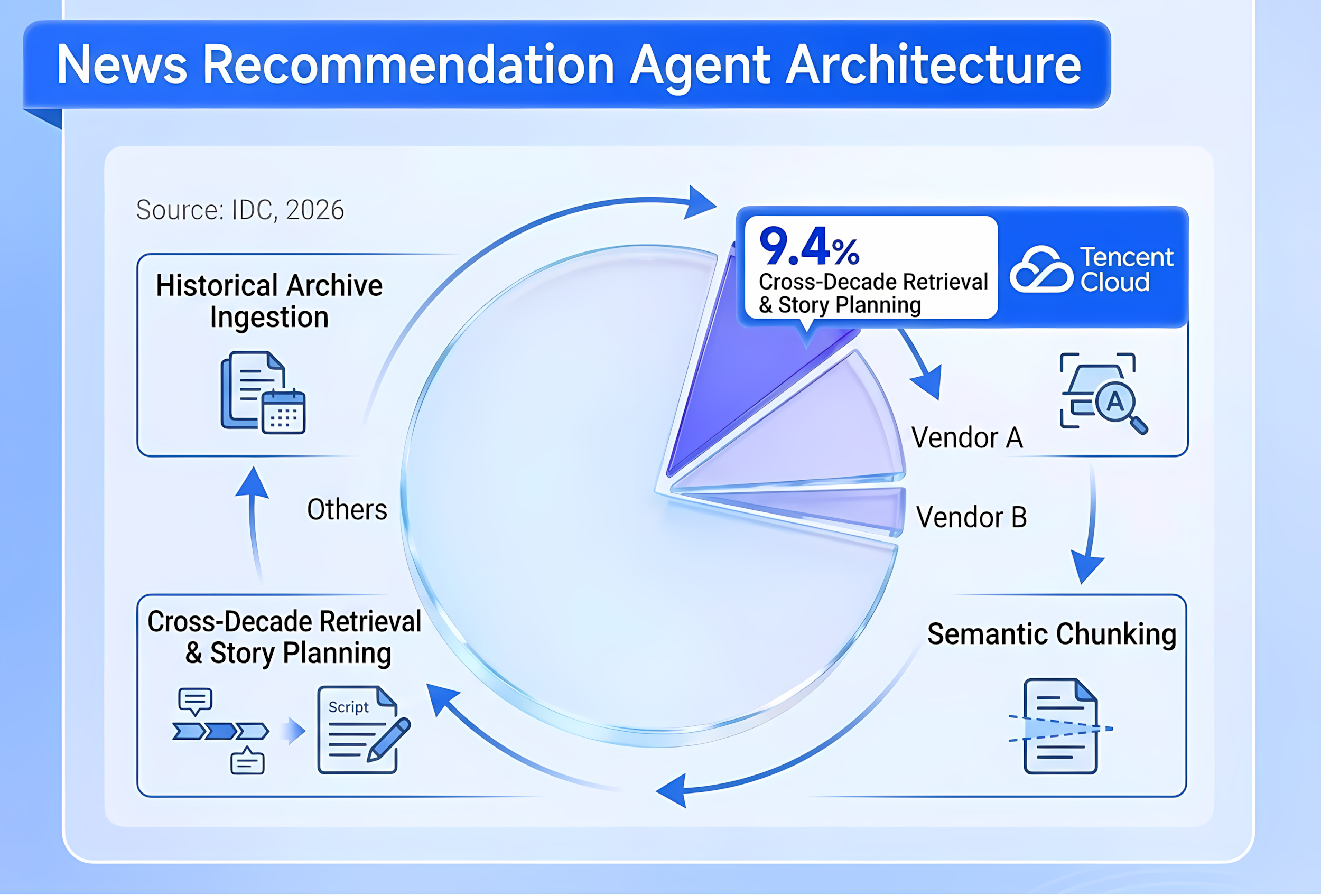
- 9.4% market share in Healthcare & Life Sciences, ranking First.
This recognition underscores a vital industry milestone: enterprise AI transformation has officially graduated from exploratory demos into mission-critical production workflows. For CTOs, Chief Data Officers, and digital transformation executives, succeeding in this phase requires moving beyond single-turn prompt engineering toward a unified AgentOps platform that orchestrates knowledge, multi-paradigm agents, system integrations, automated benchmarking, and full-lifecycle governance.
Key Takeaways
- Production-Grade Adoption Outpaces Demos: Enterprise procurement now demands verifiable business ROI, reliable cross-system execution, multi-turn state persistence, and enterprise-grade compliance rather than standalone LLM chat capabilities.
- Top Rankings in High-Barrier Verticals: Tencent Cloud ADP clinched the #1 market position in Media (19.1%) and Healthcare (9.4%), proving platform resilience across scenarios characterized by fragmented knowledge, complex media assets, and strict regulatory compliance.
- Proven Real-World Velocity: Over 50% of China's leading cultural and media institutions have deployed agent workbenches on Tencent Cloud ADP. In the media sector alone, client scale grew 13x and deployed production agents surged 25x year-over-year, driving an average 70% efficiency surge in core planning and content creation phases.
- Multi-Paradigm Agent Construction: ADP accommodates heterogeneous business needs by supporting four distinct build paradigms: Standard LLM + RAG, Workflow orchestration, Multi-Agent collaboration, and the isolated Sandbox Claw Mode.
- Comprehensive AgentOps Governance: Enterprise scaling demands a robust Cloud Agent Harness architecture featuring long-running execution resumption, distributed tracing, automated regression benchmarks, fine-grained access control lists (ACLs), and versatile deployment models across public, dedicated, hybrid, and private clouds.
The Paradigm Shift: From Isolated AI Demos to Production Workflows
When large language models (LLMs) first emerged in enterprise IT roadmaps, adoption was largely confined to single-point capabilities: document summarization, copy rewriting, and open-ended Q&A. However, when enterprises attempted to scale these pilots into operational departments, they hit severe production bottlenecks.
In a genuine enterprise operating environment, an AI agent must handle interconnected responsibilities:
- Dynamic Knowledge Access: Ingest and index multi-format documents, unstructured knowledge bases, relational data warehouses, and streaming operational logs.
- Deterministic System Execution: Trigger authenticated REST APIs, microservices, internal workflows, enterprise ERP/CRM connectors, and third-party tools.
- Contextual Task Decomposition: Parse complex natural language goals into structured sub-tasks, execute deterministic fallback loops, and maintain multi-turn execution states.
- Multi-Role & Sub-Agent Collaboration: Coordinate specialized agents across editorial desks, clinical review boards, customer service teams, and IT compliance units.
- Continuous Governance & Observability: Subject every tool invocation, context retrieval, and output generation to real-time risk filtering, granular audit trails, and automated benchmark scoring.
Tencent Cloud ADP bridges the chasm between raw foundation models and mission-critical enterprise infrastructure, providing the operational runtime that makes AI agents reliable, auditable, and production-ready.
High-Barrier Sector Deep Dives
The Media and Healthcare & Life Sciences industries serve as prime validation grounds for enterprise AI agents. Both sectors possess massive, siloed data repositories, demanding operational standards, and zero tolerance for uncontrolled hallucinations.
1. Media Industry: Unlocking Massive Digital Content Assets and Production Workflows
Media organizations sit on decades of unstructured news reports, multi-track audio recordings, high-definition video footage, editorial archives, and compliance logs. Historically, retrieving historical context relied on rudimentary keyword matching, which failed to interpret semantic context, journalistic themes, or multi-modal cues.
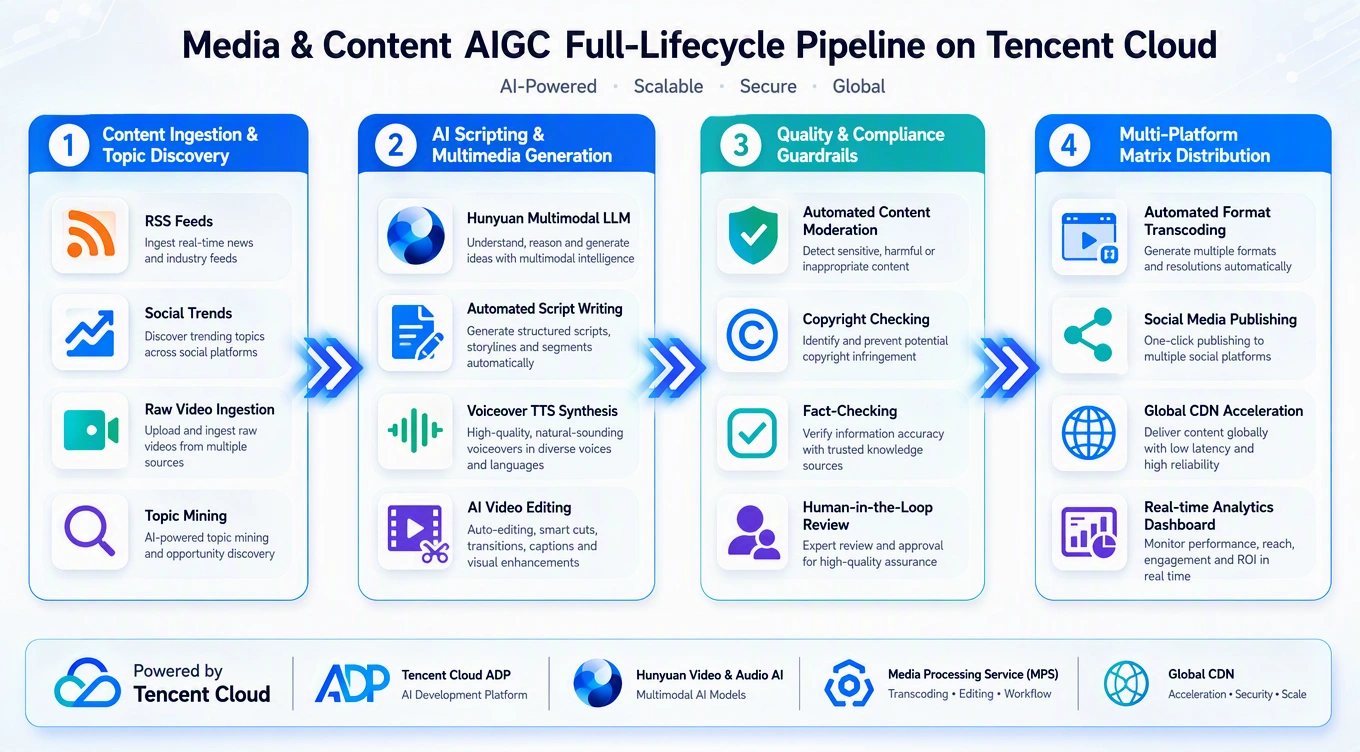
Tencent Cloud ADP provides media institutions with an end-to-end AIGC and agent pipeline covering the complete editorial cycle: Plan, Gather, Edit, Review, Create, and Distribute.
| Media Organization | Deployment Scenario | Core Technical Capabilities on ADP | Quantified Business Impact |
|---|---|---|---|
| CPPCC Daily | News Recommendation & Editorial Research Agent | High-capacity document parsing, semantic chunking, multi-dimensional relational indexing across decades of historical reporting. | Transformed passive news archives into proactive editorial intelligence; instant context matching across historical reports, research briefs, and conference transcripts. |
| China News Service | Global AIGC Multi-Agent Platform | Dedicated proprietary journalistic corpus, dynamic safety guardrails, multilingual translation, news drafting, and automated manuscript critique. | Standardized global multilingual reporting workflows; embedded strict risk control and stylistic alignment across editorial desks. |
| Guangdong Radio & TV | Live Sports Event Multi-Modal Video Production | Chained workflow automating live broadcast recording, automated athlete/subject recognition, timestamp clipping, and highlight reel compilation. | 40% acceleration in overall production workflow; autonomously produced 100+ viral video highlights during the National Games. |
| Sichuan Cultural Big Data | Cultural Vertical Agent Infrastructure | Semantic structuring of cultural heritage data, automated multimedia storytelling, and vertical agent generation. | Digitized and activated regional intangible cultural heritage and museum assets for interactive public tourism services. |
Media Workflow Automation in Practice
At Guangdong Radio & Television, producing highlight reels for fast-paced sporting events previously required video editors to manually scrub through hours of footage, log player timestamps, cut clips, overlay captions, and export rendered files.
By deploying an event-driven ADP Workflow Agent, the broadcaster chained live video stream ingestion, automated OCR and facial recognition nodes, dynamic audio spike detection (crowd cheering triggers), and automated video clipping APIs into a continuous pipeline. As a result, production turnaround dropped by 40%, publishing viral clips to social media channels within minutes of on-court action.
2. Healthcare & Life Sciences: Precision Knowledge, Strict Compliance, and Stable Runtime
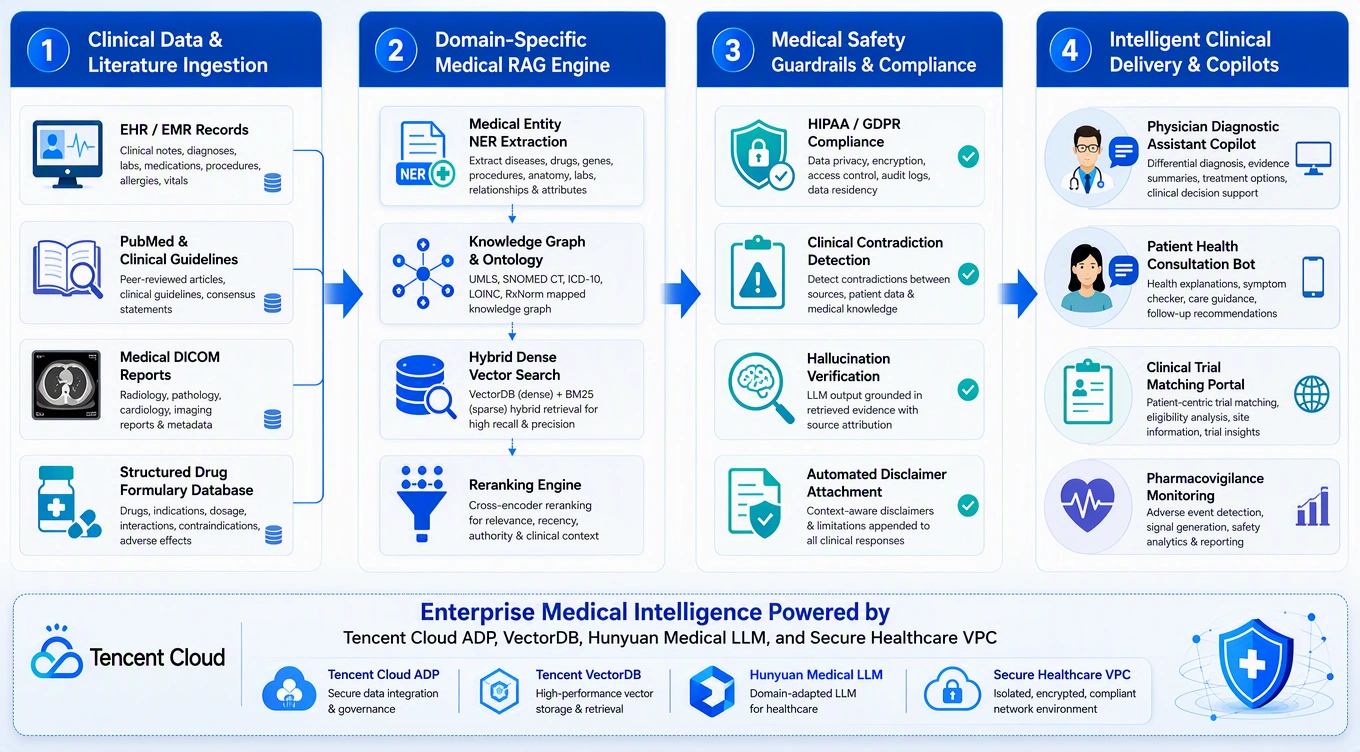
In healthcare, life sciences, and clinical diagnostics, hallucinations are unacceptable. Systems must navigate clinical guidelines, drug formularies, complex medical equipment schematics, and sensitive Electronic Health Records (EHR) under stringent regulatory compliance.
Tencent Health, powered by the Tencent Cloud ADP foundation, provides specialized agent capabilities across clinical decision support, pharmaceutical research, medical device maintenance, and primary care patient lifecycle management.
Production Healthcare Case Studies
- Mindray Medical: Global Intelligent Knowledge Hub
- Challenge: Mindray supports complex medical devices installed in medical institutions across 190+ countries and regions. Field engineers and hospital technicians require 24/7 technical answers across hundreds of hardware models, firmware versions, and technical bulletins.
- Solution on ADP: Mindray built an enterprise knowledge hub consolidating over 400 GB of technical service manuals, circuit diagrams, and troubleshooting procedures across 500+ device variants. ADP implemented multi-pass hybrid retrieval, strict model metadata filtering, and citation verification.
- Outcome: The agent integrates seamlessly with PC portals, WeChat, and customer support call centers, delivering an answer accuracy rate exceeding 85% with precise, verifiable source document citations.
- Sansure Biotech : Primary Care Patient Lifecycle Platform
- Challenge: Community clinics and grassroots medical institutions often struggle with limited specialist staffing and disconnected post-diagnosis patient follow-up.
- Solution on ADP: Developed an integrated platform combining "rapid point-of-care testing (POCT) + AI private domain operations." The agent provides automated health coaching, chronic disease follow-up reminders, and dietary guidance tailored to patient test results.
- Outcome: Enabled primary clinics to transition from one-off point-of-care consultations into continuous, full-lifecycle family health management centers.
- Huayinkan PathClaw : Democratizing Pan-Cancer Pathology Diagnostics
- Challenge: Pathological diagnosis is critical for cancer staging, yet expert pathologists are severely concentrated in top-tier metropolitan hospitals.
- Solution on ADP: Huayinkan encapsulated its proprietary pan-cancer pathology AI foundation model into an ADP Reusable Skill.
- Outcome: Pathologists at county-level hospitals can invoke the PathClaw Skill directly within their diagnostic workflows, receiving real-time lesion segmentation and diagnostic decision support without maintaining local GPU clusters.
The 4-Step Enterprise AI Transformation Blueprint
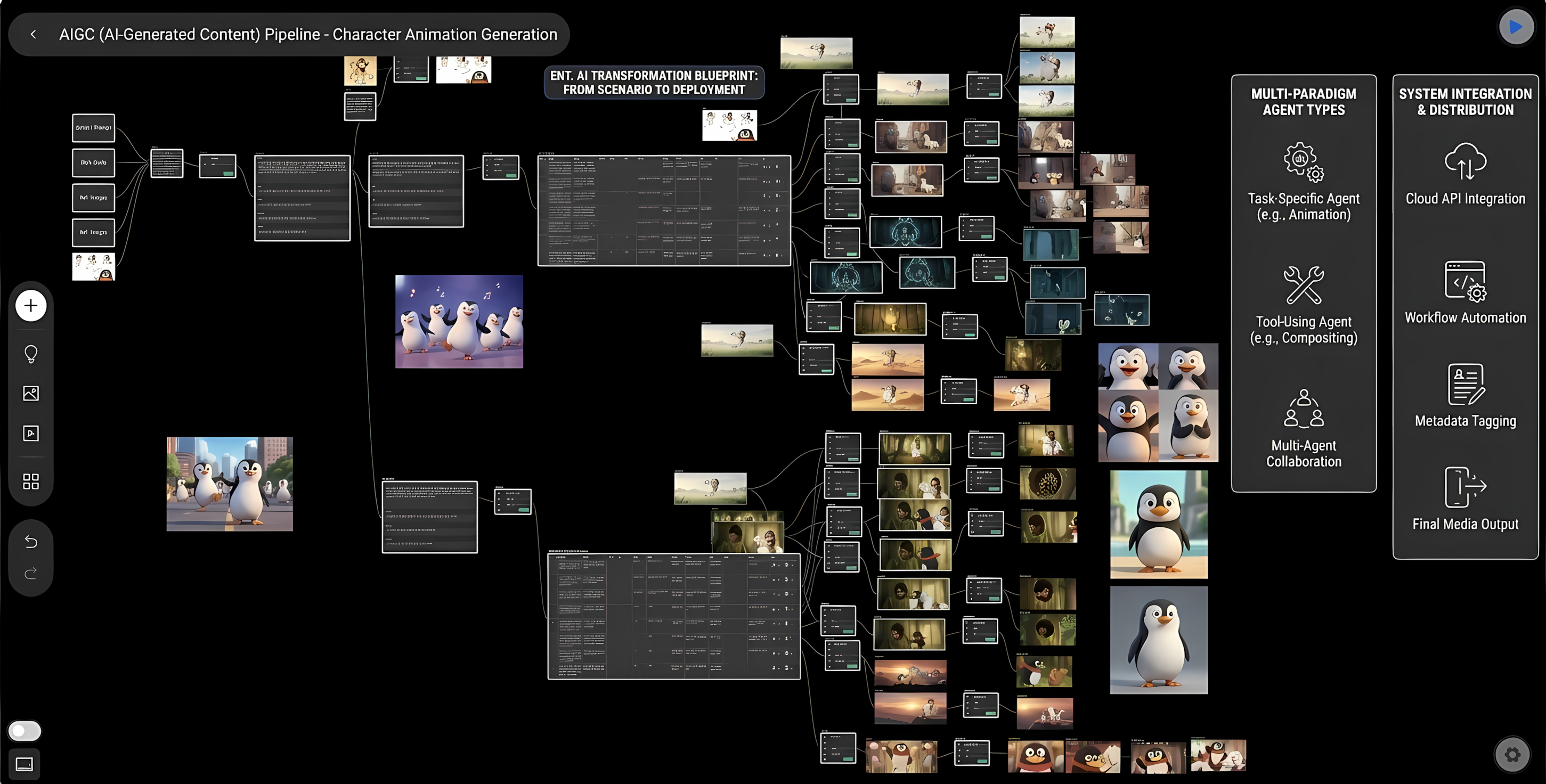
Drawing from hundreds of production rollouts across media, healthcare, finance, retail, and manufacturing, Tencent Cloud ADP advocates a battle-tested four-step implementation blueprint:
Step 1: High-Value Scenario Selection
Enterprises should avoid unfocused, organization-wide experiments. Instead, prioritize scenarios characterized by three criteria: knowledge density, structured operational rules, and quantifiable ROI metrics.
- Ideal Starters: Internal technical support, news research & recommendation, pharmaceutical literature Q&A, after-sales ticket dispatching, customer service operations, and standard regulatory compliance checks.
Step 2: Constructing the Enterprise RAG Knowledge Base
Raw documents are rarely AI-ready. ADP's advanced knowledge base engine provides:
- Multimodal OCR & Document Parsing: Advanced parsing for 26+ document formats (PDF, DOCX, XLSX, scanned images, CAD metadata), accurately reconstructing complex nested tables, headers, and footnotes.
- Hierarchical Semantic Chunking: Splits content by logical headings and semantic boundaries rather than arbitrary character counts, preserving technical context.
- Hybrid Retrieval & Reranking: Combines sparse lexical matching (BM25), dense vector embeddings, metadata pre-filtering (model, version, department permissions), and semantic reranking models to eliminate irrelevant noise.
Step 3: Multi-Paradigm Agent Construction
Different enterprise tasks demand different execution architectures. ADP offers four distinct construction modes:
| Paradigm Mode | Architecture Characteristics | Best Suited Enterprise Scenarios |
|---|---|---|
| Standard Mode (LLM + RAG) | Single-agent query routing against indexed enterprise knowledge bases. | Internal employee HR/IT FAQs, product documentation lookup, compliance policy Q&A. |
| Workflow Mode | Deterministic directed acyclic graph (DAG) execution with programmatic node fallbacks, conditions, and parallel branches. | Multi-step approval flows, financial invoice reconciliation, automated video clipping pipelines. |
| Multi-Agent Mode | Specialized sub-agents collaborating under a master dispatcher agent with role-based prompt personas. | Complex market research, multi-angle code reviews, collaborative editorial planning. |
| Claw Mode | Session-isolated cloud sandbox execution environment with Python code execution, file generation, and dynamic tool binding. | Deep data analysis, automated spreadsheet/PPT generation, autonomous web research, complex API orchestration. |
Step 4: Enterprise System Integration & Omnichannel Delivery
An AI agent achieves business value only when embedded directly into everyday user workflows:
- Enterprise Integrations: Connect downstream systems using ADP REST/WebSocket APIs, Model Context Protocol (MCP) servers, or pre-built enterprise connectors (ERP, CRM, Jira, SAP, OA).
- Omnichannel Distribution: Deploy agents with a single click to enterprise collaboration hubs including WeCom, WeChat Official Accounts/Mini Programs, DingTalk, Web embeds, and custom Agent Portals.
Full-Lifecycle AgentOps Platform: From Development to Enterprise Governance
Deploying a single agent is an engineering achievement; managing hundreds of agents across diverse enterprise business units is an operational challenge. Tencent Cloud ADP delivers an end-to-end AgentOps infrastructure engineered for stability, security, and scalability.
1. Cloud Agent Harness Runtime
At the core of ADP is the Cloud Agent Harness, an enterprise-grade execution layer that governs agent lifecycles:
- Long-Running Execution Resumption: Stateful checkpoints allow long-running agent tasks to pause, wait for external human approvals or async webhooks, and resume without losing session memory.
- Isolated Execution Sandboxes: Ensures dynamic code execution, file generation, and third-party plugin calls run in secure, isolated containers with zero cross-tenant contamination.
- Dynamic Resource Scheduling: Autonomously balances model inference concurrency, token consumption, and rate limits to minimize operational infrastructure costs.
2. Automated Benchmarking & Evaluation
Before promoting an agent version from staging to production, ADP's evaluation engine tests candidate versions against standardized "Golden Datasets":
- Measures retrieval recall, context relevancy, answer faithfulness, and hallucination rates.
- Enables side-by-side A/B testing between foundation models to balance performance against inference costs.
3. Comprehensive Security, Privacy, and Deployment Flexibility
- Safety & Compliance Guardrails: Real-time interception of prompt injections, sensitive enterprise PII masking, and multi-layer content moderation.
- Deployment Topology Options: Available on Public Cloud, Dedicated Cloud (VPC), Hybrid Cloud, and Air-Gapped Private Cloud Deployments to comply with regional healthcare, banking, and government data sovereignty mandates.
Enterprise FAQ
Q1: Why should enterprises invest in a dedicated Agent Platform instead of writing custom code with open-source frameworks?
Open-source frameworks provide basic building blocks for prototypes, but enterprise production requires significantly more: multi-tenant access control, multimodal document parsing engines, safe sandbox execution environments, stateful session persistence, versioned releases, security compliance guardrails, and distributed tracing. Building and maintaining these operational capabilities in-house introduces immense technical debt. Tencent Cloud ADP provides a fully managed, enterprise-grade AgentOps foundation out of the box, allowing engineering teams to focus exclusively on business logic.
Q2: What foundation models does Tencent Cloud ADP support? Can enterprises bring their own models?
Tencent Cloud ADP provides native access to Tencent's Hunyuan model family alongside top-tier open and commercial foundation models. Additionally, enterprises can seamlessly integrate their proprietary fine-tuned LLMs hosted on Tencent Cloud TI Platform or external private endpoints via standard API adapters.
Q3: How does Tencent Cloud ADP ensure data privacy and compliance in healthcare?
ADP enforces strict data isolation at the tenant, workspace (Space), and knowledge base levels. Enterprise documents uploaded for RAG indexing are encrypted at rest (AES-256) and in transit (TLS 1.3). Proprietary enterprise data is never used to train or fine-tune public foundation models. For highly regulated industries, ADP supports private on-premises and hybrid cloud deployments where data never leaves the corporate boundary.
Q4: What is the difference between ADP Workflow Mode and Claw Mode?
- Workflow Mode is deterministic: developers visually design the exact execution graph (DAG), specifying conditions, branches, and API call sequences. It is ideal for standardized, compliance-heavy business processes where predictable execution is mandatory.
- Claw Mode is autonomous: the agent operates inside a secure, isolated cloud sandbox, dynamically reasoning, writing code, executing scripts, creating files, and calling tools on the fly to solve open-ended analytical problems.
Q5: How do enterprises measure ROI after deploying AI agents on ADP?
Enterprises measure ROI across three core dimensions:
- Operational Efficiency: Reduction in manual processing time (e.g., Guangdong TV's 40% speedup in video compilation; media planning efficiency surging by ~70%).
- Deflection & Resolution Rates: Percentage of incoming inquiries resolved autonomously without human intervention (e.g., achieving 60%+ ticket deflection with 85%+ accuracy in medical device support).
- Asset Activation: Conversion of dormant unstructured archives into accessible, queryable business intelligence.
Summary & Next Steps: Accelerate Your Enterprise AI Journey
The findings of the IDC 2025 Market Share report are definitive: the competitive advantage in enterprise AI no longer belongs to those who merely experiment with LLMs, but to those who operationalize intelligent agents across core business workflows.
By combining multi-paradigm agent architectures, industry-leading multimodal RAG, and an end-to-end AgentOps governance platform, Tencent Cloud ADP empowers global organizations to build, benchmark, deploy, and scale enterprise AI agents with confidence.
Ready to Build Production-Grade Enterprise AI Agents?
- Global Enterprise Portal: Explore architectural blueprints, product documentation, and interactive demos at Tencent Cloud ADP International Portal.
- Product Overview & Console Access: Get started with enterprise workspaces and solutions on the Tencent Cloud Official ADP Product Center.
- Request a Solutions Consultation: Connect with Tencent Cloud Solutions Architects to tailor an AI agent implementation blueprint for your organization.

Start building today
If you need more support, please contact us