
From Demo to Production: Medical Device After-Sales Agent Practice
Explore how Tencent Cloud ADP deployed a production-grade after-sales AI agent across 860K technical documents, delivering 93%+ accuracy and 60%+ ticket deflection.


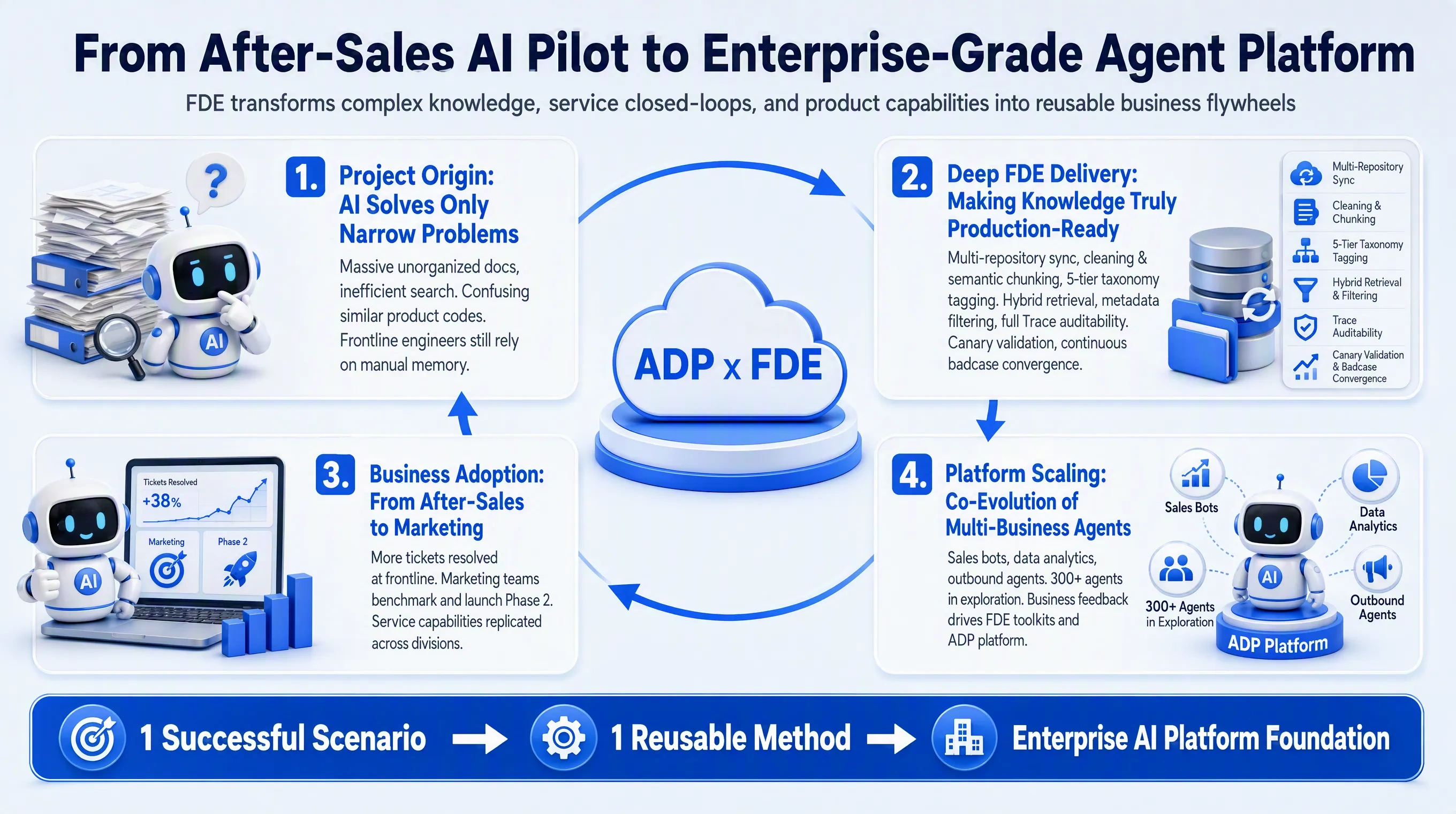
Executive Summary
Across the enterprise technology landscape, hundreds of AI agent initiatives remain trapped in the "Proof of Concept (PoC) chasm." In a sandboxed demonstration with curated questions, an LLM-powered assistant appears remarkably capable. Yet once deployed to real-world operational frontlines, system performance rapidly degrades: retrieval accuracy hovers around 60%, dense alphanumeric device model numbers are conflated, citation trails are missing, hallucinations emerge on out-of-boundary questions, and front-line service engineers abandon the tool in frustration.
Medical device after-sales service represents one of the most demanding proving grounds for enterprise AI. It combines mission-critical equipment safety, strict regulatory compliance, massive multi-source documentation, complex many-to-many model taxonomies, and continuous firmware updates. In this environment, generic chatbots and naive RAG pipelines inevitably fail.
This technical case study examines how Tencent Cloud Agent Development Platform (ADP) partnered with Project M (a global medical technology leader serving 190+ countries, 110,000+ medical institutions, and 99%+ of top-tier tertiary hospitals) to deploy a production-grade after-sales AI agent. By ingesting over 860,000 technical documents (400+ GB) across 500+ device models, implementing dynamic metadata filtering, multi-way hybrid RAG, Agentic RAG diagnostic workflows, and closed-loop ALHF (Agent Learning from Human Feedback), the joint engineering team transformed a fragile 60%-accuracy prototype into a 24/7 production engine delivering 93%+ diagnostic accuracy, sub-second retrieval, and 60%+ automated ticket deflection across 30,000+ monthly interactions.
Key Takeaways
- The PoC-to-Production Chasm: Why naive vector-based RAG collapses when scaling across 500+ similar hardware models and 860,000 heterogeneous engineering documents.
- Hierarchical Knowledge Structuring: Converting 400 GB of multi-format service files into an organized 5-tier taxonomy to eliminate unstructured noise.
- Dynamic Metadata Filtering: Extracting structured entities (model ID, craft code, market region) before vector search, shrinking the search space by 99.9% and preventing cross-model hallucinations.
- Multi-Route Hybrid & Agentic RAG: Combining dense embeddings, BM25 sparse matching, golden QA pairs, cross-modal schematics, and Reciprocal Rank Fusion (RRF) with multi-step recursive reasoning.
- Closed-Loop ALHF Governance: Implementing a 3-day badcase SLA that converts user feedback (thumbs up/down, human agent handoffs) into automated regression test suites.
- Enterprise-Wide Scaling Flywheel: How a successful after-sales pilot ignited the organic rollout of 300+ specialized enterprise agents across PLM, marketing, ITR (Issue-to-Resolution), and LTC (Lead-to-Cash).
1. The 5 Core Bottlenecks in Medical Device Technical Support
Medical equipment maintenance cannot tolerate approximations. A wrong torque specification on an ultrasound probe, an outdated circuit schematic for an anesthesia ventilator, or a misplaced firmware patch can disrupt critical clinical care or violate stringent medical compliance standards.
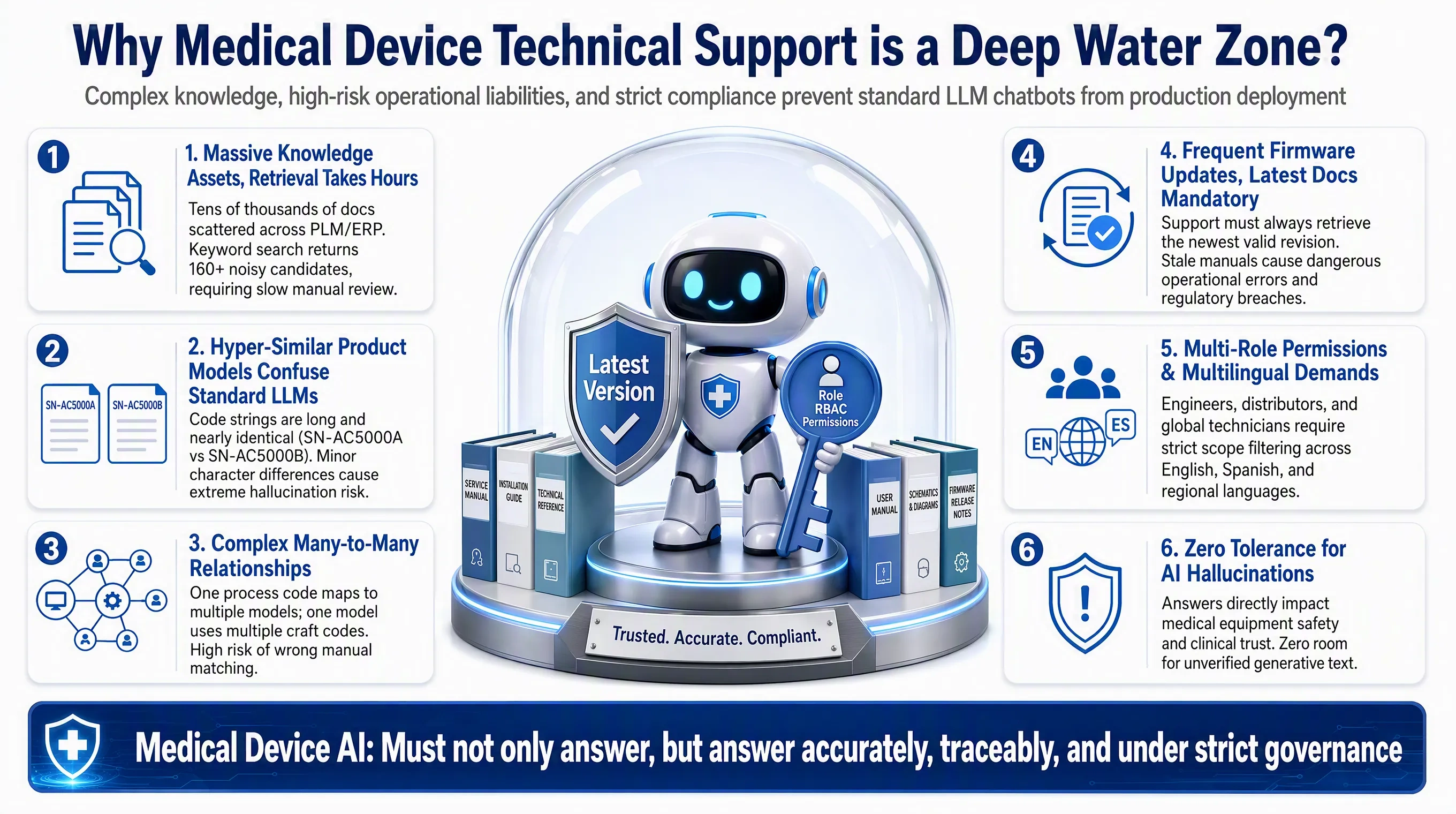
During early exploratory phases, traditional search engines and standard RAG implementations collapsed under five fundamental domain bottlenecks:
1. Massive Heterogeneous Knowledge Assets (860K+ Files, 400+ GB)
Over 860,000 technical files spanning 10+ file formats (PDF service manuals, Excel engineering BOMs, ZIP firmware release packages, technical change notices, diagnostic flowcharts, and field case videos) were scattered across disparate internal platforms. Generic keyword search engines returned over 160+ noisy candidates per query, forcing field engineers to manually sift through pages of irrelevant documentation.
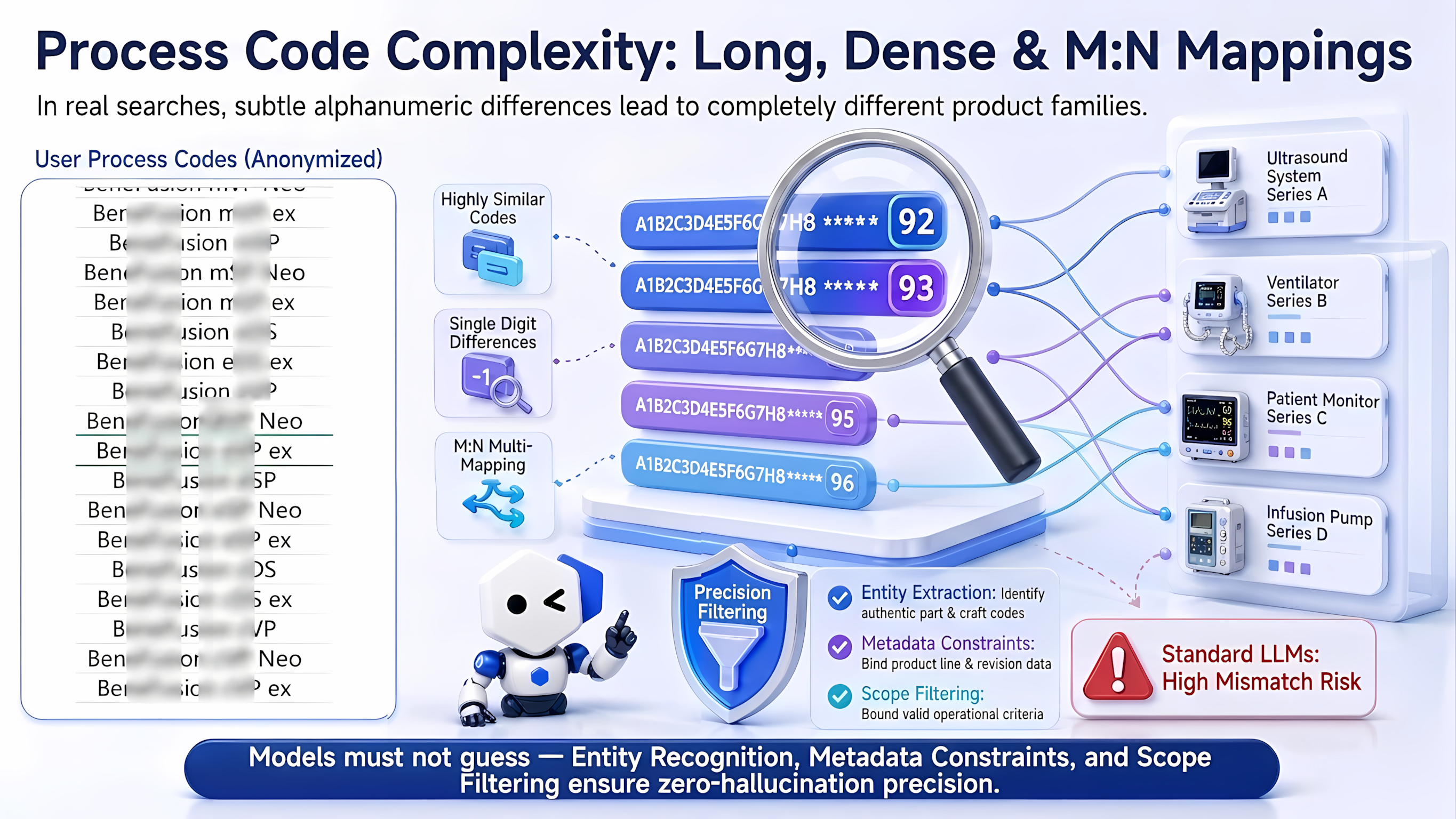
2. Hyper-Similar Alphanumeric Model Serial Strings
Medical devices feature long, dense alphanumeric model codes (e.g., Mindray-MX7-Pro-V2 vs Mindray-MX7-Plus-V1 vs Mindray-M7-Advanced). Standard LLM tokenizers split these strings unpredictably, obscuring critical sub-model distinctions and leading models to retrieve repair procedures for adjacent, incompatible hardware revisions.
3. Complex Many-to-Many (m:n) Entity Mappings
Manufacturing process/craft codes and commercial product models do not follow a simple 1:1 hierarchy. A single craft code can apply across multiple commercial models, while a single model may encompass multiple internal craft revisions. When technicians query by hardware board revision, naive retrieval systems fail to resolve the correct equipment architecture.
4. Continuous Firmware & Manual Versioning
Medical hardware and embedded software undergo frequent engineering changes (ECNs/ECRs). Service technicians must strictly operate against the latest active revision. In unmanaged vector stores, historical and deprecated documentation dilutes search scores, risking the recall of obsolete maintenance protocols.
5. Multi-Role, Multilingual & Zero-Hallucination Compliance
Field support involves diverse stakeholders (internal R&D experts, certified field engineers, third-party distributors, and hospital biomedical staff) operating across global regions in Chinese, English, Spanish, and Portuguese. Furthermore, because recommendations directly impact clinical device availability, probabilistic hallucinations and unverified assumptions are strictly unacceptable.
2. The 5-Stage FDE (Forward Deployed Engineering) Production Implementation Path
To bridge the 100-step chasm between a fragile prototype and an enterprise-grade production platform, Tencent Cloud deployed its Forward Deployed Engineering (FDE) methodology. Rather than delivering custom one-off scripts, the ADP FDE approach establishes standardized knowledge engineering, hybrid retrieval pipelines, and operational governance mechanisms directly within the platform.
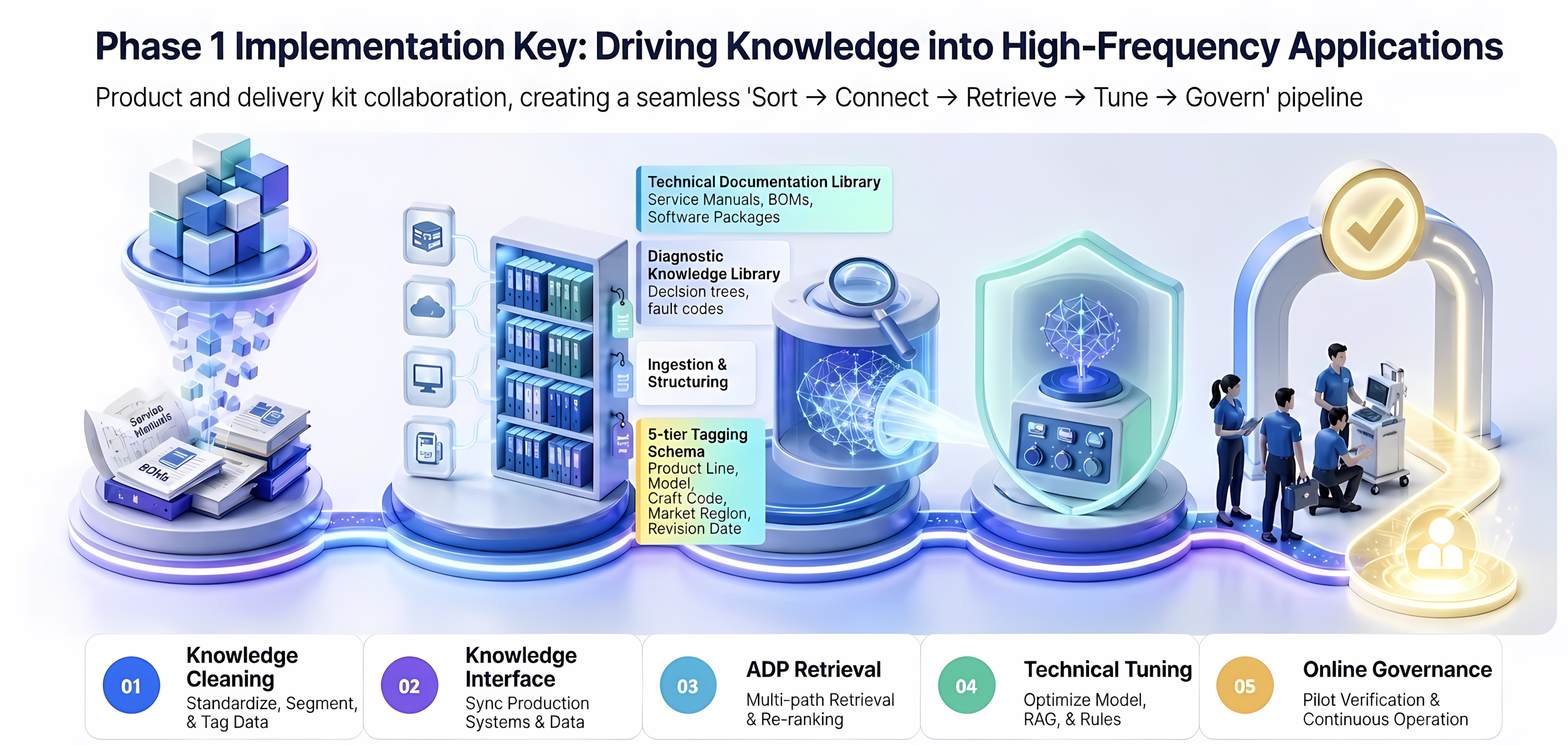
Stage 1: Multi-Source Knowledge Cleaning & Structured Tagging
Raw documentation cannot simply be dumped into an embedding model. The team divided all enterprise assets into two core repositories:
- Unstructured Technical Repositories: Over 800,000 service manuals, tender material lists, firmware release notes, technical bulletins, and field troubleshooting logs.
- Structured Diagnostic Repositories: Fault code trees, diagnostic decision matrices, and spare part replacement catalogs with explicit field attributes.
Tencent Cloud ADP established a normalized 5-tier metadata schema attached to every indexed chunk:
Documents were processed via layout-aware semantic parsers, preserving table structures, circuit schematics, parent section headers, and callout warning blocks without arbitrary token truncations.
Stage 2: Knowledge Pipeline Integration & Tag Propagation
Medical device knowledge originates across multiple enterprise systems: Product Lifecycle Management (PLM), Engineering Change Request (ECR) workflows, external technical portals, and manual uploads.
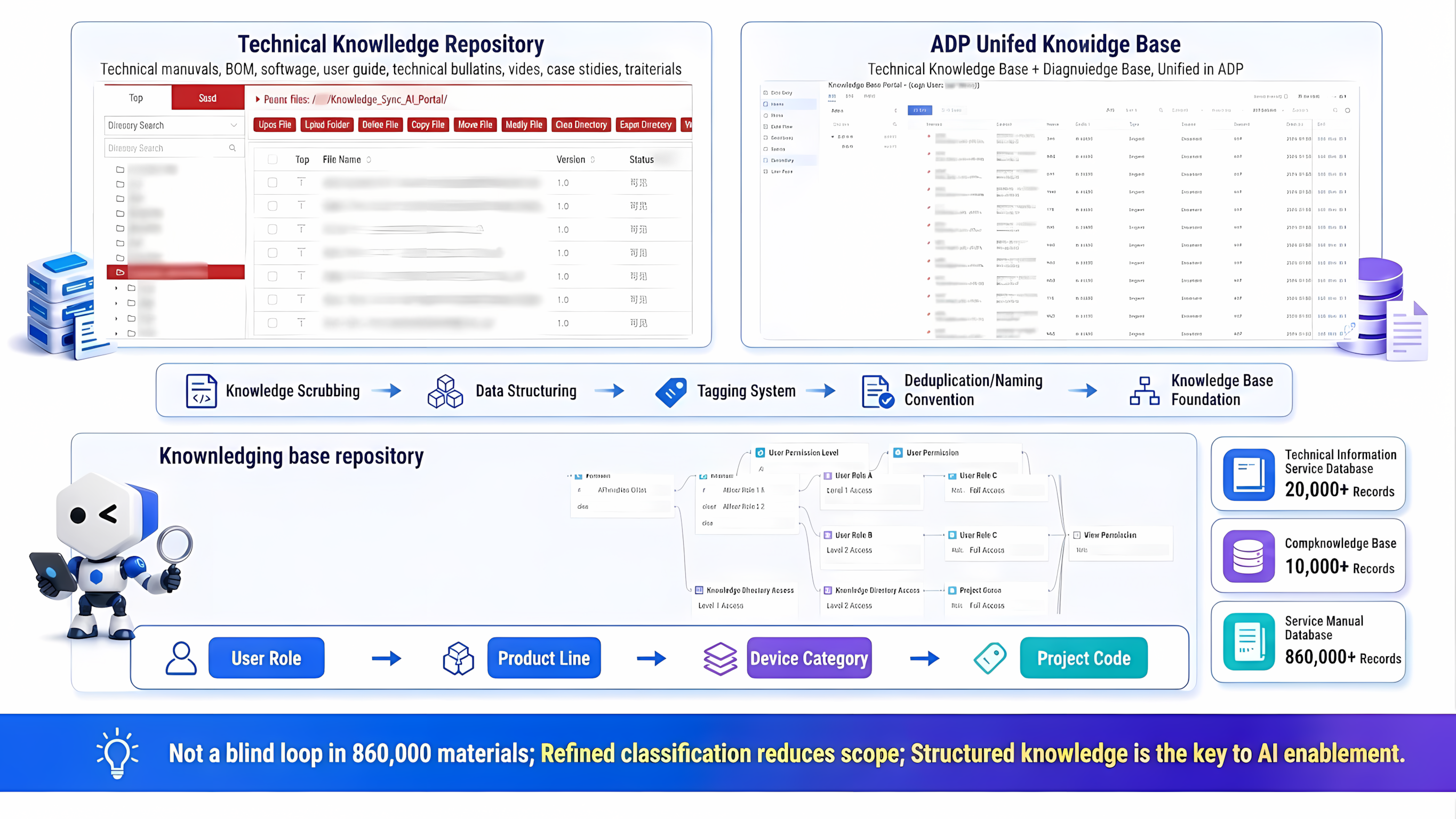
Tencent Cloud ADP serves as the unified enterprise retrieval engine, integrating directly with upstream PLM engineering data streams. When a new document or technical change bulletin is published:
- The data is parsed, cleaned, and assigned metadata tags (product line, device category, model ID, craft code, market region).
- Metadata tags are propagated through document chunks, ensuring that files from different product divisions never cross-contaminate.
- Obsolete document versions are automatically flagged with expiration timestamps to prevent outdated citations.
Stage 3: Metadata-Driven Filtering & Dynamic Scope Reduction
In standard RAG, querying an 860,000-document database creates unacceptable search latency and high false-positive recall rates. When a technician asks, "How do I calibrate the acoustic output power on the TE7 ultrasound transducer?", standard semantic search frequently pulls calibration tables from the TE5 or M9 models due to vocabulary overlap.
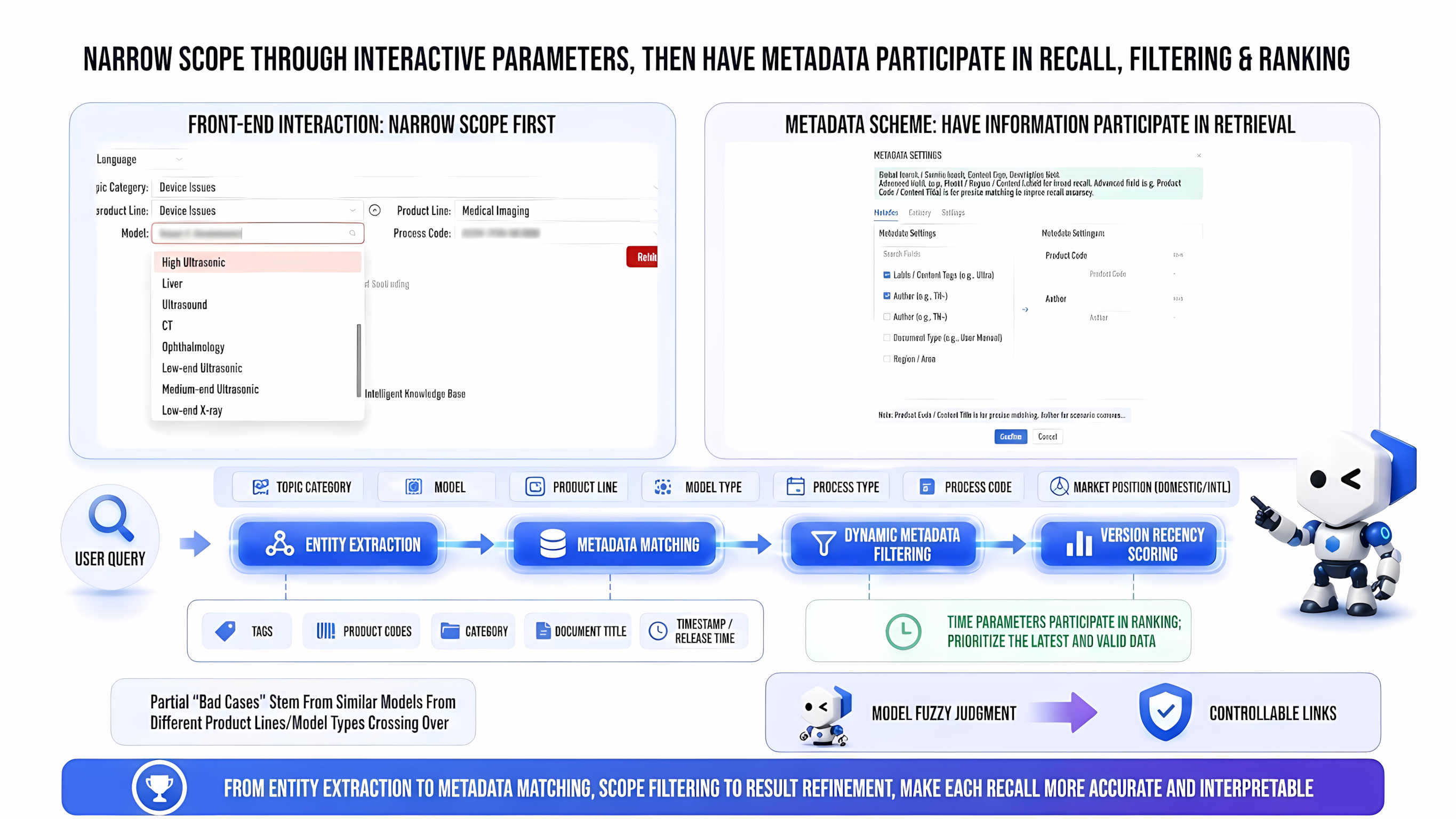
To solve this, ADP implements a 4-step controlled retrieval pipeline:
By filtering on structured metadata prior to vector calculation, the search space is instantly reduced from hundreds of thousands of files to dozens of precise manuals, slashing query latency and eliminating cross-model confusion.
Stage 4: Advanced Multi-Route Hybrid RAG & Agentic Diagnostic Workflows
Medical fault isolation is rarely a single-turn lookup. A reported symptom such as "System fails to complete boot sequence after power interruption" requires systematic multi-step verification.
ADP combines multi-route hybrid retrieval with Agentic RAG orchestration:
Deterministic Safety Guardrails
- Strict Grounding & Traceable Citations: Every generated diagnostic step must carry an exact citation anchor referencing the document ID, section header, and manual page number.
- Active Refusal on Low Confidence: If the retrieval relevance score falls below 0.78, or if the user's equipment serial number is ambiguous, the agent explicitly refuses to guess, prompting for serial verification or offering one-click escalation to human tier-3 engineers.
- Cross-Modal Diagram Retrieval: High-resolution circuit schematics, wiring pinouts, and exploded component diagrams are extracted and rendered directly in the chat interface alongside textual repair steps.
Stage 5: Closed-Loop Agent Learning from Human Feedback (AHLF)
A production AI agent is not finished at deployment; deployment is simply day one of the operational learning flywheel.
Tencent Cloud ADP and Project M instituted a joint operational governance process driven by ALHF (Agent Learning from Human Feedback):
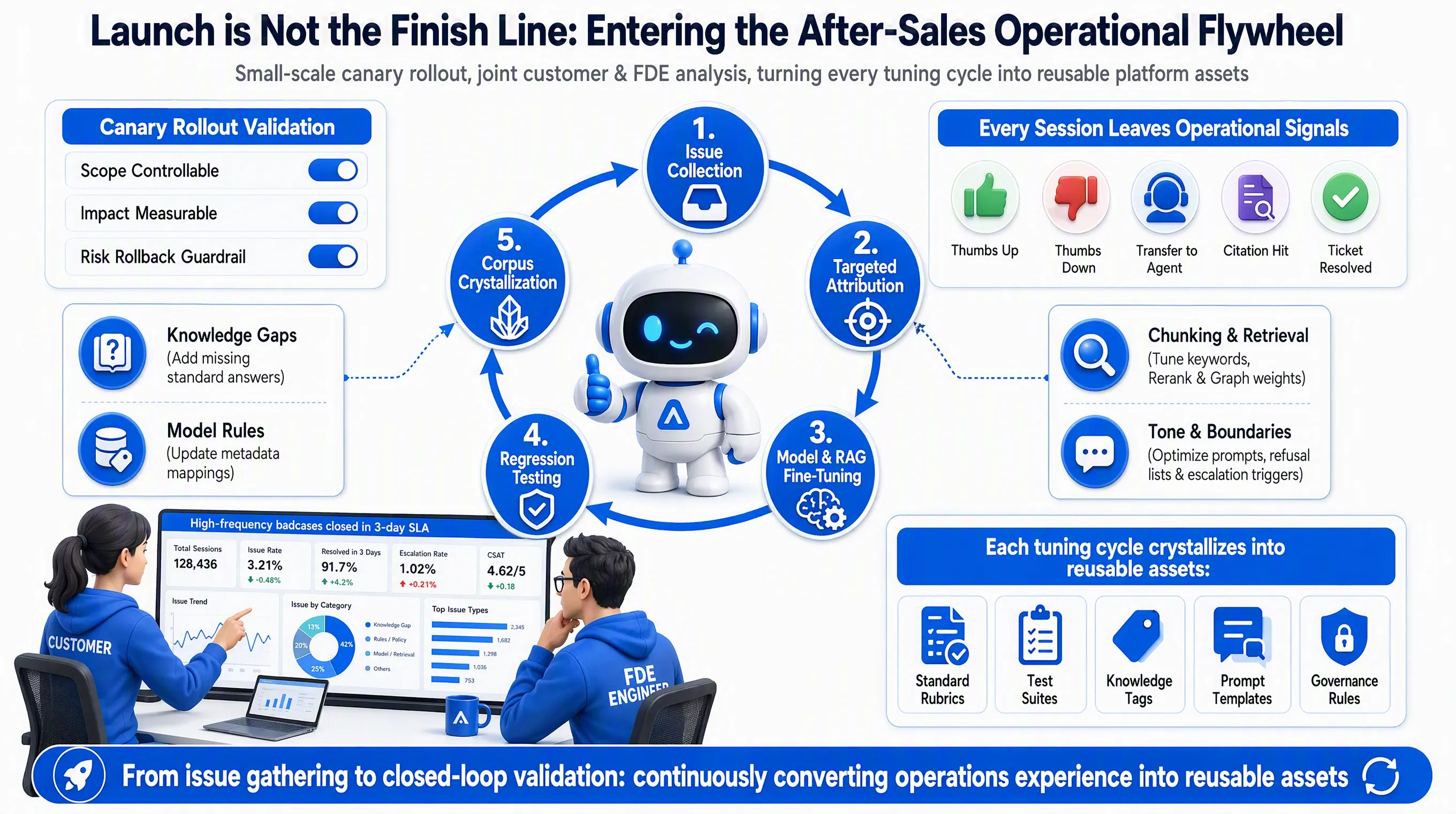
High-frequency badcases are assigned a strict 3-day resolution SLA. Every resolved issue is permanently committed to automated regression test suites, ensuring that subsequent prompt updates or model transitions never re-introduce historical errors.
3. Real-World Case Outcomes & Operational Impact
The production deployment of the Tencent Cloud ADP After-Sales Agent yielded immediate, measurable improvements across service speed, operational cost, and resource availability.
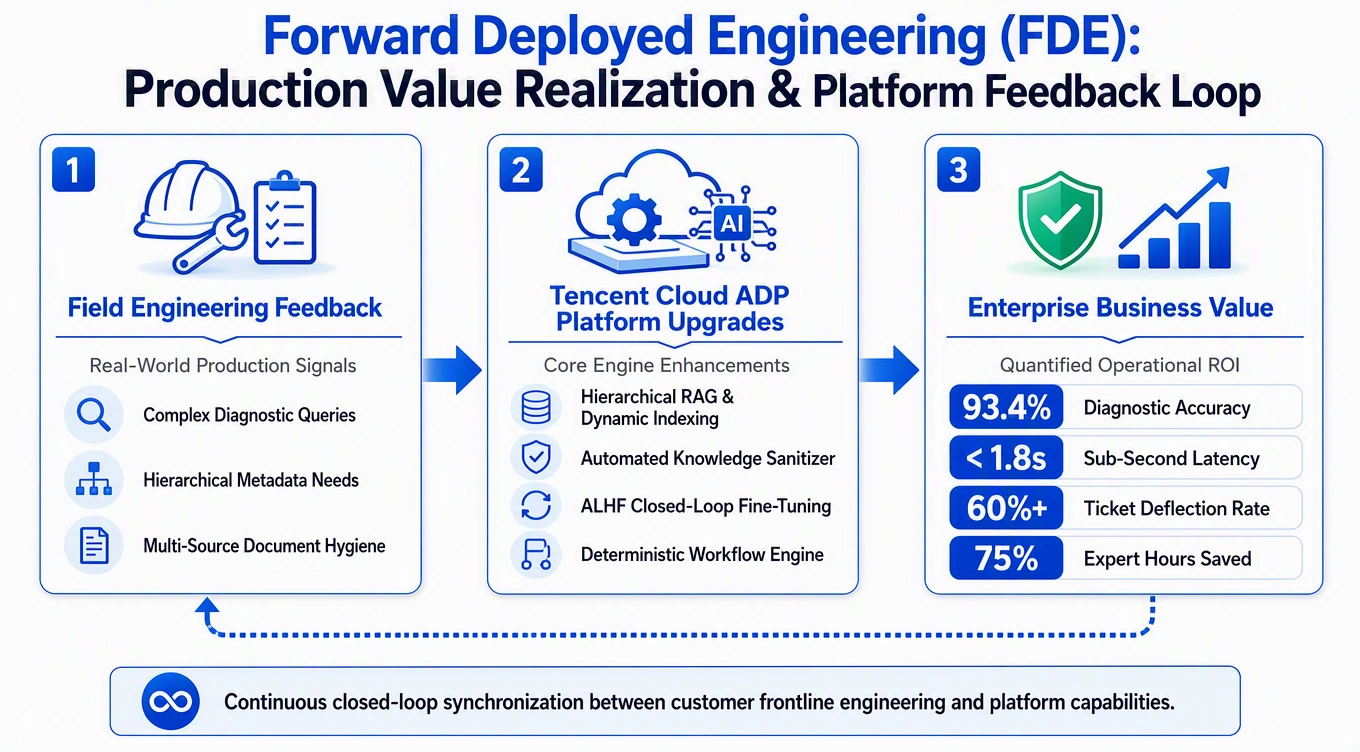
Quantitative Production Benchmarks
| Metric | Pre-AI Baseline (Manual Search) | Naive RAG PoC | Tencent Cloud ADP Production Agent |
|---|---|---|---|
| Diagnostic & Retrieval Accuracy | ~85% (Dependent on human seniority) | 60% – 63% (Model confusion) | 93.4% Verified Accuracy |
| Information Retrieval Latency | 10 – 30 minutes / inquiry | 5 – 8 seconds | < 1.8 seconds (Sub-second RAG) |
| Monthly Session Volume | 30,000+ manual inquiries | Untrusted for production | 30,000+ Autonomous Sessions/Mo |
| Automated Ticket Deflection | 0% (All inquiries to humans) | N/A | 60%+ Ticket Deflection Rate |
| R&D Expert Bandwidth Reclaimed | 120+ hours/mo per product line | 0 hours | Over 75% expert time freed for R&D |
| First-Contact Resolution (FCR) | 42% | 28% | 74.6% |
| Multilingual Coverage | 48-hour translation lag | Hallucinated terminology | Real-time instant support in 4 languages |
Multi-Channel Deployment Ecosystem
The after-sales agent is embedded across the customer's complete service topology:
- Hospital Customer Mini-Programs: Enabling hospital technicians to self-diagnose basic equipment alarms.
- Enterprise Ticketing System: Automatically analyzing incoming work orders, suggesting troubleshooting steps, and recommending verified replacement part SKUs.
- Field Engineer Workstation: Providing mobile and desktop field technicians with instant access to technical bulletins and wiring diagrams.
4. Enterprise-Wide Scaling: From 1 Pilot to 300+ Active Agents
The measurable success of the after-sales pilot ignited widespread enterprise adoption across other operational divisions within Project M:
- Marketing & Sales Enablement: A second-phase agent was deployed to ingest marketing brochures, clinical study whitepapers, and competitive battlecards, supporting global sales representatives.
- PLM & Engineering Assistants: Internal R&D teams now query historical failure logs, CAD specifications, and supplier BOMs through dedicated internal agents.
- ITR (Issue-to-Resolution) Orchestration: Agents automatically triage incoming hospital issues, assign severity levels, and route tickets to the appropriate engineering specialist.
- Scale: The enterprise expanded from 1 single after-sales pilot to over 300 active specialized agents orchestrated on Tencent Cloud ADP, establishing a comprehensive enterprise AI operational platform.
5. Cross-Industry Blueprint: Beyond Medical Devices
The architectural patterns developed during this deployment—hierarchical knowledge engineering, dynamic metadata filtering, multi-route hybrid RAG, and closed-loop ALHF—are directly transferable to any mission-critical, asset-heavy industry.
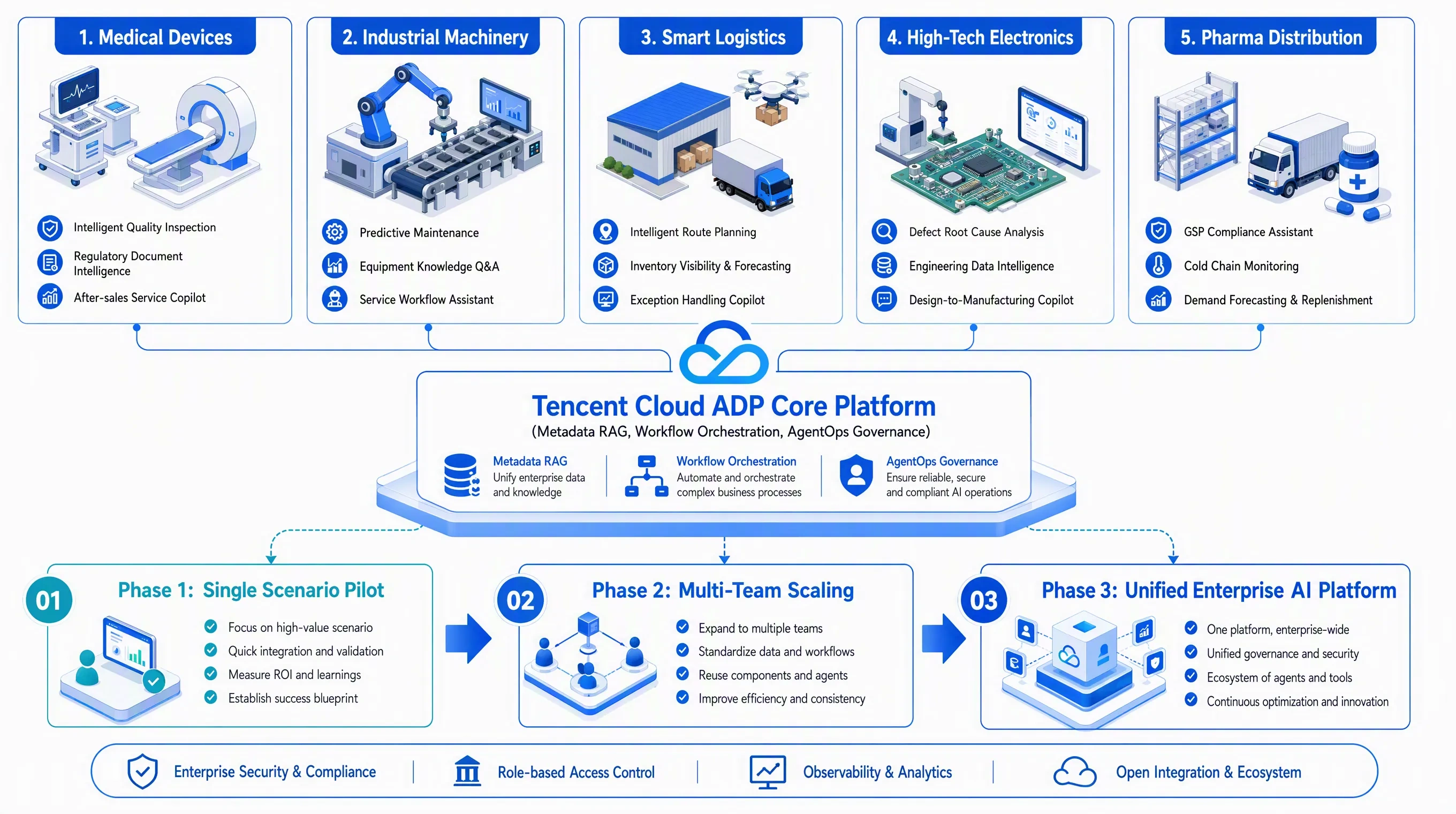
Applicable Verticals
- Industrial Automation & Robotics: Field diagnostics for CNC machinery, robotic controllers, and PLC systems with complex parameter registers.
- Automotive & Electric Vehicles: Workshop diagnostic assistants for EV powertrains, battery management systems (BMS), and charging infrastructure.
- Semiconductor & High-Tech Manufacturing: Cleanroom equipment maintenance, wafer handling protocols, and lithography tool manuals.
- Energy & Heavy Utilities: Turbine maintenance, power grid sub-station diagnostics, and pipeline monitoring documentation.
Enterprise FAQ
Q1: How does Tencent Cloud ADP prevent unauthorized access to sensitive technical manuals across different user roles?
Tencent Cloud ADP supports Space-Level Isolation and Role-Based Dynamic Knowledge Permitting. When an incoming request arrives from an external distributor or hospital technician, their authentication claims (e.g., role, tier, authorized product lines) are passed as runtime variables. ADP automatically enforces pre-retrieval filtering so that proprietary R&D blueprints, raw BOM costings, and unreleased firmware notes are strictly excluded from the searchable index.
Q2: How does the system handle continuous updates when engineering releases dozens of technical change notices (ECNs) weekly?
ADP provides Dynamic Knowledge Base Connectors and Automated ETL Webhooks. Instead of manually uploading PDFs, ADP connects directly to enterprise PLM, DMS (Document Management Systems), and SharePoint repositories. When an ECN is approved, the updated document is parsed, chunked, and tagged with updated validity timestamps, while superseded chunks are marked inactive or pruned in real time without taking the agent offline.
Q3: Why not rely on a frontier model's ultra-long context window (e.g., 1M–2M tokens) to ingest all documents instead of building RAG?
While long-context models (such as Tencent Hunyuan Hy4 Preview) excel at reasoning across hundreds of pages, ingesting 860,000 documents (400+ GB) in every prompt is mathematically impossible and cost-prohibitive. Furthermore, long-context prompts do not solve the challenge of real-time metadata filtering or version decay. The optimal enterprise architecture is Hierarchical RAG + Long-Context LLM: dynamic metadata filtering and hybrid retrieval first narrow 860,000 documents down to the top 20 relevant pages, after which a high-intelligence model conducts deep cross-document reasoning.
Q4: What compute infrastructure or Credit quotas are required to run this architecture?
Tencent Cloud ADP abstracts infrastructure provisioning through managed Credit Quota pools (compute credits). High-concurrency embeddings, vector indexing, hybrid search, and inference routing are auto-scaled. Enterprises can configure multi-dimensional Credit quota limits across departments, guaranteeing that customer-facing after-sales channels have guaranteed burst capacity while internal experimental bots operate within predictable monthly cost caps.
Q5: Can the ADP After-Sales Agent integrate with existing CRM and ticketing systems like Salesforce, ServiceNow, or internal portals?
Yes. ADP provides enterprise connectors, OpenAPI gateways, and standard WebSocket/SSE chat endpoints . An ADP agent can listen to ticket creation events, fetch machine telemetry from IoT gateways, execute diagnostic workflows, and post structured findings directly back into ServiceNow, Salesforce Service Cloud, or enterprise chat clients (Slack, Microsoft Teams, or custom web portals).
Conclusion & Next Steps
Bridging the 100 steps from a fragile demonstration to a production-grade enterprise agent requires far more than basic prompt engineering and an off-the-shelf vector database. It demands rigorous knowledge engineering, layout-aware parsing, dynamic metadata filtering, multi-step Agentic RAG reasoning, and an institutionalized operational feedback loop.
By systematically addressing these challenges, Tencent Cloud ADP enabled Project M to transform 860,000 complex technical documents into a high-precision, 24/7 autonomous support engine—achieving 93%+ accuracy and deflecting over 60% of manual maintenance tickets.
Ready to Build Your Production-Grade Enterprise Agent?
- 🌐 Explore the International Platform: https://adp.tencentcloud.com
- 📘 Official Product Documentation: https://www.tencentcloud.com/products/adp
- 💬 Get Started with FDE: Contact Tencent Cloud Solutions Architects for enterprise PoC evaluations and tailored FDE acceleration programs.

Start building today
If you need more support, please contact us