
Smart Retail AI Agent Solutions: From In-Store Guides to Operations
Deploy production AI agents across in-store sales guides, VIP loyalty operations, and multimodal product consultants using Tencent Cloud ADP and retail system connectors.

Executive Summary
The retail industry operates across extended supply chains, complex omnichannel touchpoints, and volatile commercial cycles. Fast SKU rotations, shifting discount schemes, regional pricing tiers, and personalized loyalty programs continuously overwhelm frontline sales associates and backend operations teams. Traditional rule-based chatbots and static keyword search engines fail because they cannot reason over dynamic business states, parse multifaceted consumer intents, or interact programmatically with enterprise transactional systems.
Retail enterprises are now shifting their artificial intelligence paradigm from simple conversational bots to autonomous, business-integrated execution agents. Built on the Tencent Cloud Agent Development Platform (ADP), enterprise AI agents bridge enterprise knowledge bases (RAG), core transactional systems (CRM, CDP, POS, OMS, ERP), and multi-step orchestration workflows into unified operational digital co-workers.
This technical solution blueprint details how global retailers deploy production-grade AI agents across three flagship scenarios—In-Store Sales Guides, VIP Membership Operations, and Multimodal Product Consultants—delivering up to 300% content production gains, 70% visual diagram answer accuracy, and slashing customer support escalation down to 20%.
Key Takeaways
- Action-Oriented Digital Co-Workers: Modern retail AI must move beyond static FAQ retrieval to execute multi-step business transactions, such as real-time inventory checks, package credit lookups, and dynamic appointment bookings.
- 5-Layer Modular Capability Architecture: Production-grade retail agents require a decoupled architecture spanning Knowledge Bases, Hybrid RAG, Workflow Orchestration, System Integration Connectors, and AgentOps Governance.
- Multimodal Visual RAG Eliminates Ambiguity: Parsing complex technical manuals and schematics with multimodal vision models allows agents to return annotated wiring diagrams and hardware guides, boosting First Contact Resolution (FCR).
- Multi-Intent Workflow State Machines: Complex customer inquiries combining multiple intents (e.g., entitlement balances, weekend booking slots, and active discount campaigns) are decomposed into discrete API calls with deterministic verification.
- Rigorous Enterprise Guardrails: Zero-Trust Role-Based Access Control (RBAC), Personally Identifiable Information (PII) masking, and mandatory Human-in-the-Loop (HITL) checkpoints ensure brand safety, regulatory compliance, and financial accuracy.
- Proven Real-World ROI: Leading global enterprises running on Tencent Cloud ADP demonstrate decisive returns—a Tier-1 Dairy Conglomerate processing tens of millions of daily copy requests with 95% review pass rates, PhiSkin automating VIP balance lookups, and TP-Link cutting customer service handoffs to 20% within one week.
1. The Frontline Retail Dilemma: Moving from Chatbots to Autonomous Agents
Retail organizations suffer from persistent information latency and disconnected software silos. Marketing teams design omni-channel campaigns at corporate headquarters, but frontline store associates struggle to master unique selling propositions (USPs) across thousands of SKUs. Simultaneously, customer support centers drown in repetitive inquiries regarding product compatibility, return policies, and loyalty points.
The Structural Bottlenecks of Legacy Retail IT
- Inconsistent Frontline Sales Execution: Across extensive franchised or direct-store networks, store associates exhibit significant variance in product knowledge and pitch delivery. High staff turnover continually inflates onboarding overhead.
- Scattered Enterprise Knowledge: Product specification sheets, promotional PDFs, regional price books, and warranty clauses live in isolated wikis, ERP databases, and local spreadsheets. Frontline staff waste valuable minutes locating basic information.
- Impersonal VIP & Private Domain Outreach: Although enterprises possess Customer Data Platforms (CDPs) with granular purchase histories and lifecycle tags, customer outreach remains dominated by generic blast SMS and broadcast messages.
- Heavy Support Escalation Load: When consumers inquire about subtle SKU differences, package balances, or complex return conditions, legacy keyword bots fail to parse context, instantly pushing tickets to human agents.
- Headquarters Strategy Dilution: Strategic merchandising guidelines and promotional rules dilute as they cascade from corporate leadership down to regional supervisors and store associates.
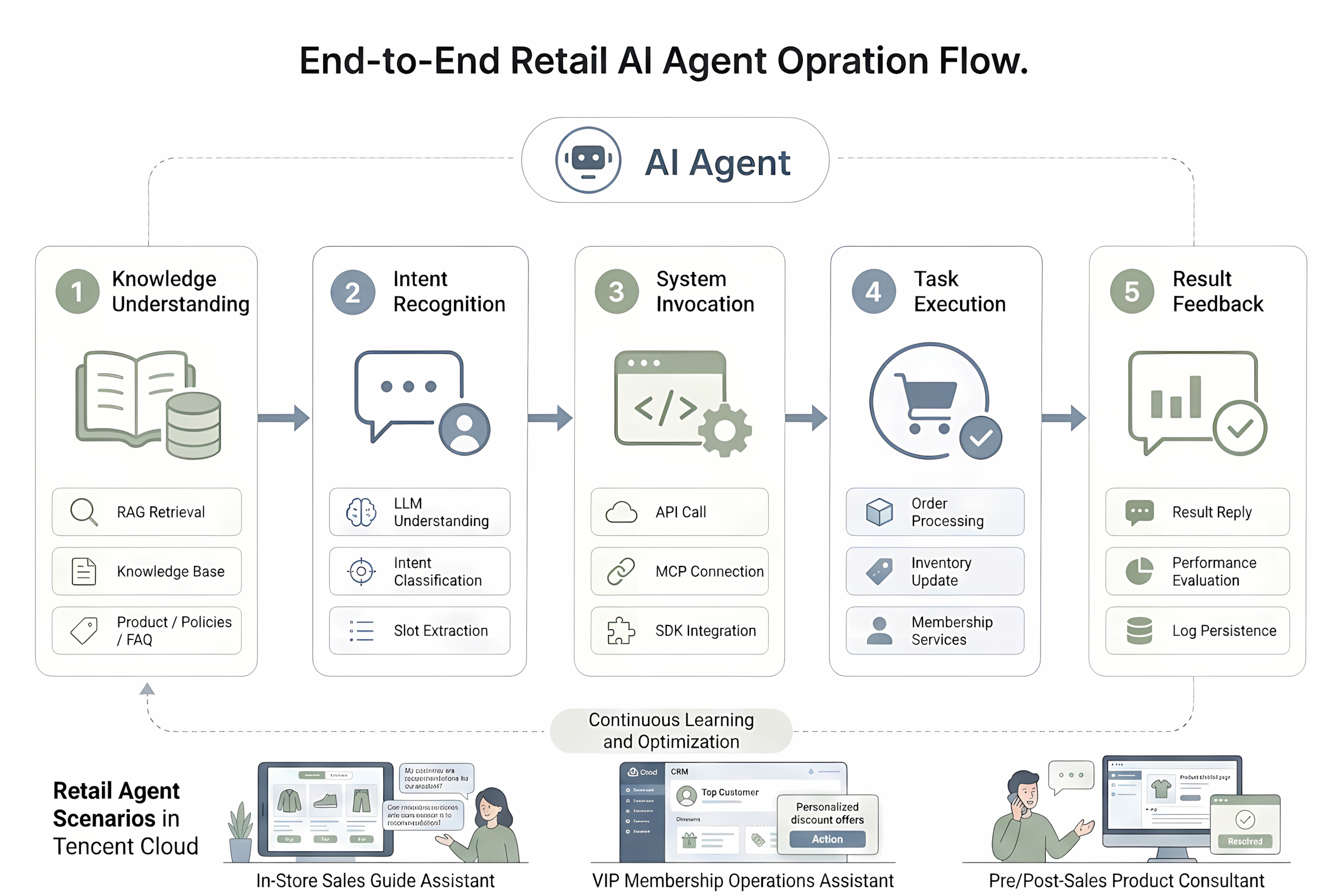
Tencent Cloud ADP resolves these challenges by transforming static corporate assets into actionable, autonomous agents capable of perceiving context, retrieving accurate facts, executing transactional tools, and enforcing enterprise governance.
2. Three Flagship Retail AI Agent Scenarios
To maximize return on investment (ROI), retail enterprises structure their AI roadmap around internal workforce enablement and external customer-facing service.
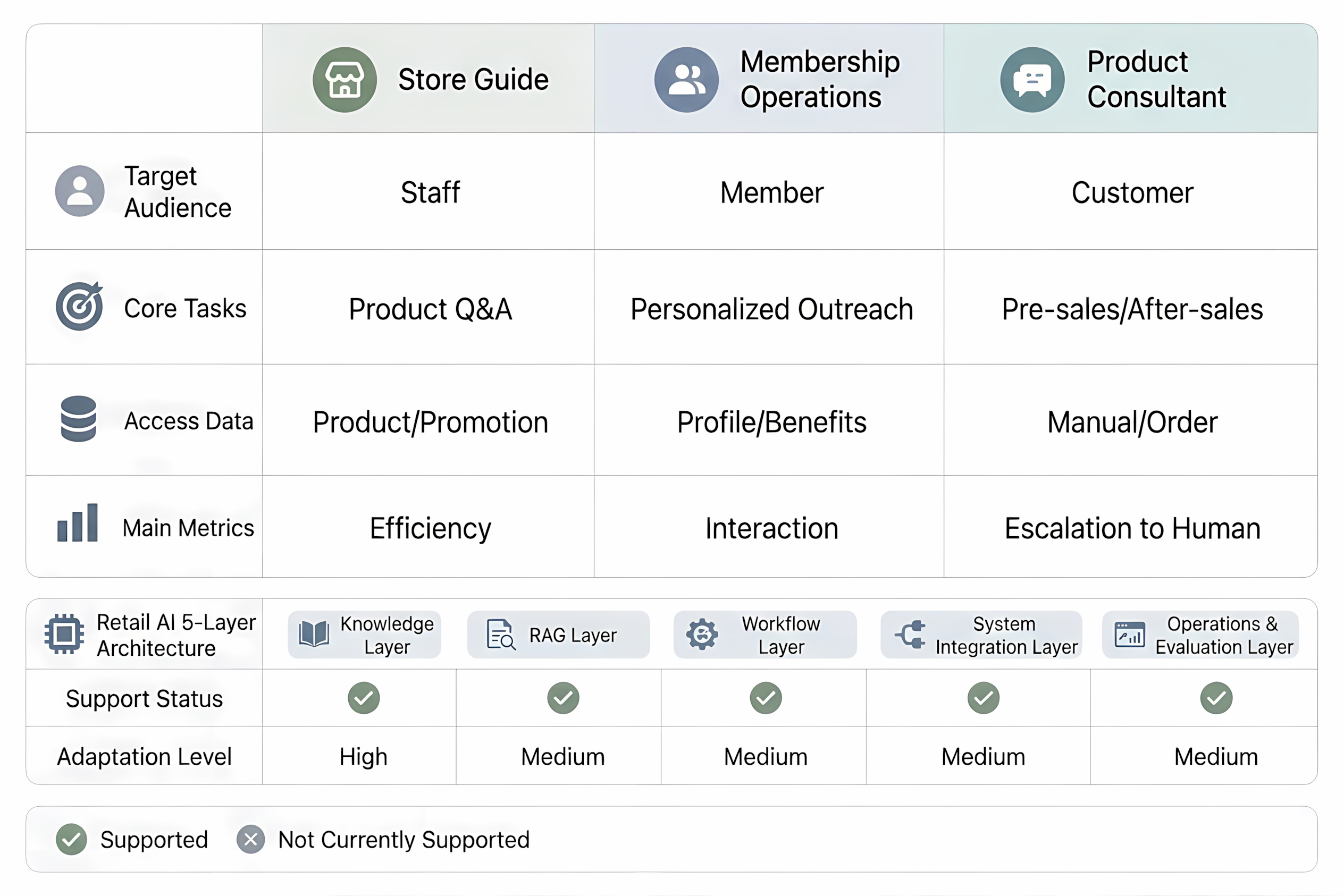
Scenario 1: In-Store Sales Guide Assistant (The FMCG & Dairy Blueprint)
In fast-moving consumer goods (FMCG), luxury, and apparel, store associates must tailor sales pitches to diverse buyer personas (e.g., health-conscious parents, fitness enthusiasts, price-sensitive shoppers) while incorporating active regional bundle promotions.
Technical Implementation
Using Tencent Cloud ADP, a leading national dairy conglomerate unified its master product repository, nutritional certifications, and localized campaign databases into a Smart Content Generation Agent. Frontline sales associates input a customer profile and target SKU into their internal mobile interface; the agent instantly synthesizes compliant, persuasive marketing copy and chat scripts.
Measured Business Impact
- Throughput: Processed over 10,000,000+ daily copy generation requests during peak nationwide marketing campaigns.
- Quality Control: Achieved a 95% first-pass approval rate under strict corporate compliance and legal auditing.
- Operational Efficiency: Delivered a 300% surge in localized sales content production speed, eliminating manual agency drafting cycles.
Scenario 2: VIP Membership & Private Domain Operations (PhiSkin Beauty Services)
High-touch service retailers (medical aesthetics, luxury goods, automotive dealerships, wellness clinics) rely on long-term customer relationships and scheduled package redemptions.
Technical Implementation
PhiSkin deployed an AI Beauty Consultant Agent powered by Tencent Cloud ADP. The agent integrates securely with the enterprise CRM and CDP via encrypted connectors:
- Profile Aggregation: Retrieves customer tier, treatment frequency, skin profile, and unredeemed package credits in real time.
- Consultative Dialogue: Employs an empathetic, brand-aligned persona to answer treatment precautions and recovery guidelines.
- Workflow-Driven Fulfillment: Automatically queries clinic room availability, proposes personalized time slots, and queues appointment reservations.
- Escalation Gating: If a customer requests a refund, credit transfer, or medical prescription change, the agent seamlessly hands off the interaction to a human clinic manager with a synthesized contextual dossier.
Scenario 3: Pre- & Post-Sales Multimodal Product Consultant (TP-Link Hardware)
Consumer electronics, appliances, and home improvement retailers manage vast SKU catalogs with complex wiring schematics, firmware dependencies, and dense user manuals.
Technical Implementation
Global networking giant TP-Link integrated thousands of device models and extensive technical manuals into Tencent Cloud ADP:
- Rapid Cold Start: Uploaded raw PDF user manuals and engineering schematics directly to the ADP Knowledge Base. ADP's automated chunking, metadata extraction, and indexing compressed the deployment timeline from months down to 1 week.
- Multimodal Visual RAG: Using Tencent Hunyuan Vision capabilities, the agent disambiguates subtle hardware revisions (e.g., Router V1 vs Router V2 port configurations) and retrieves exact annotated wiring diagrams directly from the original PDF documentation.
Measured Business Impact
- Escalation Reduction: Customer service handoff rate plunged to 20% within 7 days of launch.
- Visual Accuracy: Over 70% of technical responses featured precise visual diagram references, drastically boosting first-contact resolution (FCR).
3. The 5-Layer Enterprise Capability Architecture
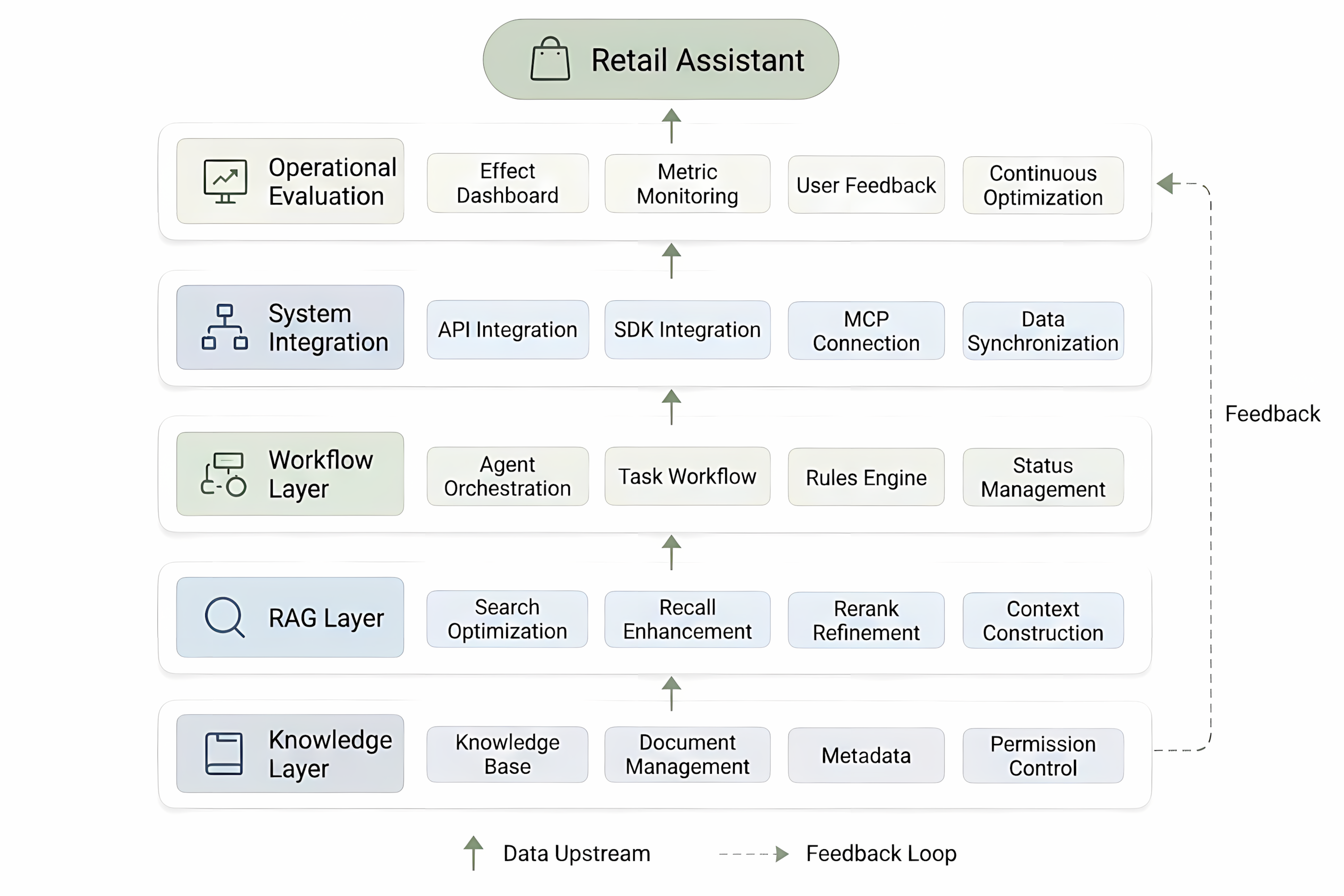
To guarantee reliability, sub-second latency, and deterministic execution, retail AI agents built on Tencent Cloud ADP follow a modular, decoupled 5-layer architecture.
1. Enterprise Knowledge Layer
Maintains structured and unstructured retail assets. Granular metadata tags categorize data by access privilege:
- Public Domain: Product specifications, promotional brochures, public FAQs.
- Internal Only: Margin structures, sales negotiation scripts, competitor battle cards.
- Regulated: Medical claims, financial credit terms, legal return covenants.
2. Hybrid RAG & Semantic Retrieval Layer
Combines lexical search (BM25) with high-dimensional dense vector embeddings, augmented by cross-encoder rerankers. Metadata filtering prevents cross-model contamination (e.g., preventing promotional discounts from Region A from surfacing in Region B queries).
3. Workflow Orchestration Layer
Orchestrates deterministic business logic across non-deterministic LLM generations. Complex customer dialogues are mapped into directed acyclic graphs (DAGs) that manage state transitions, memory retention, and fallback routing.
4. Integration & Tooling Layer
Exposes bidirectional communication channels between the agent and corporate systems through REST APIs, OpenAPI standards, and Tencent Cloud ADP Skill Hub plugins. Handles authentication, token refreshing, and transactional idempotency.
5. Operations & Evaluation Layer
Ensures operational visibility through end-to-end trace logging, Credit compute quota allocation, automated red-teaming, and toxic output filtering.
4. Decomposing Complex Inquiries: Multi-Intent Workflow Design
Retail customers rarely speak in single-intent sentences. A typical message contains multiple simultaneous questions and transactional requests.
Real-World Execution Trace
Consider a high-value customer inquiry:
"How many sessions do I have left on my skincare package, can I book this Saturday afternoon at the downtown branch, and are there any active discounts on hyaluronic serums?"
Tencent Cloud ADP processes this compound request through a multi-branch workflow:
{
  "trace_id": "req-retail-889104",
  "workflow_id": "wf-vip-omnichannel-concierge",
  "execution_steps": [
    {
      "step_name": "intent_decomposition",
      "status": "success",
      "intents_detected": ["get_package_balance", "check_appointment_slot", "query_promotions"]
    },
    {
      "step_name": "crm_balance_lookup",
      "tool_invoked": "crm_gateway.get_member_entitlements",
      "latency_ms": 112,
      "output": { "package_name": "Skin Renewal Hydro-Care", "remaining_units": 2, "expiry": "2026-12-31" }
    },
    {
      "step_name": "slot_availability_check",
      "tool_invoked": "schedule_service.query_calendar",
      "latency_ms": 84,
      "output": { "available_slots": ["2026-08-22T14:00:00Z", "2026-08-22T16:30:00Z"] }
    },
    {
      "step_name": "rag_promotion_retrieval",
      "retrieval_mode": "hybrid_vector_bm25",
      "similarity_score": 0.892,
      "matched_document": "2026_Q3_VIP_Beauty_Campaign_Tier1.pdf"
    }
  ]
}
5. Three-Stage Phased Implementation Roadmap
Attempting to automate the entire retail lifecycle in a single release creates severe delivery risks. Enterprises achieve the highest ROI by following ADP's three-stage rollout methodology.
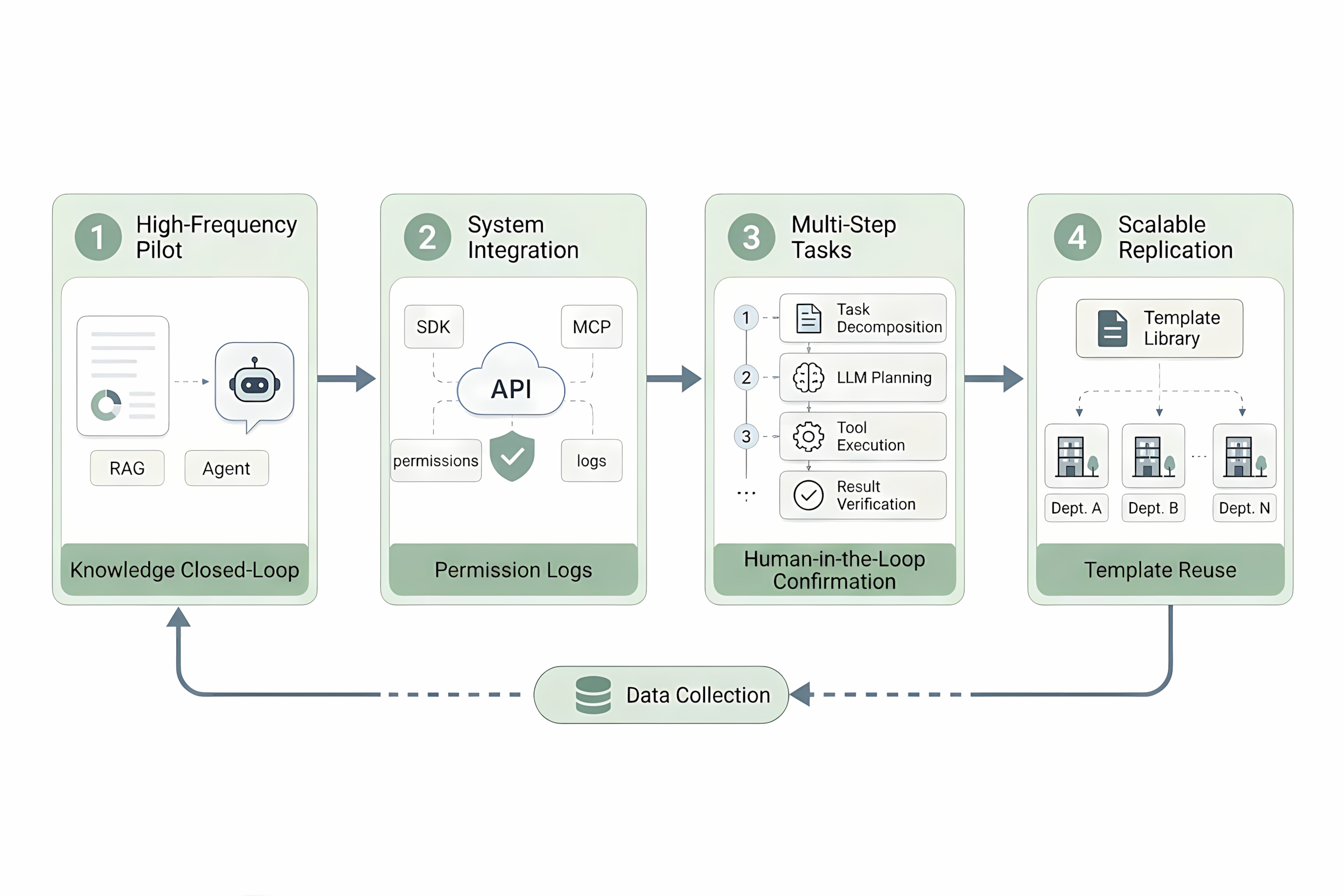
| Phase | Core Objective | Key Deliverables | Risk Level | Target Timeframe |
|---|---|---|---|---|
| Phase 1: Single-Point Pilots | Validate RAG accuracy and frontline adoption in high-frequency, read-only tasks. | Knowledge Base ingestion, sales pitch generator, public promotional FAQ assistant. | Low | 1 – 2 Weeks |
| Phase 2: System Integrations | Transform agents from informational chatbots into transactional digital co-workers. | CRM/CDP connectors, POS inventory lookup, automated ticket dispatching, human escalation gates. | Medium | 4 – 6 Weeks |
| Phase 3: Enterprise Scale | Scale across omnichannel touchpoints and deploy role-specific multi-agent networks. | Multi-agent collaboration, headquarters analytics agents, autonomous supplier document ingestion, unified AgentOps monitoring. | Controlled | 8 – 12 Weeks |
6. Enterprise Metric & Evaluation KPI Dashboard
Evaluating retail AI agents requires balancing service efficiency, response quality, and commercial conversion.
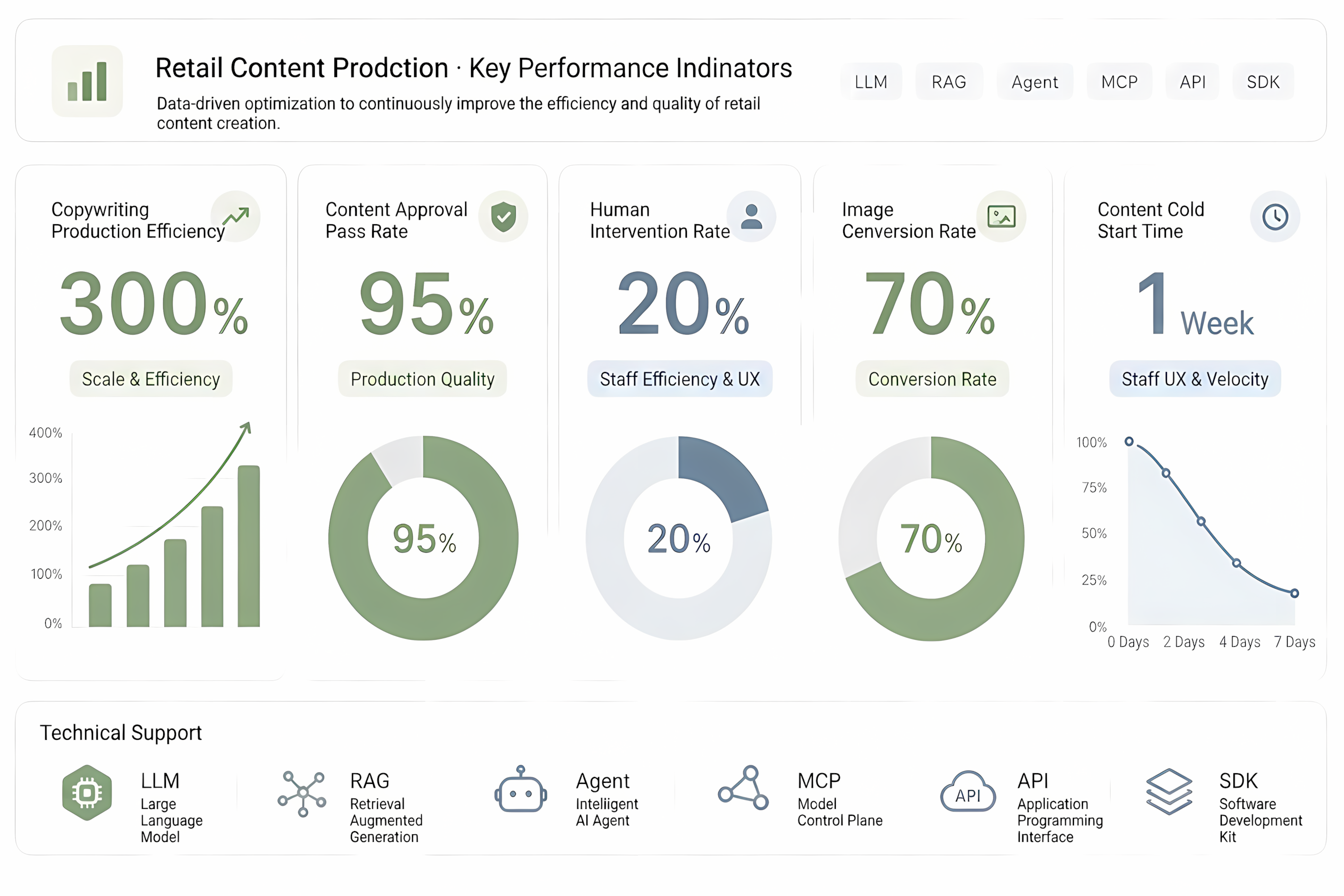
Comprehensive KPI Framework
| KPI Category | Metric Name | Definition & Business Impact | Industry Benchmark |
|---|---|---|---|
| Service Scale | Daily Invocation Volume | Total requests processed across all retail channels. | 1M – 10M+ Requests/Day |
| Store Associate Adoption Rate | Percentage of active frontline staff using the assistant weekly. | > 85% Active Ratio | |
| Service Efficiency | First Response Time (FRT) | Milliseconds elapsed before streaming the first response token. | < 800 ms |
| Autonomous Resolution Rate | Percentage of inquiries fully resolved without human escalation. | 75% – 85% | |
| Response Quality | Grounding Accuracy (RAG) | Percentage of generated claims directly supported by enterprise knowledge. | > 98% |
| Hallucination Rate | Frequency of unsupported pricing, SKU specs, or policy promises. | < 0.5% | |
| Workforce Enablement | Copywriting Review Pass Rate | Percentage of AI-generated marketing pitches accepted without edits. | > 92% |
| Frontline Ramp-up Acceleration | Reduction in training days required for new store associate onboarding. | 40% – 60% Reduction | |
| Commercial Conversion | Personalized Outreach CTR | Click-through rate on personalized VIP engagement messages. | 2.5x – 4x Baseline |
| Cart Uplift from AI Pitches | Increase in average order value (AOV) driven by cross-sell suggestions. | +12% – 18% |
7. Data Governance, RBAC, and Human-in-the-Loop Safeguards
Retail agents interface with sensitive customer records, confidential margins, and legally binding promises. Enterprise deployments must enforce rigid security boundaries.
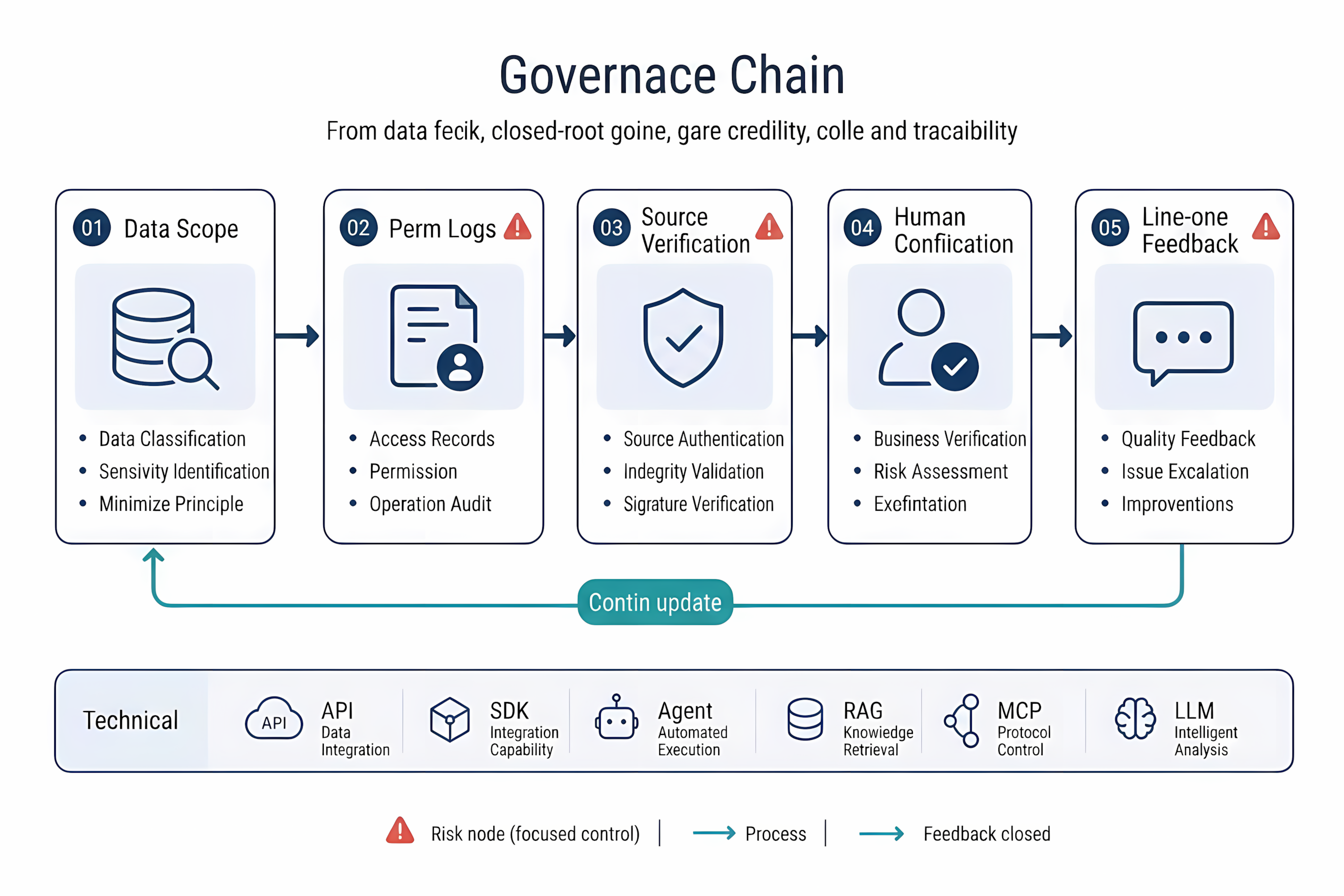
1. Zero-Trust Role-Based Access Control (RBAC)
- Store Associates: Granted access to customer public profiles, general campaign perks, and in-store stock levels. Strictly blocked from raw financial reports and wholesale cost bases.
- Regional Managers: Granted access to aggregate regional sales performance, inventory transfer agents, and staff efficiency metrics.
- External Customers: Authenticated via AppKey / OAuth tokens with ephemeral session scopes, isolated entirely from other tenants.
2. Mandatory Human-in-the-Loop (HITL) Triggers
Certain transaction classes cannot be executed autonomously by generative models:
- Financial Discrepancies: Any refund or discount adjustment exceeding preset thresholds.
- Entitlement Alterations: Manual adjustments to VIP tiers, points, or purchased packages.
- Legal / Health Claims: Product safety disputes, contraindications, or medical claims.
8. Expanding Beyond the Storefront: Enterprise Operational Agents
Once the frontline retail agent infrastructure is established, enterprises leverage Tencent Cloud ADP to automate back-office operations.
B2B Trade & Cross-Border Supply Chain Processing
Global retailers managing supplier contracts, customs declarations, and multi-currency invoices deploy document parsing agents in ADP Claw Mode. The sandboxed execution environment extracts line items from complex PDF manifests, cross-references purchase orders (POs), and flags invoice discrepancies before ERP ingestion.
Back-Office Operational Workspaces
Finance and regional inventory controllers utilize ADP Intelligent Workspaces to run periodic audit automations. Agents parse daily sales returns, balance regional stock deviations, and compile executive summaries pushed directly to collaboration channels (Slack, Microsoft Teams, WeChat Work).
Enterprise FAQ
Q1: What is the recommended starting scenario for an enterprise retail brand?
We strongly recommend starting with In-Store Sales Guide Enablement or Pre-Sales Product Spec Q&A. These scenarios operate primarily on structured read-only enterprise knowledge, delivering immediate frontline efficiency gains while eliminating risks associated with autonomous transactional writes.
Q2: How does Tencent Cloud ADP prevent agents from quoting expired discount codes?
ADP utilizes Dynamic Knowledge Base Syncing with TTL (Time-to-Live) metadata headers. When a promotional campaign expires, the ingestion pipeline automatically invalidates the corresponding vector embeddings and falls back to baseline pricing rules. Real-time pricing queries are routed directly through transactional POS/ERP API connectors rather than static text documents.
Q3: How do we handle multi-language product catalogs for cross-border retail?
Tencent Cloud ADP supports native multilingual embeddings and cross-lingual retrieval. A customer asking a technical question in Spanish or Japanese can be accurately answered from an English master engineering manual, with terminology strictly preserved via custom domain glossaries.
Q4: Does our frontline staff need technical prompt engineering training?
No. Frontline associates interact through intuitive conversational mobile UIs or embedded widgets in their standard workforce management apps. Backend prompt optimization, RAG retrieval parameters, and tool invocation schemas are managed centrally by the IT and operations teams within the ADP console.
Q5: How does ADP handle high concurrency during shopping festivals (e.g., Black Friday, Double 11)?
Tencent Cloud ADP is architected on enterprise-scale cloud infrastructure with elastic compute scaling. Applications can seamlessly handle millions of concurrent requests through dynamic Credit scaling and distributed cache layers, ensuring sub-second response times during peak shopping periods.
Q6: What role does Tencent Cloud ADP play in the overall enterprise IT ecosystem?
Tencent Cloud ADP functions as the intelligent orchestration and execution layer atop existing enterprise systems (CRM, CDP, POS, ERP, WMS). Rather than replacing legacy software, ADP connects disparate databases and APIs, transforming static enterprise assets into autonomous digital agents that execute tasks across channels.
Conclusion & Next Steps
The competitive landscape in modern retail favors organizations that transform institutional knowledge and customer data into real-time operational execution. By unifying RAG, workflow orchestration, enterprise system connectors, and rigorous AgentOps governance, Tencent Cloud ADP provides the definitive foundation for enterprise retail intelligence.
Whether you are seeking to empower thousands of in-store sales associates, modernize VIP customer retention, or automate complex technical product consultations, Tencent Cloud ADP delivers proven, production-grade architectures.
- Start Building: Explore the Tencent Cloud ADP Global Portal
- Product Overview: Read the official Tencent Cloud ADP Product Documentation
- Consult Solutions: Contact our Retail AI Solutions Architecture Team to schedule a customized architectural assessment and PoC.

Start building today
If you need more support, please contact us