
Why Silicon Valley Is Reviving the Forward Deployed Engineer for Enterprise AI
As enterprise AI shifts from demos to production, Silicon Valley is reviving Forward Deployed Engineers to conquer messy documents, deterministic workflows, and legacy intranet systems.


Around 2006, early-stage Palantir made a decision that baffled the enterprise software industry.
At the time, enterprise software delivery followed a well-worn playbook: sales executives and pre-sales consultants brought slide decks to client sites, documented feature requests, tossed them over the wall to central engineering at headquarters, and returned months later with binders of user manuals to run training sessions. Palantir threw that playbook out. Instead, they dispatched core software engineers directly to operational frontlines—in some cases embedding them alongside military personnel at data command nodes in Afghanistan and Iraq.
Alex Karp, Palantir's co-founder and CEO, framed this with a now-famous "French restaurant" metaphor: in a world-class dining room, the front-of-house staff are never mere order-takers. They understand the intricacies of the kitchen—the timing, seasoning, and heat. Standing closest to the diner, they channel authentic feedback directly back to the kitchen, driving continuous iteration across the menu and prep line.
Inside Palantir, these hands-on engineers—capable of navigating the organizational mud of client operations while writing production-grade code—were christened Forward Deployed Engineers (FDEs).
Nearly twenty years later, this role—once viewed as an unconventional, special-ops deployment model—is staging a massive resurgence across Silicon Valley and the broader tech landscape. From OpenAI and Anthropic to leading enterprise engineering teams, job boards show a sharp uptick in demand for FDEs, with compensation packages frequently matching or eclipsing those of pure research scientists.
Why now? In enterprise AI, as the breakneck pace of foundation model breakthroughs settles into incremental gains, engineering teams have reached a sobering realization: whether an agent project succeeds or fails in production rarely hinges on model parameter count. It hinges on the messy "last mile" closest to the business.
Key Takeaways
- Field-Grounded Value: An FDE's mission is rooted in the operational trenches—bridging business reality, production systems, and product feedback loops rather than transcribing static client requirements.
- The PoC-to-Production Chasm: Enterprise AI initiatives typically stall on three real-world barriers: unstructured documentation, deterministic workflow requirements, and legacy intranet integrations.
- Beyond Generative Capability: Production agents cannot rely solely on next-token prediction; they require curated knowledge bases, deterministic workflows, secure connectors, role-based access control, and automated evaluation suites.
- The Role of Low-Code Agent Platforms: Purpose-built agent development platforms productize baseline complexities—network traversal, sandboxed isolation, model orchestration, and RAG optimization—into a standardized runtime foundation, freeing FDEs to focus on business logic rather than infrastructure plumbing.
1. Why Enterprise AI Resurrected the Forward Deployed Engineer
The FDE role was forged in hostile, high-friction delivery environments. Its foundational premise is simple: place systems engineers directly into client environments to confront data fragmentation, brittle workflows, and organizational silos head-on.
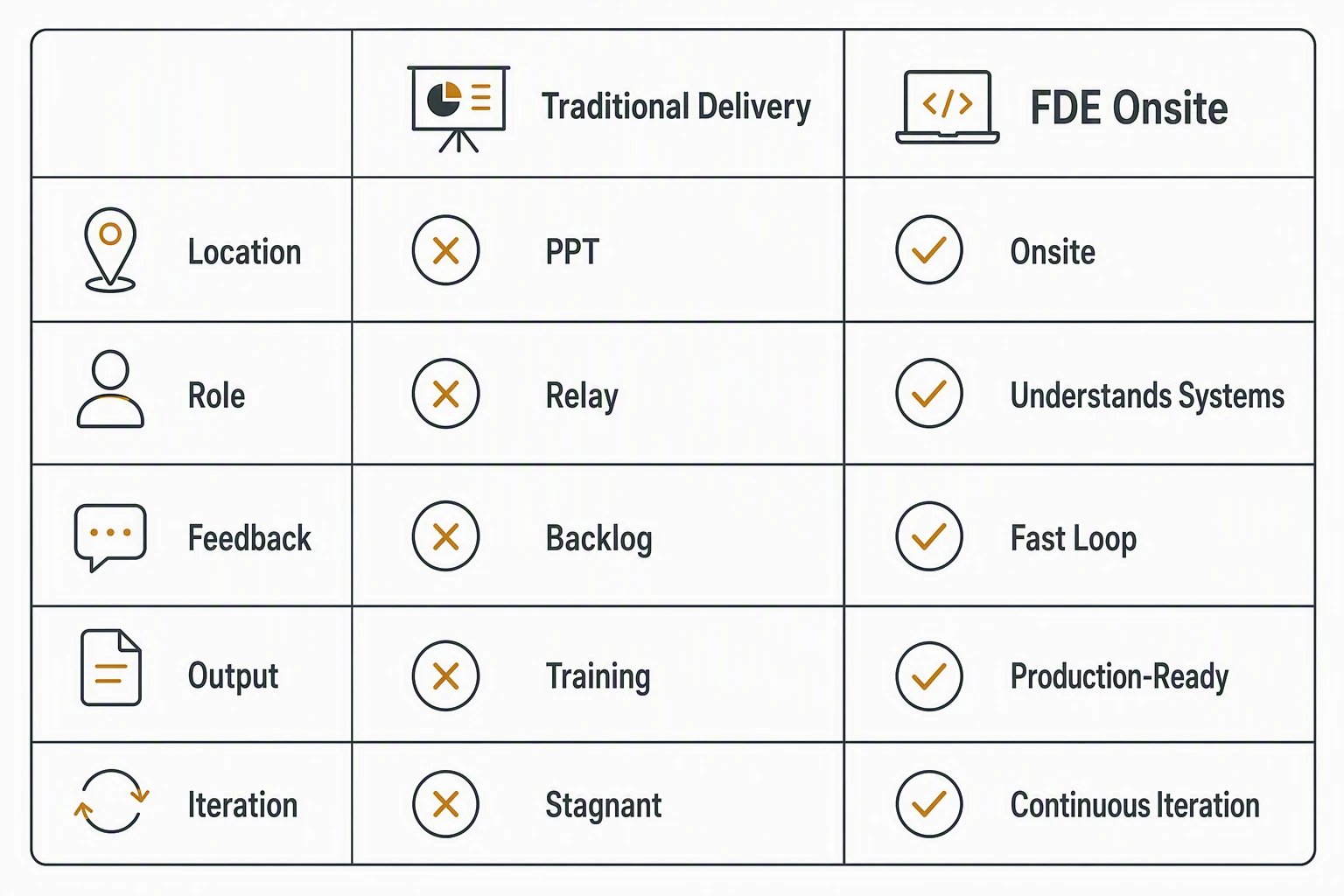
This operating model sharply contrasts with traditional enterprise IT delivery. Legacy vendors depend on multi-month requirement gathering, pre-sales handoffs, centralized engineering roadmaps, and post-launch user training. FDEs operate as production engineers embedded inside the client's operational bloodstream. They must understand frontline friction and possess the engineering caliber to translate that chaos into system architecture, data governance, workflow orchestration, and core platform enhancements.
In enterprise AI, this capability has become a scarce bottleneck. In a conference room, agent demos look effortless: select a top-tier LLM, connect an out-of-the-box vector database, ingest a handful of clean PDFs, and watch it answer curated prompts. But the moment the agent enters an enterprise intranet and confronts live production data, the illusion evaporates.
Models generate fluent language, but they do not inherently comprehend document version control, hardware batch revisions, access permissions, proprietary APIs, or multi-tiered approval hierarchies. The resurgence of the FDE is an industry-wide admission that these last-mile engineering challenges cannot be solved by scaling model parameters alone.
2. From Demo to Production: The Three Real-World Chasms
In PoC sandboxes, enterprise AI feels omnipotent. Once tasked with running real operational workloads, deployments routinely stall within days.
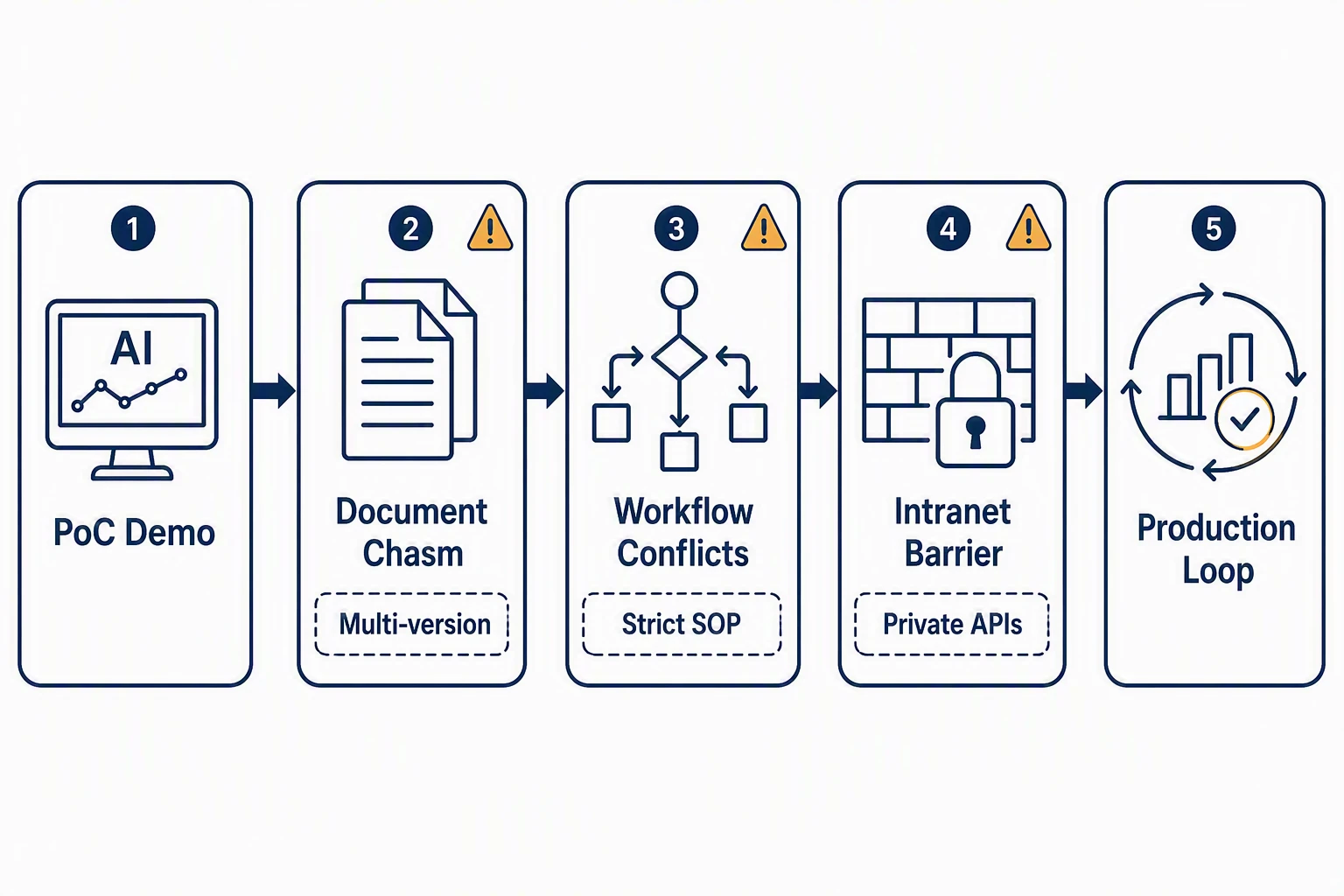
Chasm 1: The Quagmire of Unstructured Documentation
Real-world enterprise documentation is fraught with low-resolution scans, multi-layer nested tables, cryptic internal acronyms, and conflicting revisions. In manufacturing, two equipment variants might share an identical chassis while their internal component part numbers differ by a single suffix. If a system relies on naive global vector search across an unmanaged document pool, it frequently pulls maintenance procedures for parts decommissioned two years ago.
Chasm 2: The Collision of Deterministic Workflows and Probabilistic Generation
Core operational workflows—after-sales diagnostics, contract validation, equipment inspections—follow strict Standard Operating Procedures (SOPs). LLMs are probabilistic engines. Left unconstrained in an open-ended conversational interface, models contradict themselves across turns, skip critical safety verifications, or drift into hallucinated logic loops.
Chasm 3: The Integration Void of Legacy Intranets
High-value operational data rarely sits on public endpoints; it resides behind dedicated leased lines, on legacy ERPs, on-prem CRMs, or proprietary databases with custom authentication protocols and strict perimeter security forbidding public Internet exposure. Business units also demand granular, role-based tool and data access. Hand-crafting bespoke middleware scripts for every endpoint is prohibitively expensive and impossible to maintain.
These unglamorous engineering hurdles represent the true cost of enterprise AI. The FDE's job is to build order between probabilistic models and deterministic enterprise infrastructure.
3. How Agent Development Platforms Form the FDE's Modern Arsenal
Palantir's early FDE model was notoriously labor-intensive—relying on elite engineers writing bespoke code on-site to bridge every operational gap. From a software economics perspective, that artisanal approach cannot scale across thousands of enterprises.
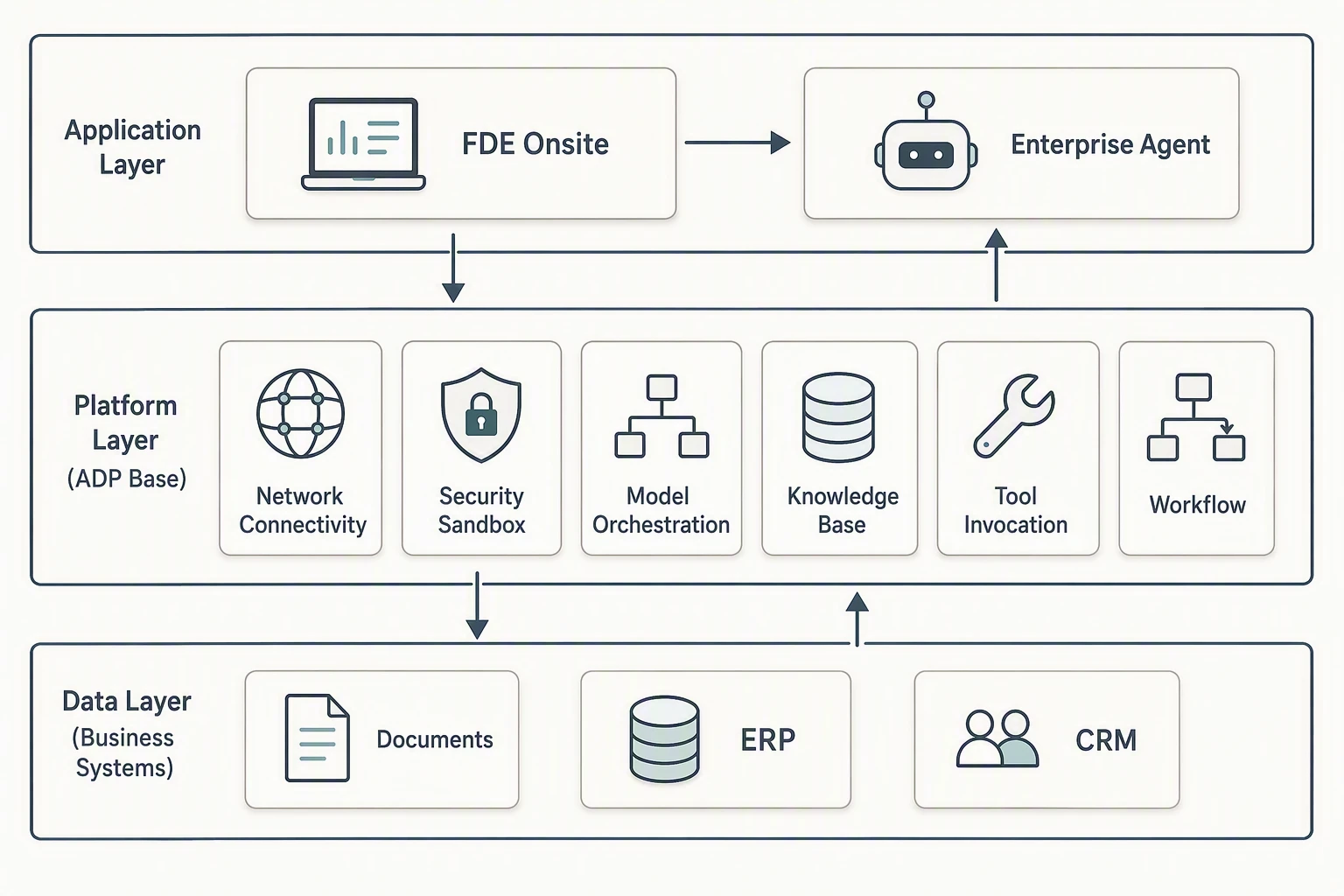
Today, the evolution of agent platforms like Tencent Cloud ADP is productizing the hard-won battlefield experience of FDEs into standardized infrastructure. Field engineers no longer need to write reverse proxies, token rotation daemons, or custom chunking logic from scratch. Instead, they leverage native platform primitives to bypass systemic roadblocks.
The value of an enterprise agent platform is not in turning systems engineering into a simplistic toy builder. It is in abstracting network connectivity, secure sandboxing, streaming execution pipelines, model routing, knowledge retrieval, tool execution, and workflow orchestration. This frees the FDE to focus on decomposing business logic and enforcing delivery quality.
In mission-critical sectors such as manufacturing, healthcare, finance, and the public sector, AI deployments face stringent standards for uptime, access governance, auditability, and regression testing. Standardizing delivery on a unified platform transforms tribal, individual knowledge into team-wide, repeatable engineering execution.
4. Decoupling Knowledge Retrieval from Workflow Execution
In manufacturing plants and hospital medical device suites, a company may operate hundreds of closely related equipment variants. Component part numbers often span 15-character alphanumeric strings differing by only one trailing character. When maintenance manuals are dumped blindly into a vector database, cosine similarity easily conflates part numbers across model years, dragging retrieval accuracy below production thresholds.
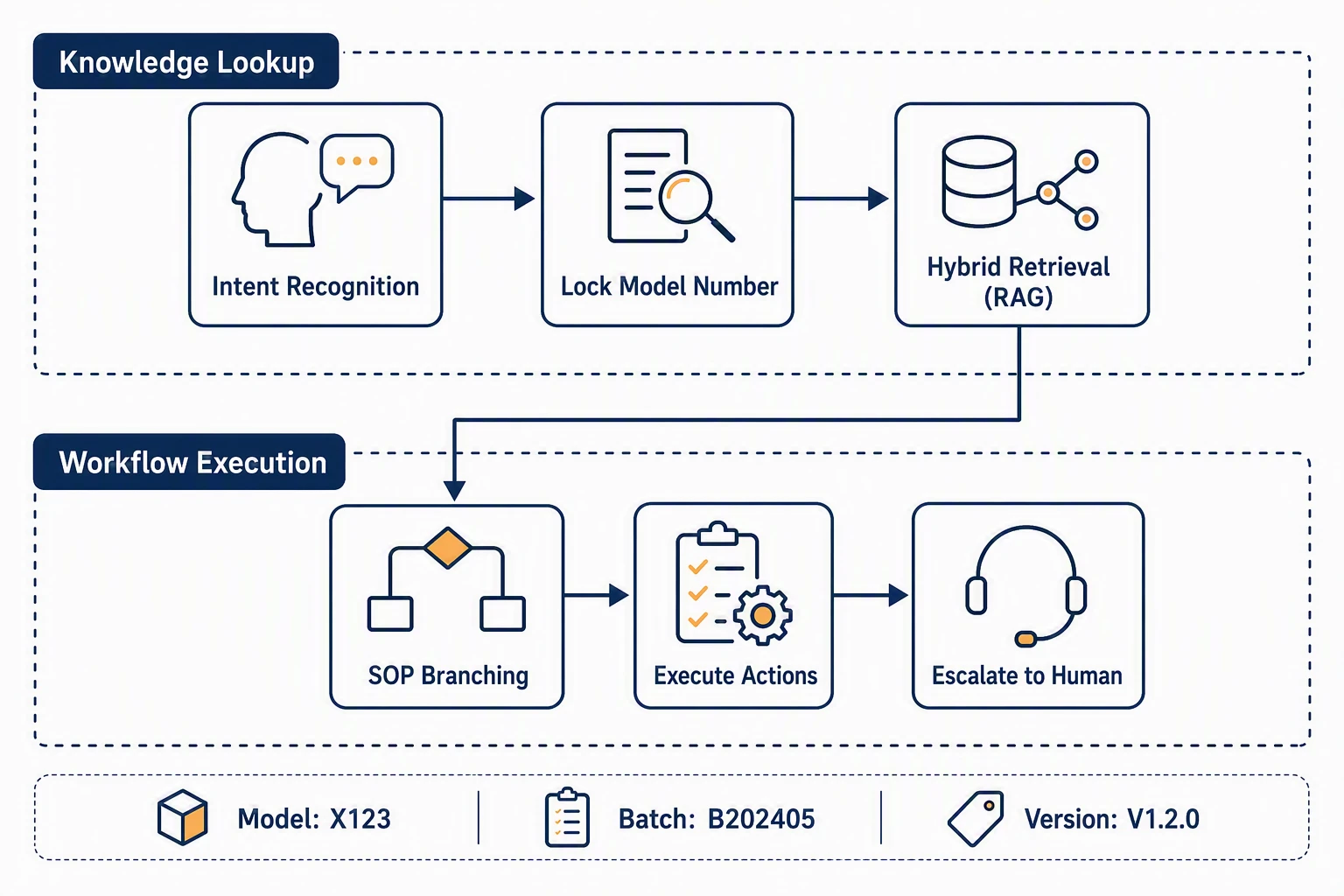
Experienced FDEs never let a model wander through an unconstrained document pool. Instead, they deploy a two-phase architecture:
- Metadata-Constrained Retrieval: Extract the exact equipment model, batch number, and region from user intent to lock down the search boundary using structured metadata, followed by hybrid retrieval (combining dense vector embeddings and sparse BM25 keyword matching) to prevent cross-model contamination.
- Deterministic Workflow Execution: Troubleshooting must follow rigid SOPs. Measuring voltage, inspecting warning LEDs, and escalating to human engineers should be anchored as deterministic workflow nodes on a visual canvas. The system advances step by step along verified conditional branches, rather than relying on an LLM to guess what to do next in a free-form chat.
This decoupled architecture is standard practice across industrial and healthcare deployments—wherever part-number precision and procedural safety carry non-negotiable stakes.
5. Bridging Enterprise Systems with Connectors and MCP
Enterprise data is rarely stored in isolated files. It is locked inside decades of accumulated records across ERPs, CRMs, MES, or proprietary SQL databases running on internal subnets with custom auth and stringent audit controls.
In the past, delivery engineers spent weeks writing ad-hoc gateway proxies, managing token rotation, and hand-marshalling internal data formats. A single schema update on the backend could break the entire integration layer.
The emergence of Enterprise Connectors and the Model Context Protocol (MCP) standardizes the contract between enterprise APIs and autonomous agents. The FDE simply defines the tool inputs, execution parameters, and output schemas against open specifications, while the underlying platform handles transport security, credential isolation, and network peering.
This propels the agent far beyond static document retrieval. Within clear governance and compliance boundaries, the agent can safely read live operational metrics, route tickets, and trigger actions across enterprise systems—closing the loop between intelligence and execution.
6. Grounding Delivery Acceptance in Real-World Ticketing Data
Looking back at Palantir's trajectory, its moat in defense intelligence and Fortune 500 enterprises was never just raw algorithms. It was the governance, integration, and mastery of messy, multi-source enterprise data. On real operational battlefields, algorithms without clean factual ground truth fail quickly.
The same reality governs enterprise AI today. Foundation models are a shared commodity. The proprietary data accumulated over decades—unresolved tickets, service inspection logs, maintenance histories, and QA transcripts—is the enterprise's true competitive moat.
Many AI deployments devolve into a frustrating standoff: business stakeholders complain the agent is unusable, while engineers don't know what to fix. The root cause is the absence of an empirical evaluation anchor. Blindly tweaking system prompts based on anecdotal complaints inevitably creates a game of whack-a-mole—fixing one edge case while breaking three others.
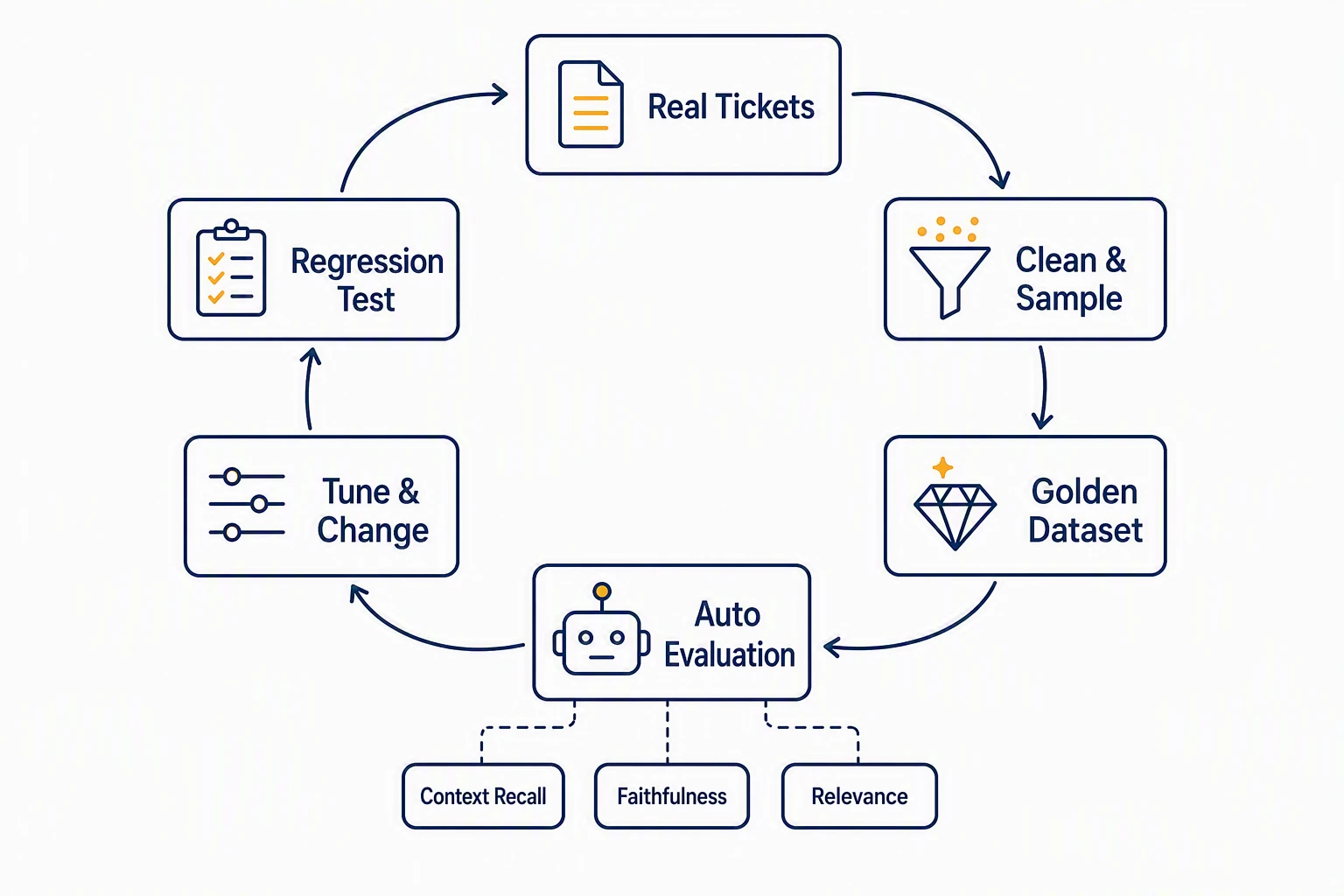
Veteran FDEs do something different on day one: they dive into historical ticketing logs and extract 100 to 200 representative, real-world cases to construct a "Golden Evaluation Dataset." Within Tencent Cloud ADP, engineers import these production test suites into the automated evaluation engine to benchmark context recall, answer faithfulness, and business relevancy.
Whenever retrieval parameters, prompts, or workflow branches are modified, the engineer runs full regression benchmarks in the console. Only when system accuracy is quantitatively validated against real production distributions is the agent ready for deployment.
7. From Bespoke Craftsmanship to Industrialized Engineering
The maturation of any transformative technology follows the same curve: moving from artisanal heroics by a handful of experts to repeatable, assembly-line standardization.
Early FDEs operated like tactical firefighters deployed on-site, relying on personal engineering intuition to tackle one-off fires. But as enterprise AI scales across core pillars—manufacturing, healthcare, finance, public sector—the industry requires an objective, reproducible benchmark for engineering competency and delivery methodology.
Low-code agent development platforms serve as the industrial foundation. By encapsulating high-barrier concerns like VPC peering, secure code sandboxes, streaming pipelines, and model routing, they allow field engineers to concentrate on domain modeling, knowledge curation, tool contracts, workflow orchestration, and regression testing. The industrialization of enterprise AI delivery is underway—and the FDE is at its center.
Frequently Asked Questions (FAQ)
1. How does an FDE differ from a traditional pre-sales consultant or delivery engineer?
A Forward Deployed Engineer bridges deep systems engineering with acute business comprehension. Rather than documenting feature requests or executing static software deployments, an FDE operates directly within the client's operational environment to resolve data fragmentation, proprietary integrations, complex workflows, and security boundaries—converting raw customer friction into reusable platform architecture.
2. Why do enterprise AI projects consistently stall after the PoC phase?
PoCs typically evaluate curated documents and pre-formulated questions within sanitized sandbox environments. Production environments, by contrast, present scanned PDFs, conflicting document versions, strict multi-step SOPs, private intranet infrastructure, role-based access controls, and compliance audits—realities that cannot be resolved without dedicated field engineering.
3. Why is naive global vector search insufficient for enterprise knowledge bases?
Enterprise technical documentation frequently features dense alphanumeric model codes, minor revision suffixes, and superseded maintenance bulletins. Global semantic similarity easily confounds adjacent hardware revisions across product lines. Production systems require structured metadata filtering to isolate the search partition before applying hybrid vector and sparse keyword retrieval.
4. What critical problem do deterministic workflows solve in agent delivery?
Workflows enforce deterministic execution for mission-critical operations. In fault diagnostics, contract validation, or field inspections, execution sequences, threshold evaluations, and human escalation rules must follow strict rules rather than depending on an LLM to probabilistically decide what action to take next in a chat dialogue.
5. Why are golden evaluation datasets vital for enterprise AI?
Golden datasets provide empirical anchors for delivery acceptance. By curating 100 to 200 representative production cases from real ticketing logs, field reports, and customer service transcripts, engineering teams can run automated regression tests after every prompt adjustment, RAG parameter tuning, or workflow modification—eliminating guesswork and subjective evaluations.
Summary: Engineering the Last Mile of Enterprise AI
The resurgence of the Forward Deployed Engineer reflects a fundamental maturation in enterprise AI. While foundation model breakthroughs remain essential, the transition from compelling demos to mission-critical production requires engineers who can synthesize messy documents, deterministic workflows, secure intranet systems, and automated evaluation suites into a dependable operational loop.
Delivering enterprise agents is not an exercise in calling an isolated inference API; it is full-stack systems engineering. Knowledge assets must be governed, business processes orchestrated, legacy infrastructure integrated, and performance continuously benchmarked. The FDE’s value lies in transforming these disparate complexities into an engineered, verifiable, and scalable capability.

Start building today
If you need more support, please contact us