
Tencent Cloud ADP 4.0 Smart Retail Solution: Hung Fook Tong Case Study
Designed for retail technology leaders, IT operations teams, and digital transformation owners, this article examines how Tencent Cloud and UXSoft supported Hung Fook Tong’s smart retail transformation. It highlights how Tencent Cloud ADP 4.0 enables practical AI Agent deployment across real-time…


Digital transformation in retail often starts with systems such as POS, membership, inventory, and marketing. However, as store networks expand, customer touchpoints increase, and promotional cycles accelerate, new challenges emerge: data is scattered across different systems, inventory status lags behind, marketing strategies are difficult to adjust in real time, member insights rely on manual consolidation, and management must wait for reports before accessing business analysis.
Recently, Tencent Cloud, together with UXSoft, a solution provider specializing in digital transformation for retail, supported Hung Fook Tong in a large-scale smart retail transformation. The solution uses Tencent Cloud’s computing power, cybersecurity services, and infrastructure services (IaaS) as the backend, combined with UXSoft’s POS system and UXRetail system. It integrates Hung Fook Tong’s previously fragmented retail management, marketing strategy management, membership management, and inventory management systems into a fully real-time integrated management center, while introducing AI Agents for business analysis and in-depth member analysis.
From the perspective of Tencent Cloud ADP 4.0, this case provides a clear reference for the smart retail industry: for AI Agents to enter production environments, they must be able to connect to business systems and understand business data, while also supporting permission control, log auditing, cost observability, and continuous optimization. This article uses Hung Fook Tong’s practice as a reference to explain how retail enterprises can implement, govern, and operate AI Agents through Tencent Cloud ADP 4.0.
Key Takeaways
- Hung Fook Tong’s original sales, inventory, and customer relationship systems operated relatively independently, requiring significant manpower and time for data integration and analysis.
- UXSoft helped Hung Fook Tong migrate and integrate retail management, marketing strategy management, membership management, inventory management, and other systems into an integrated management center.
- Inventory data that previously lagged by one day has been upgraded to real-time data, supporting store transfers, replenishment, and inventory risk alerts.
- AI Agents mainly cover business analysis and in-depth member analysis. Management can quickly obtain analytical results through Prompts, while member consumption behavior can be used to generate marketing or promotional strategies.
- ADP 4.0 addresses the full lifecycle of enterprise-grade Agents, emphasizing building, evaluation, integration, distribution, governance, observability, and optimization.
- In smart retail scenarios, Agent operations cannot focus only on model performance. They must also address permissions, logs, Token usage, invocation chains, data security, and business closed loops.
1. The Retail Transformation Pressure Behind Hung Fook Tong’s Case
Founded in 1986, Hung Fook Tong is a local health food and beverage brand with a 40-year history and more than 100 stores in Hong Kong. As its retail network expanded, the company faced increasingly complex challenges in system collaboration and operational decision-making.
Dr. Ricky Szeto, Chief Executive Officer and Executive Director of Hung Fook Tong Group Holdings Limited, noted in the case that the group’s sales, inventory, customer relationship, and other systems had been operating independently. Large amounts of manpower and time were required to consolidate and analyze fragmented data. Even then, the analytical results did not necessarily translate into deep insights for decision-making, and operational judgment still depended on a small number of managers with extensive sales experience.
Such issues are common in chain retail:
- Siloed systems: POS, membership, inventory, promotion, and reporting systems are built separately, making it difficult to unify data definitions.
- Delayed inventory visibility: Store sales change quickly, but delayed inventory data affects replenishment, stock transfers, and loss control.
- Broad-brush marketing: Customer profiles vary significantly across stores, yet enterprises can only apply unified sales strategies.
- Inefficient reporting: Management must wait for manual consolidation and cannot make decisions anytime based on the latest data.
- AI struggles to enter production: Point AI tools can be piloted, but lack permissions, auditing, operations, and cost management capabilities.
The key to smart retail transformation is to turn these “fragmented capabilities” into enterprise-grade capabilities that AI can securely invoke, business teams can continuously use, and IT can centrally govern.
2. From Fragmented Systems to “Four-in-One Real-Time Management”
Mr. Lu Chief Operating Officer of UXSoft Global Limited, said that one of the key priorities of the solution was to migrate Hung Fook Tong’s previously disconnected operational systems, including retail management, marketing strategy management, membership management, and inventory management, to Tencent Cloud, and integrate them through UXSoft’s UXRetail system into a unified management center.
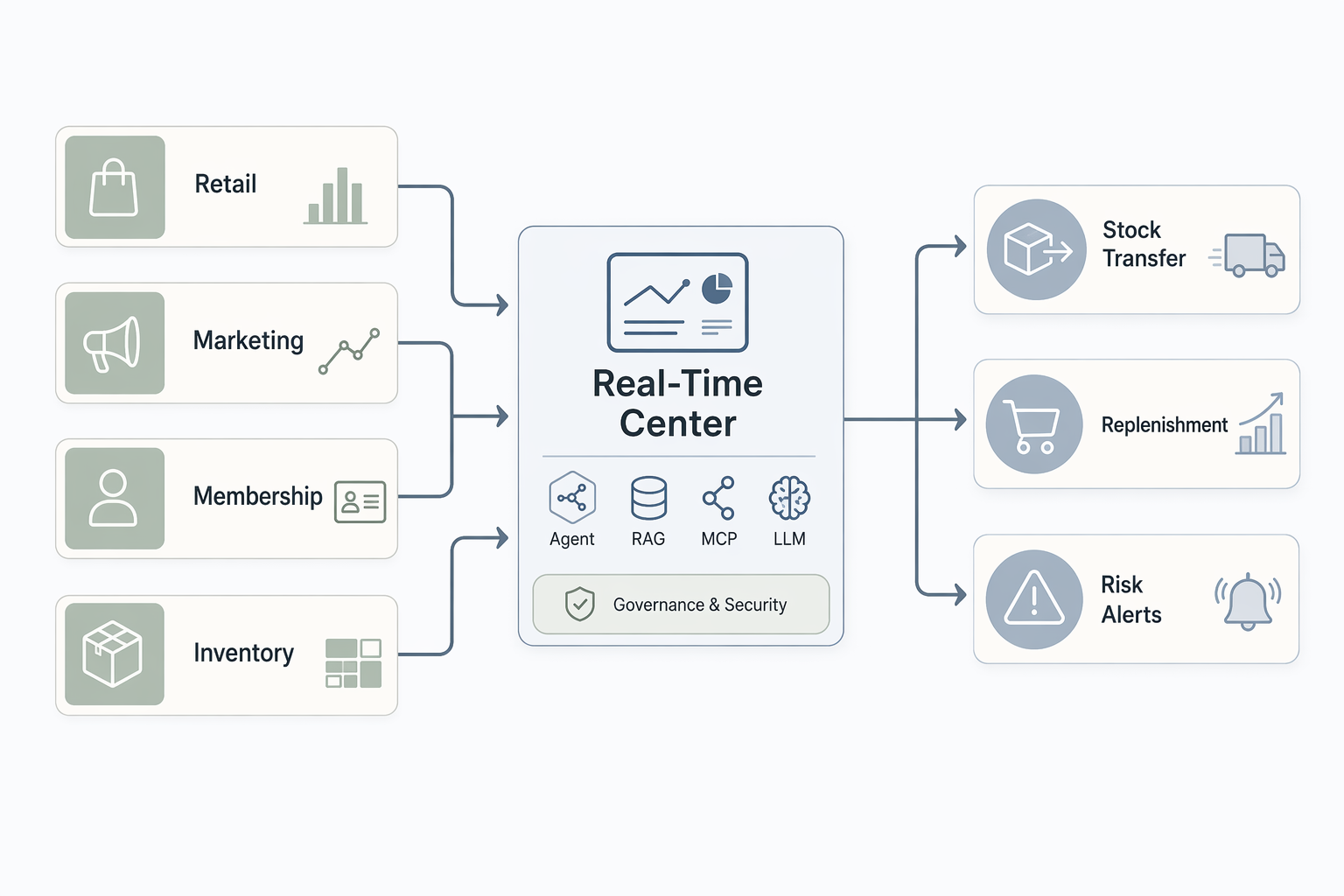
This change has a direct impact on retail operations: data shifts from “post-event consolidation” to “real-time visibility.”
After the transformation, Hung Fook Tong can monitor all group-wide data in real time from a single platform, reducing the workload required for manual collection, consolidation, and analysis. The source material notes that inventory data, which previously lagged by one day, was upgraded to real-time data, enabling immediate stock transfers and replenishment for each store.
For chain retail enterprises, real-time inventory brings value at three levels:
- Store level: Identify stockout risks for fast-selling products in time and reduce cases where customers arrive but products are unavailable.
- Regional level: Allocate inventory based on the sales rhythm of different stores to improve overall turnover efficiency.
- Headquarters level: Evaluate product strategies and marketing campaign performance by combining inventory, sales, membership, and promotional data.
Without a unified data foundation, AI Agents can only answer localized questions. Once inventory, membership, sales, and promotion data are integrated, Agents gain the foundation required for cross-system analysis.
3. How AI Agents Enter Business Analysis and Member Operations
Mr. Lu mentioned that the AI Agents currently provided by UXSoft for Hung Fook Tong mainly cover business analysis and in-depth member analysis. For business analysis, management can use AI Agents to complete business analysis in a short time anytime and anywhere with a Prompt. For in-depth member analysis, AI Agents analyze member consumption behavior to generate marketing or promotional strategies.
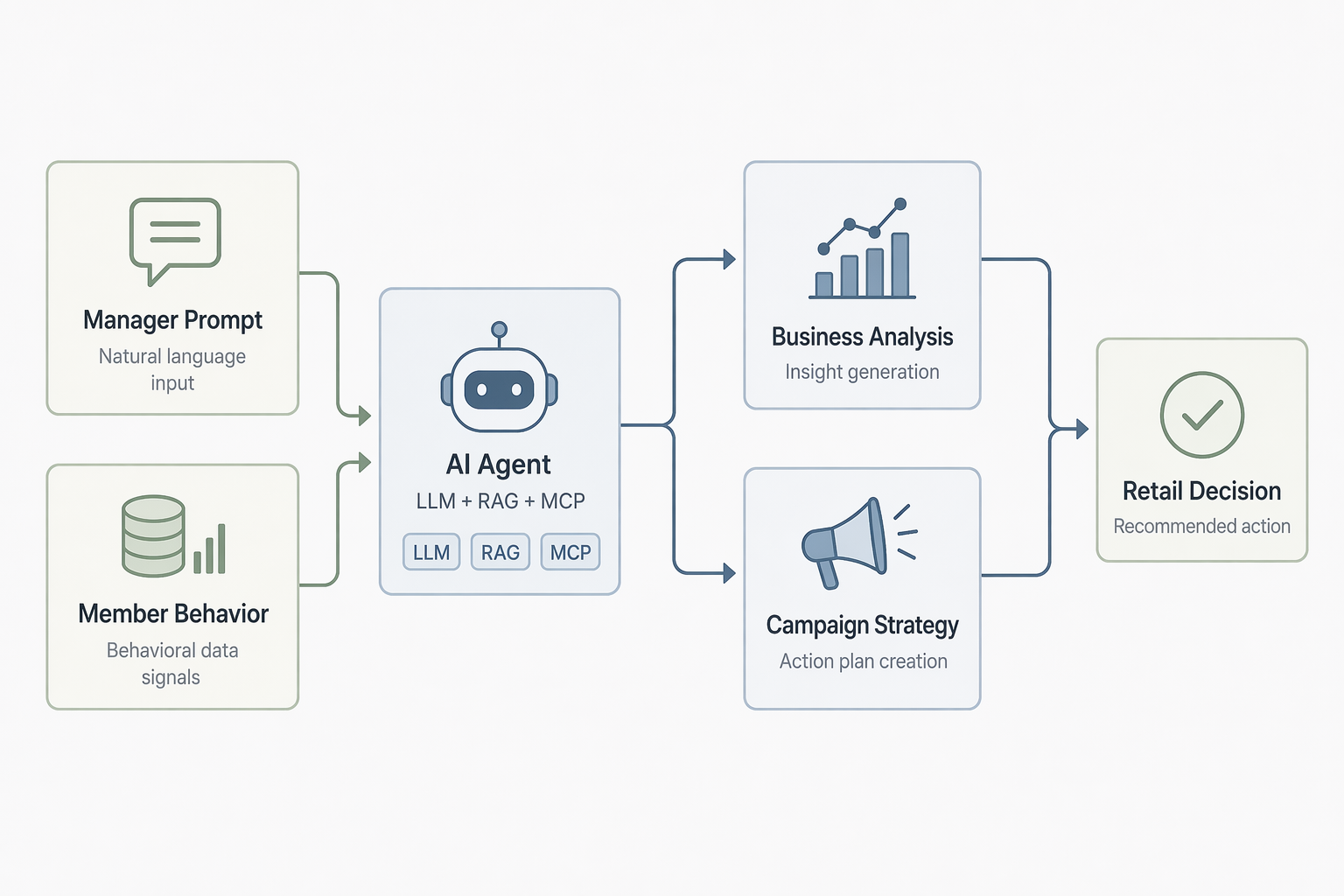
These scenarios represent a typical implementation path for Agents in smart retail: start with high-frequency, data-intensive, and labor-consuming analytical tasks, then gradually expand to operational recommendations and automated execution.
For example, management can initiate analysis around the following questions:
- Which stores have seen significant sales changes recently?
- Which products are at risk of stockouts?
- Which products are underperforming and may create overstocking or expiry risks?
- Are different store customer groups suitable for differentiated promotional strategies?
- What types of member consumption behavior can trigger more targeted marketing campaigns?
Dr. Ricky Szeto also noted that, in the future, he hopes colleagues will no longer need to spend large amounts of time organizing and analyzing data. Instead, they can use AI to analyze the company’s inventory losses and manpower arrangements, and even predict the potential impact of future weather and holidays on sales, allowing teams to spend more time discussing solutions and making operational decisions.
From the perspective of technical leaders, this means the value of AI Agents is not only in “answering questions,” but also in connecting existing enterprise systems, business knowledge, and data analysis processes to form reusable business analysis capabilities.
4. Tencent Cloud ADP 4.0 Provides the AgentOps Foundation for Smart Retail
Tencent Cloud ADP 4.0 is built around the core concept of AgentOps and upgrades the full lifecycle of enterprise AI Agents, covering building, evaluation, integration, distribution, governance, observability, and optimization. For retail enterprises, these capabilities determine whether AI Agents can move from pilots into the daily work of stores, headquarters, and operations teams.
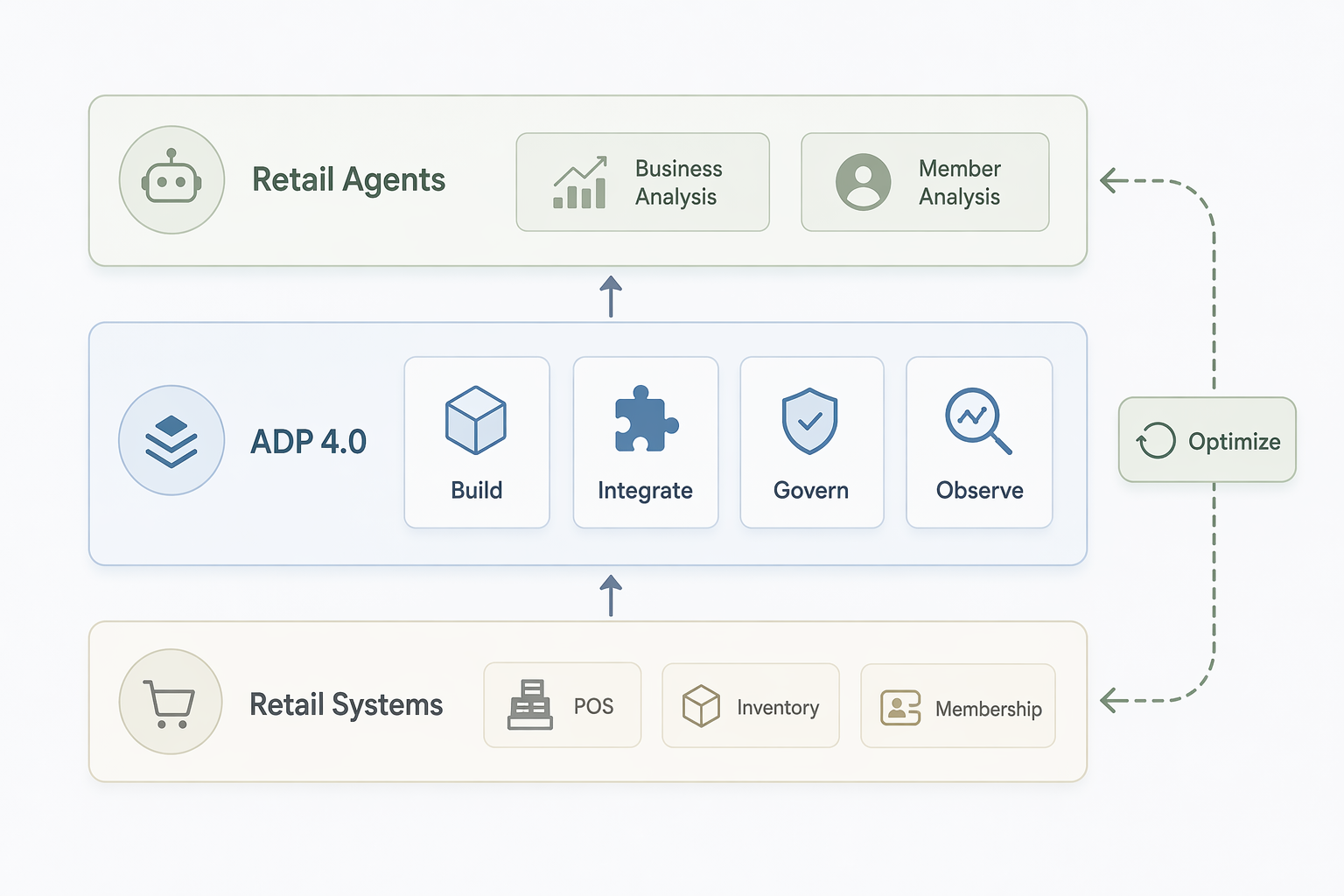
In the Hung Fook Tong case, Mr. Poshu Yeung, General Manager of Tencent Cloud Hong Kong and Macau, mentioned that ADP is designed specifically for enterprises. All instructions and responses given to Agents have complete log records, and permission settings can restrict departments and users to only access the data required for their work. Management can also monitor Token usage in a timely manner to control costs and support planning and auditing.
This is highly aligned with ADP 4.0’s enterprise-grade positioning. Through Tencent Cloud ADP, enterprises can establish an Agent operations system around the following areas:
- Building: Quickly create AI Agents based on natural language, Workflows, Knowledge Bases, and tools.
- Integration: Connect to existing enterprise systems through APIs and embed Agents into business processes such as POS, CRM, OA, and ticketing.
- Governance: Manage permissions for users, departments, applications, data, and tool invocation.
- Observability: Track invocation volume, error rates, Token usage, chain logs, and operating costs.
- Optimization: Continuously adjust Prompts, Knowledge Bases, tools, and business processes based on usage feedback.
For retail enterprises, AgentOps provides the foundation for AI capabilities to be “deployable, auditable, adjustable, and continuously operable.”
For more ADP 4.0 capabilities, see: ADP 4.0 Feature Update Overview.
5. Claw Mode Lowers the Barrier to Building Complex Agents
ADP 4.0 introduces Claw mode for AI Agent scenarios that require stronger logic and longer task chains. Enterprise users can describe task objectives in natural language. The Agent then autonomously plans, writes, and runs code in a cloud sandbox, while invoking governed Skills, Connectors, Knowledge Bases, and Workflows that have already been integrated.
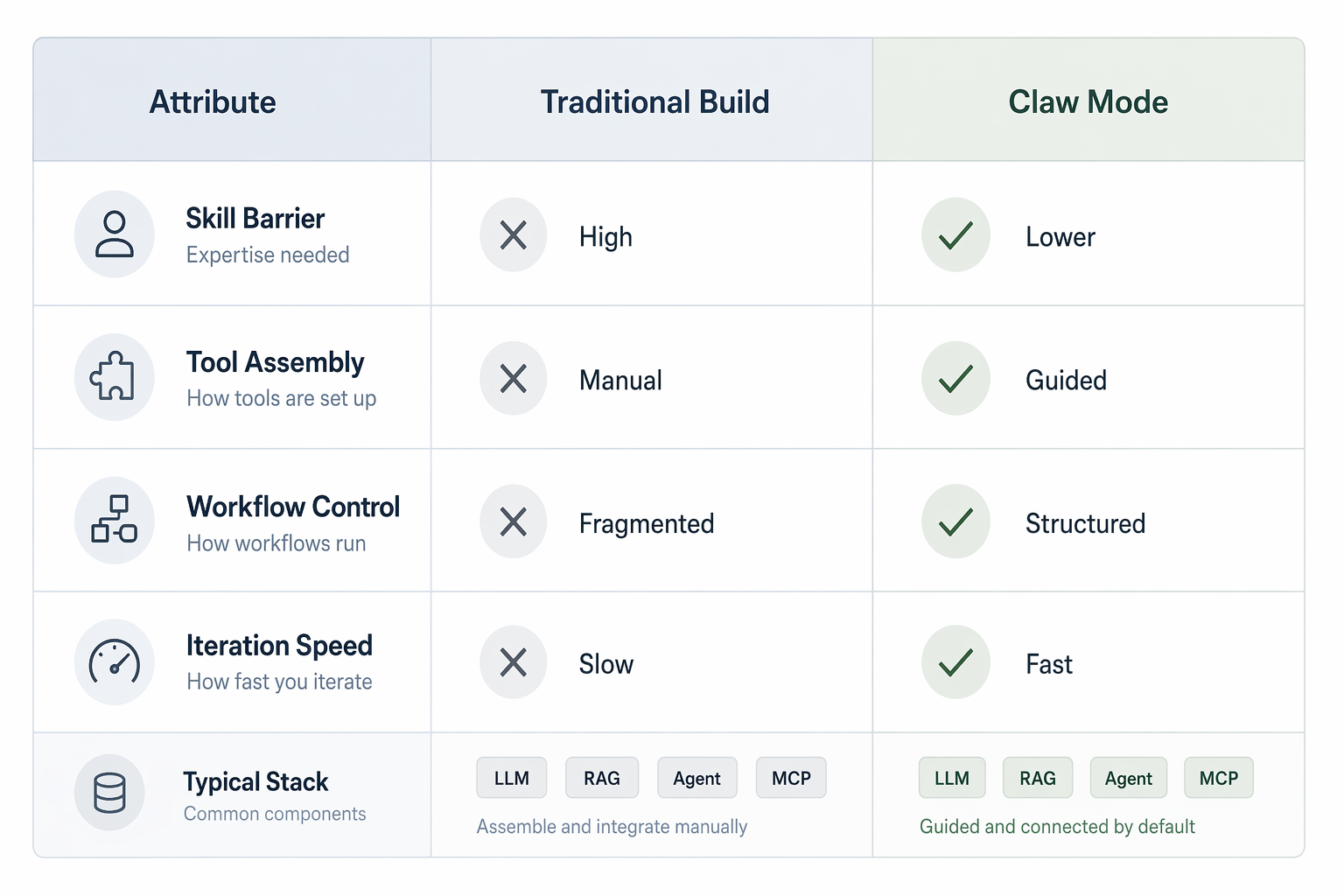
In smart retail scenarios, Claw mode is suitable for more complex analytical tasks, such as:
- Summarizing sales performance across multiple stores, categories, and time periods;
- Generating replenishment recommendations based on inventory and sales velocity;
- Performing segmentation analysis on member consumption behavior;
- Generating store operation dashboards or operational analysis documents;
- Passing AI analysis results to Workflows to trigger manual approval or subsequent operational actions.
ADP 4.0 also supports two-way invocation between Workflows and Claw applications: Claw applications can invoke existing Workflows, and the Workflow editor can use published Claw applications as functional nodes. For retail enterprises, this helps embed “AI analysis” into existing operational processes without rebuilding legacy systems from scratch.
For example, after an inventory Agent discovers that certain products are selling quickly in some stores, it can first generate replenishment recommendations and then enter an approval or transfer process. After a member analysis Agent identifies a specific member segment, it can generate campaign recommendations for marketers, which the business team can then confirm before execution.
6. Permissions, Logs, and Token Costs: Three Main Lines of Retail Agent Operations
Retail enterprises handle large volumes of sales data, member information, and store operation data. The source material also notes that Hung Fook Tong has a large sales network involving significant amounts of confidential sales data and member information, with large volumes of data access occurring every second. System security and stability must therefore be ensured.
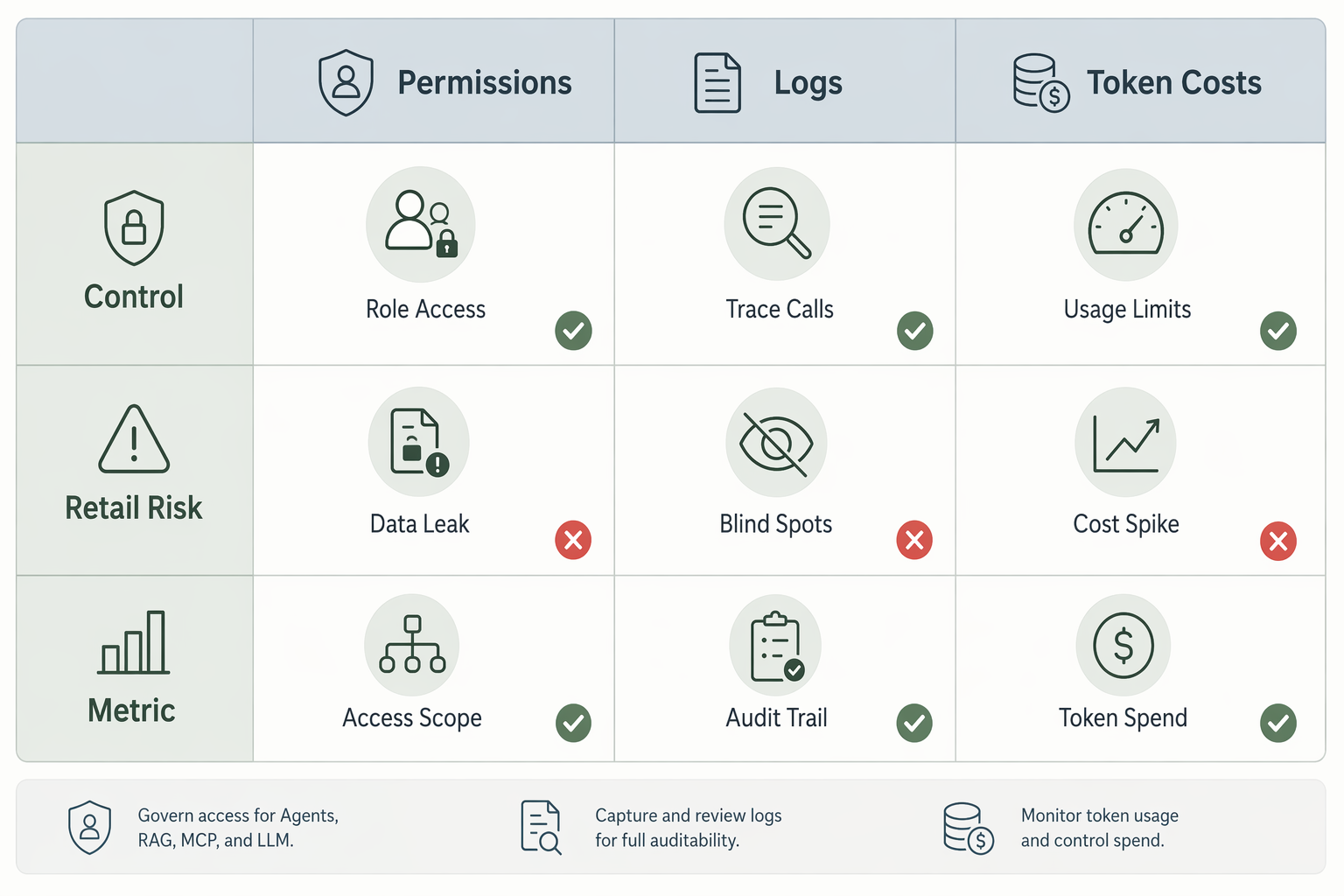
As a result, Agent operations in smart retail should focus on three main lines.
1. Permission Boundaries
Different roles should have clearly defined data access scopes. For example, store staff can view operational data for their own store, regional managers can view data for their jurisdictions, and headquarters management can view group-level data. ADP 4.0 supports permission management across levels such as enterprise, space, and application, and controls access boundaries through mechanisms such as RBAC.
2. Log Auditing
Every instruction, response, and tool invocation of an enterprise-grade Agent must be traceable. Logs not only support security audits, but also help IT teams troubleshoot incorrect responses, abnormal invocations, and process failures.
3. Cost Observability
When AI Agents enter daily operations, Token usage, invocation frequency, and computing costs become ongoing operational metrics. Management needs to observe usage across departments and AI Agents, and evaluate the relationship between cost and business value. When planning budgets, enterprises can also refer to ADP pricing for package and cost information.
For more on enterprise AI Agent security governance, see: Enterprise Security Governance for AI Agents.
7. From Inventory Monitoring to Flexible Promotions: A Smart Retail Agent Scenario Map
Based on Hung Fook Tong’s practice and ADP 4.0 capabilities, retail enterprises can prioritize Agent implementation in the following scenarios.
| Scenario | Business Challenge | Agent Capability Direction |
|---|---|---|
| Real-time inventory monitoring | Inventory data lags behind, delaying stock transfers and replenishment | Automatically monitor inventory changes and alert on stockout and overstocking risks |
| Product sales analysis | Fast-selling and slow-moving products are not identified in time | Summarize sales trends and generate product strategy recommendations |
| Member behavior analysis | Member operations rely on manual segmentation | Analyze consumption behavior and assist in generating marketing or promotional strategies |
| Flexible promotions | Customer groups differ by store, and unified strategies have limited effectiveness | Generate differentiated recommendations by store, customer group, and product mix |
| Management data inquiry | Report preparation is time-consuming, delaying decision-making | Quickly obtain business analysis results through Prompts |
| Store classification operations | Operating characteristics vary significantly across stores | Assist store classification based on sales and customer group data |
| Cost and audit | AI usage costs and risks are difficult to control | Observe Token usage, invocation logs, and permission access |
Dr. Ricky Szeto mentioned that the group will continue to train AI Agents in the future, enabling them to grow from simple assistants into intelligent partners that understand Hung Fook Tong’s customer needs, business scale, and store network, helping teams drive suitable solutions and further improve service quality.
This also reminds retail enterprises that building Agent capabilities is not a one-off project. Enterprises need to continuously improve data, knowledge, processes, and evaluation mechanisms so that Agents can keep evolving through real business feedback.
8. Implementation Path for Retail Enterprises Adopting ADP 4.0
For technical leaders and operations teams in retail enterprises, ADP 4.0 implementation can proceed along the following path.
Step 1: Map Systems and Data Assets
First, clarify the data structures, interface capabilities, and permission boundaries of systems such as POS, membership, inventory, marketing, ERP, and reporting. For systems that cannot be connected immediately, start by connecting high-value scenarios within a limited scope.
Step 2: Select High-Frequency Analytical Scenarios for Pilots
Prioritize scenarios with clear business value, relatively complete data, and high manual effort, such as inventory monitoring, business data inquiry, member segmentation, and promotional strategy generation. Pilot objectives should focus on “reducing manual data preparation time, improving analysis efficiency, and enhancing operational responsiveness.”
Step 3: Build Governable Agents
Use ADP 4.0 to connect Knowledge Bases, Skills, tools, and Workflows, and build AI Agents that business teams can use. At the same time, configure permissions, logs, audits, and usage observability to prevent AI capabilities from bypassing the enterprise governance system.
Step 4: Connect to Existing Business Processes
Embed AI Agents into daily Workflows through APIs or enterprise collaboration channels, allowing operations teams, stores, and management to use AI capabilities through familiar entry points. ADP 4.0 supports integration of AI capabilities into business systems such as OA, CRM, and ticketing, and can also publish them to channels such as WeCom, WeChat, DingTalk, and Agent Portal.
Step 5: Establish an Agent Operations Mechanism
Continuously track invocation volume, error rates, Token usage, business adoption rates, and user feedback. For high-frequency questions, optimize Prompts, Knowledge Bases, and tool configurations. For higher-risk actions, add human confirmation or approval nodes.
Through this path, retail enterprises can gradually expand AI Agents from “assisted queries” to “business analysis,” “operational recommendations,” and “process collaboration.”
FAQ
1. What AI Agent scenarios is ADP 4.0 suitable for in retail enterprises?
ADP 4.0 is suitable for scenarios such as inventory monitoring, business analysis, member behavior analysis, promotional strategy generation, store classification operations, report generation, knowledge Q&A, and business process automation. For Agents that require cross-system access, multiple data sources, and continuous operations, ADP 4.0’s governance, observability, and integration capabilities are especially critical.
2. Why do retail enterprises need to focus on Agent operations?
After AI Agents enter production environments, they involve permission access, tool invocation, data security, log auditing, Token costs, and business stability. Agent operations help enterprises continuously observe whether Agents are being used correctly, whether abnormal invocations exist, whether costs are controllable, and whether outputs meet business expectations.
3. What value does Claw mode bring to retail business?
Claw mode supports building more complex AI Agent tasks through natural language, with autonomous planning, code execution, and tool invocation in a cloud sandbox. For retail enterprises, it can be used for long-chain tasks such as multi-store sales analysis, inventory and replenishment recommendations, member segmentation, and operation dashboard generation.
4. Do retail enterprises need to transform all systems at once?
A more prudent approach is to first select high-value scenarios for pilots, such as real-time inventory monitoring or member analysis, and then gradually expand to promotions, stock transfers, reporting, and management data inquiry. System integration can be advanced in phases, but permissions, logs, and data governance should be incorporated into the design at an early stage.
Conclusion: Make Smart Retail Agents Governable, Operable, and Evolvable
The Hung Fook Tong case demonstrates the key direction of smart retail transformation: first integrate fragmented retail management, marketing strategy management, membership management, and inventory management systems into a real-time integrated management center, and then allow AI Agents to create value around business analysis, member insights, inventory monitoring, and promotional strategies.
For more retail enterprises, the focus of AI Agent implementation is not only model capability, but also whether Agents can connect to real business systems, comply with enterprise permission boundaries, retain complete logs, observe Token costs, and continuously optimize performance in operations. With AgentOps at its core, Tencent Cloud ADP 4.0 provides an enterprise-grade AI Agent foundation for the smart retail industry, spanning building and governance, integration and observability.
To learn how Tencent Cloud ADP 4.0 can help retail enterprises build governable and operable AI Agents, you are welcome to schedule a smart retail solution consultation or request a product demo.

Start building today
If you need more support, please contact us