
Beauty Retail AI Shopping Guide Practice
Build beauty retail AI guide with Multi-Agent architecture. Three sub-Agents for skin analysis, ingredient decoding & product recommendations.


Summary
Beauty retail is transforming from "selling products" to "selling solutions"—consumers don't just want skincare products, they want to solve skin problems. This article shares a practical case of intelligent beauty shopping guide based on Multi-Agent architecture: a main Agent coordinates three specialized sub-Agents (Skin Analyst, Ingredient Decoder, and Product Recommender), combining brand product knowledge base with web search plugins to deliver full-chain intelligent shopping services from skin analysis to precise recommendations.
Industry Pain Points in Beauty Retail
Beauty retail shopping guides face three core challenges:
| Pain Point | Manifestation |
|---|---|
| Personalized Consumer Needs | Everyone has different skin types and concerns; standardized recommendations fall short |
| High Product Knowledge Barrier | Numerous product categories, complex ingredients—ordinary sales staff struggle to provide professional answers |
| Rapidly Updating Ingredient Information | New ingredients and effects constantly emerge; knowledge bases struggle to maintain real-time coverage |
Industry Trend: Consumers are increasingly "ingredient-savvy," researching ingredient lists, checking effects, and comparing products before purchasing. Intelligent shopping guides must not only recommend products but also explain why they're recommending them.
Solution: Multi-Agent Architecture Design
Overall Architecture
Adopting a "1+3" Multi-Agent architecture, the main Agent handles intent recognition and workflow orchestration, while three specialized sub-Agents each focus on their expertise:
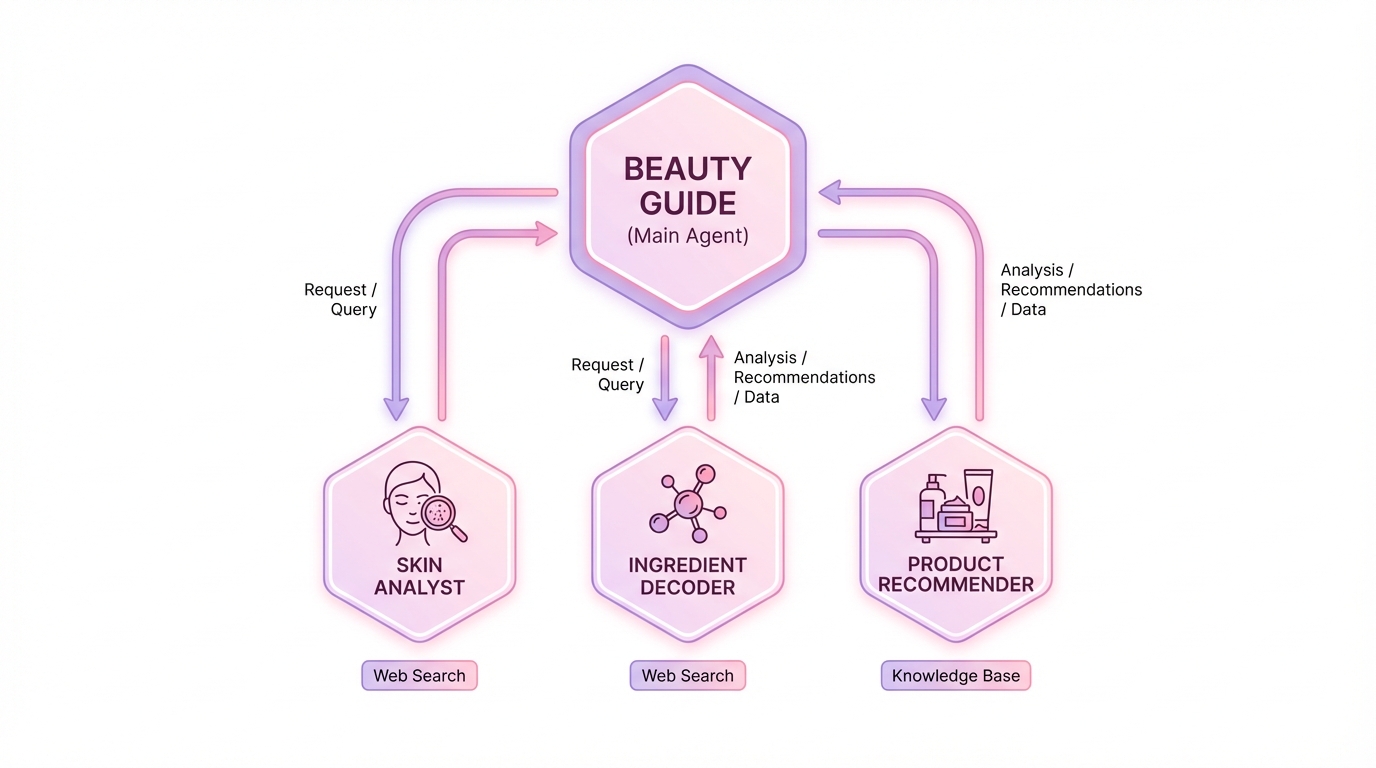
| Component | Role | Core Capabilities | Data Source |
|---|---|---|---|
| Beauty Shopping Guide (Main Agent) | Unified entry, intent recognition, workflow orchestration | Understand user needs, coordinate sub-Agent collaboration | - |
| Skin Analyst Agent | Skin analysis expert | Skin type assessment, problem diagnosis, skincare advice | Web Search Plugin |
| Ingredient Decoder Agent | Ingredient analysis expert | Ingredient effect interpretation, comparisons, contraindication alerts | Web Search Plugin |
| Product Recommender Agent | Product recommendation expert | Precise product matching, regimen combination recommendations | Brand Product Knowledge Base |
Design Highlights
| Highlight | Description |
|---|---|
| Knowledge Base + Search Complementarity | Product info uses knowledge base for accuracy; skin/ingredient knowledge uses web search for timeliness |
| Professional Specialization | Diagnosis, interpretation, recommendation separated—each does their specialty |
| Workflow Orchestration | Main Agent orchestrates as needed: diagnose → interpret → recommend |
| Explainable Recommendations | Not just recommending products, but explaining ingredients and suitable skin types for persuasiveness |
Three Sub-Agents in Detail
1. Skin Analyst Agent
Positioning: User's "dermatology consultant" for skin issues
| Capability | Scenario Example |
|---|---|
| Skin Type Assessment | "Am I oily or combination-oily?" |
| Problem Diagnosis | "What causes closed comedones on my face?" |
| Skincare Advice | "How should sensitive skin be cared for?" |
| Cause Analysis | "Why does my skin get dry and flaky during season changes?" |
Data Source: Web Search Plugin
- Real-time search for dermatology expertise
- Latest skincare research findings
- Coverage of various skin type Q&A
2. Ingredient Decoder Agent
Positioning: The "translator" for skincare ingredients
| Capability | Scenario Example |
|---|---|
| Ingredient Effects | "What does niacinamide do?" |
| Ingredient Comparison | "Which is more moisturizing, hyaluronic acid or ceramides?" |
| Concentration Guidance | "What concentration of Vitamin C is appropriate?" |
| Contraindication Alerts | "Can retinol and salicylic acid be used together?" |
Data Source: Web Search Plugin
- Search latest ingredient research literature
- Obtain ingredient safety information
- Coverage of emerging ingredient interpretations
3. Product Recommender Agent
Positioning: Brand's "product selection expert"
| Capability | Scenario Example |
|---|---|
| Need Matching | "Recommend a toner-lotion set for oily skin" |
| Product Comparison | "Which of these two serums suits me better?" |
| Regimen Combinations | "Help me put together an anti-aging skincare routine" |
| Price Filtering | "What good moisturizers are under $50?" |
Data Source: Brand Product Knowledge Base
- Full product line information (ingredients, effects, suitable skin types)
- Product prices and specifications
- User reviews and feedback data
- Product pairing suggestions
Collaborative Design: Knowledge Base + Web Search
Why Adopt a Hybrid Architecture?
| Data Type | Characteristics | Suitable Solution |
|---|---|---|
| Brand Product Info | Stable, accurate, proprietary | ✅ Knowledge Base |
| Skin/Ingredient Knowledge | Fast-updating, broad scope, public | ✅ Web Search |
Collaborative Workflow
User: "I have sensitive skin, looking for a gentle serum, not too high in niacinamide"

1. Main Agent identifies needs: skin type=sensitive + product=serum + ingredient requirement=low concentration niacinamide

2. Skin Analyst (Web Search) → Analyzes sensitive skin characteristics, confirms skincare precautions

3. Ingredient Decoder (Web Search) → Interprets niacinamide effects, explains suitable concentrations for sensitive skin

4. Product Recommender (Knowledge Base) → Matches qualifying products, provides recommendation rationale

5. Main Agent integrates output → Complete diagnosis + interpretation + recommendation solution
Architecture Advantages
| Advantage | Description |
|---|---|
| Accurate Product Info | Knowledge base ensures core info like prices, ingredients, inventory is error-free |
| Comprehensive Knowledge Coverage | Web search supplements general knowledge not covered in knowledge base |
| Information Timeliness | New ingredients, new research obtained in real-time via search |
| Cost Control | Core data in knowledge base, long-tail knowledge via search—balancing effectiveness and cost |
Typical Conversation Examples (Agent responses based on fictional knowledge base, for reference only)
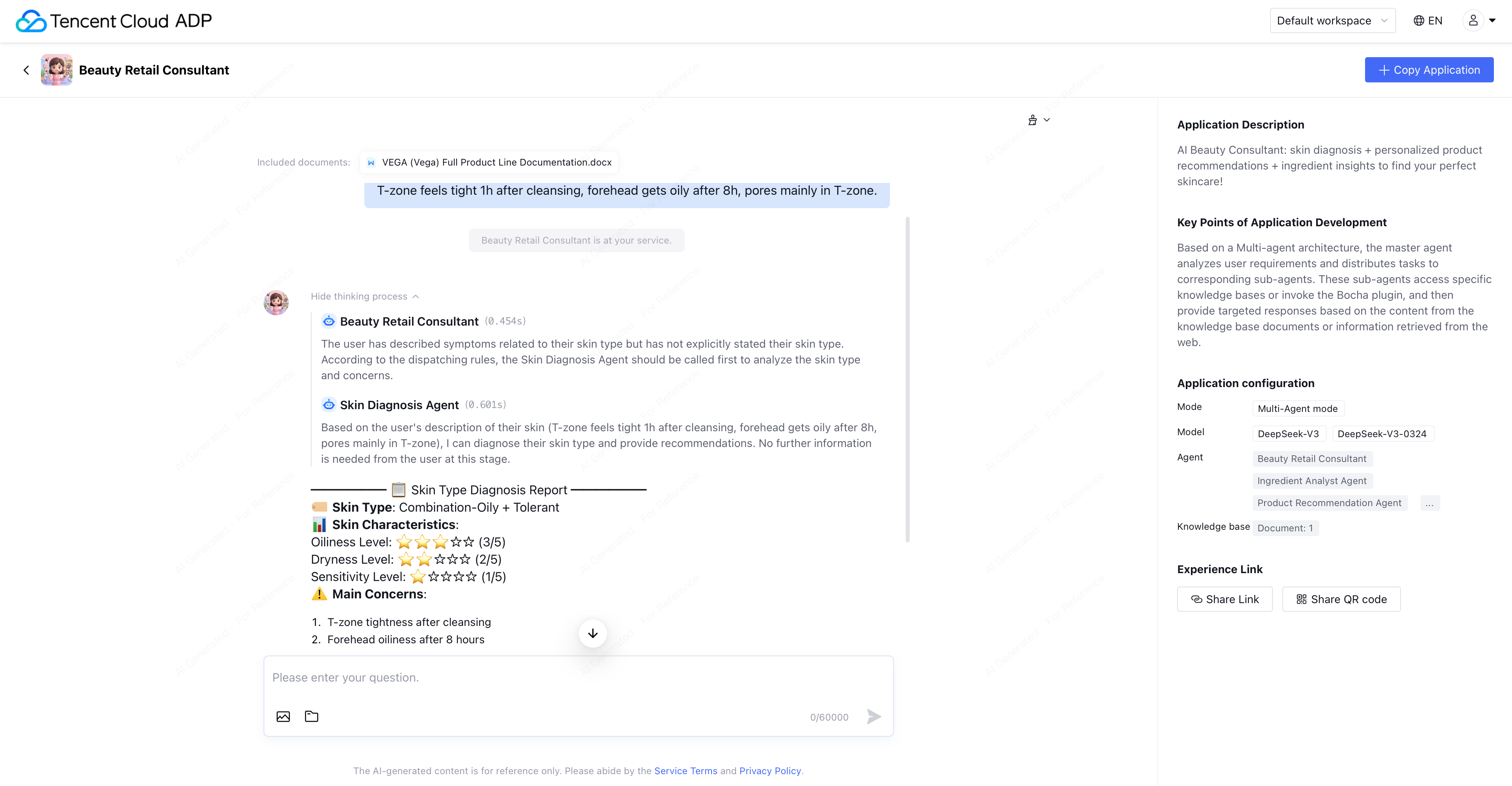
Scenario 1: Skin Diagnosis
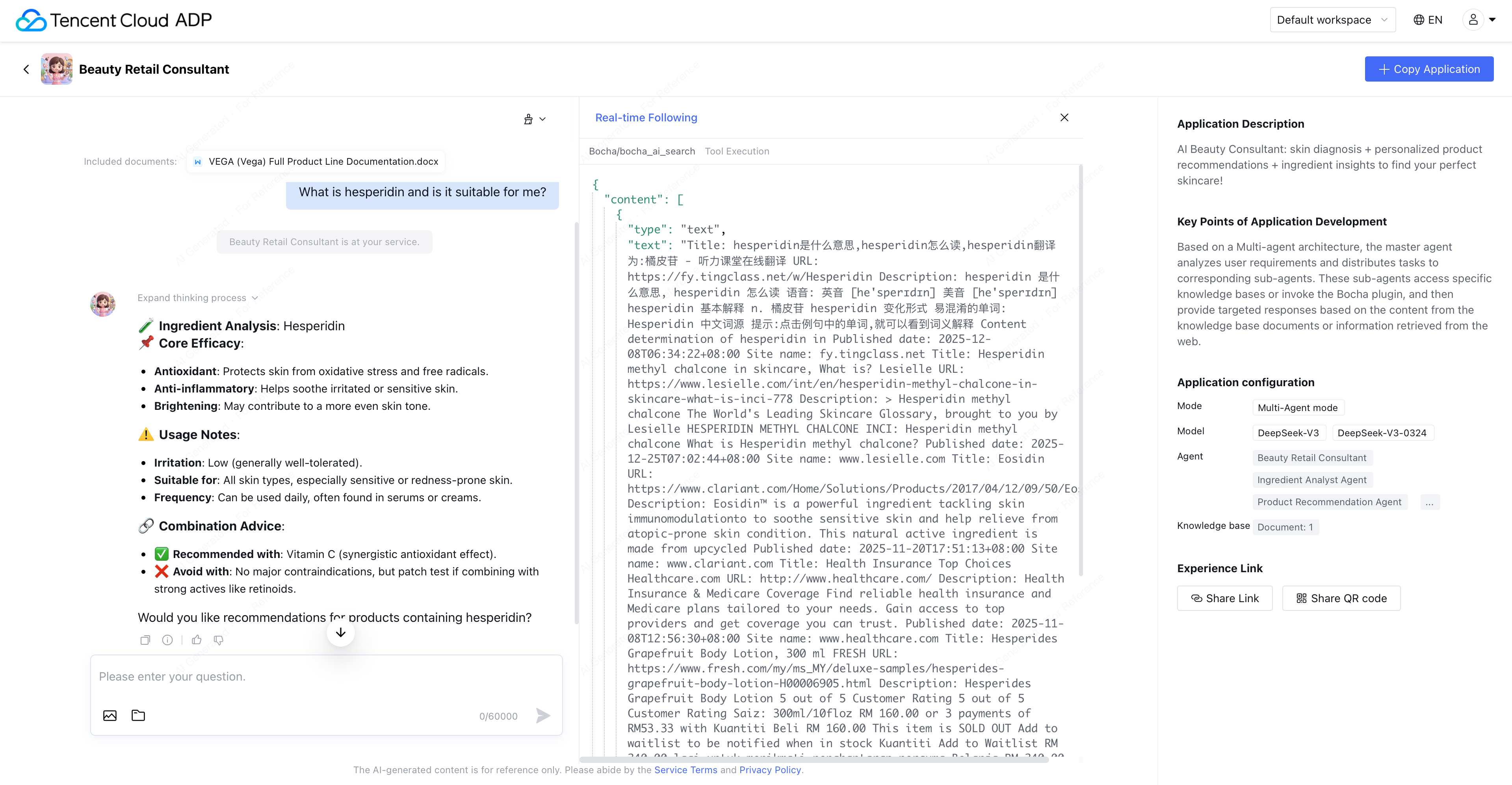
Scenario 2: Ingredient Interpretation Consultation
Scenario 3: Product Recommendation
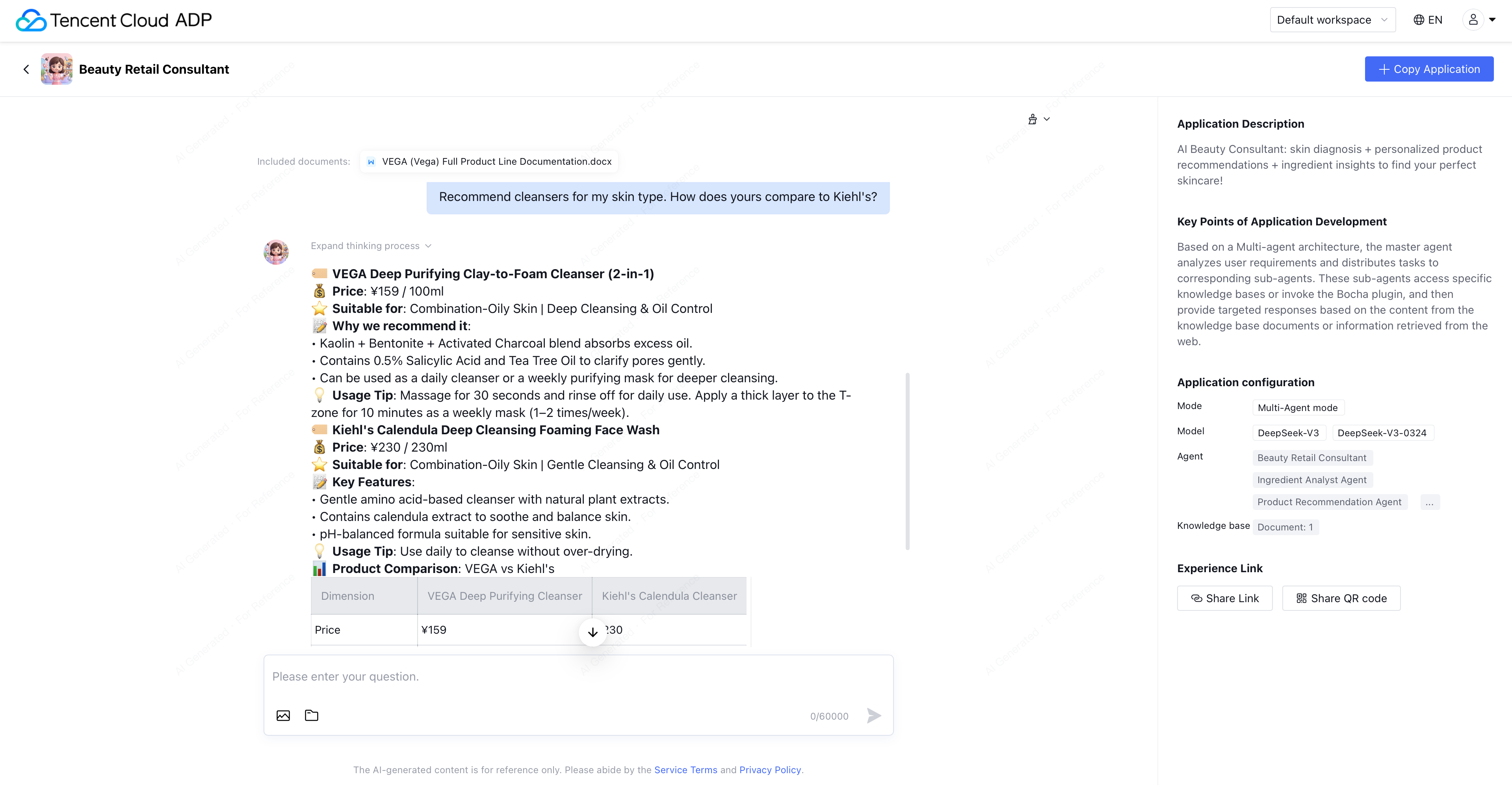
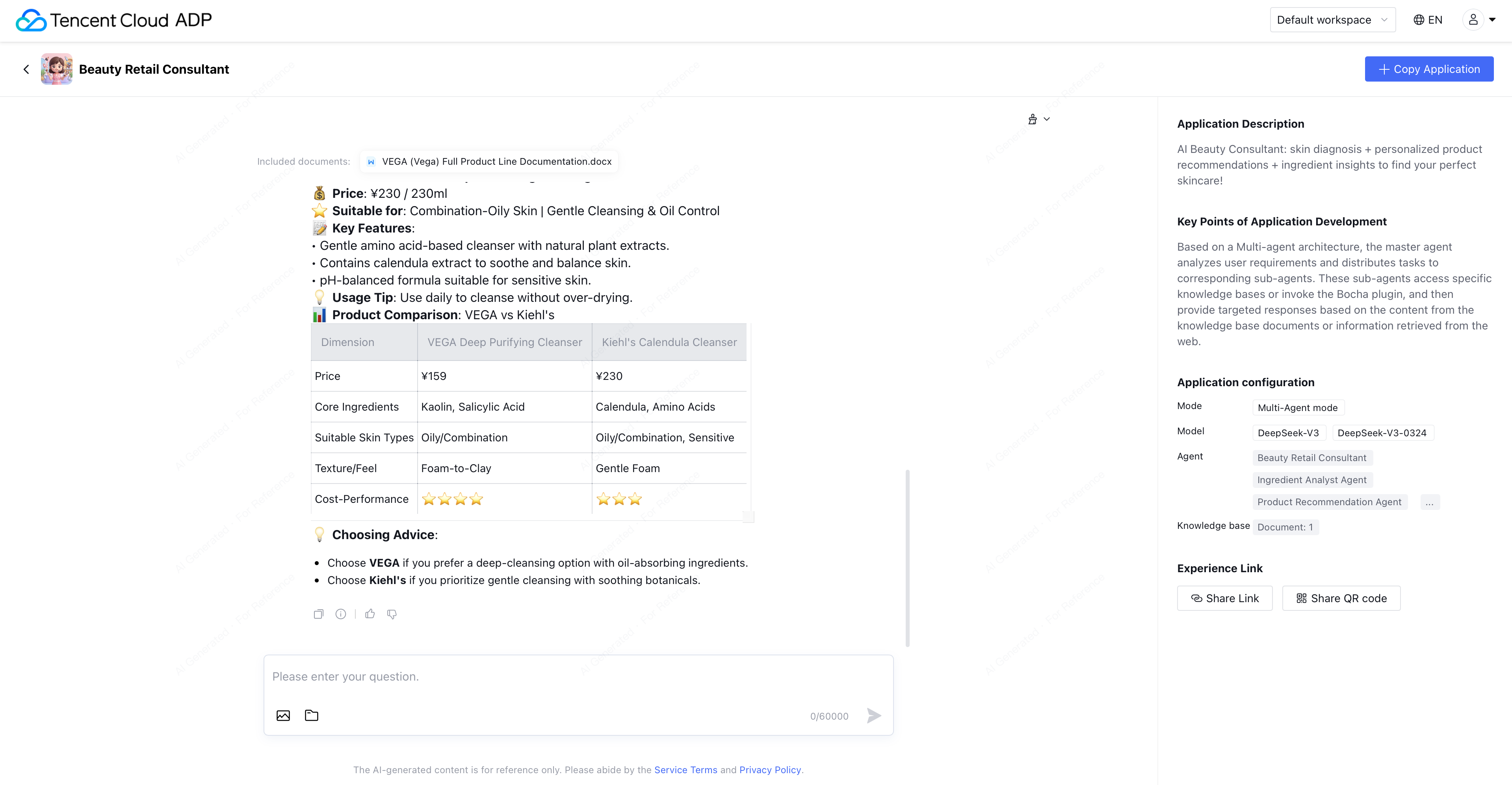
Project Results
Core Metrics Improvement
| Metric | Result |
|---|---|
| Consultation Conversion Rate | Significant improvement compared to traditional customer service |
| Average Order Value | Increased through regimen combination recommendations |
| User Satisfaction | Professional answers build trust, satisfaction improved |
| Response Efficiency | 24/7 availability, average response within 3 seconds |
User Feedback
"I used to buy skincare just based on sales rankings. Now AI tells me why a product suits me—I feel more confident in my purchases."
"Asked about ingredients and got more professional answers than from counter staff. They even warned me which ingredients shouldn't be used together."
FAQ
Q1: Why choose the hybrid knowledge base + web search solution?
The two complement each other:
- Knowledge Base: Product info needs to be accurate and controllable—prices, ingredients, inventory can't be wrong
- Web Search: Skin/ingredient knowledge updates fast and covers broad scope; putting all related knowledge in knowledge base is costly and quickly outdated
Q2: How do you ensure web search result reliability?
Multiple safeguard mechanisms:
- Search results are filtered, prioritizing authoritative sources (e.g., medical publications, professional journals)
- Agent labels information sources so users can verify themselves
- When combined with product recommendations, knowledge base takes precedence
Q3: How do the three sub-Agents collaborate?
Main Agent orchestrates the collaboration workflow:
- Simple questions: Route directly to corresponding sub-Agent
- Complex needs: Call sequentially as workflow (diagnose → interpret → recommend)
- Information passing: Analysis results from preceding Agents are passed to subsequent Agents
Q4: How do you handle out-of-stock recommended products?
Product Recommender Agent will:
- Prioritize recommending in-stock products
- Suggest same-effect alternatives when out of stock
- Inform users of restock timing (if available)
Conclusion
The core of intelligent beauty shopping guides lies in understanding user needs + professional knowledge support + precise product matching. Through the Multi-Agent architecture + knowledge base and web search collaboration solution, you can achieve:
- Professional Diagnosis: Skin analysis and problem diagnosis build trust foundation
- Ingredient Transparency: Interpret ingredient effects to satisfy "ingredient-savvy" consumers
- Precise Recommendations: Recommend most suitable products based on diagnosis and needs
- Explainability: Not just recommending, but explaining why—enhancing persuasiveness
Key success factors:
- Knowledge base is the foundation for product recommendations: Accurate product info determines recommendation quality
- Web search supplements knowledge: Covers long-tail questions, maintains information timeliness
- Multi-Agent enables professional specialization: Diagnosis, interpretation, recommendation each do their part
Take Action
Ready to build an intelligent beauty retail shopping guide Agent?
Try Tencent Cloud ADP Now
Related Reading

Start building today
If you need more support, please contact us