
Automotive AI Customer Service with Multi-Agent
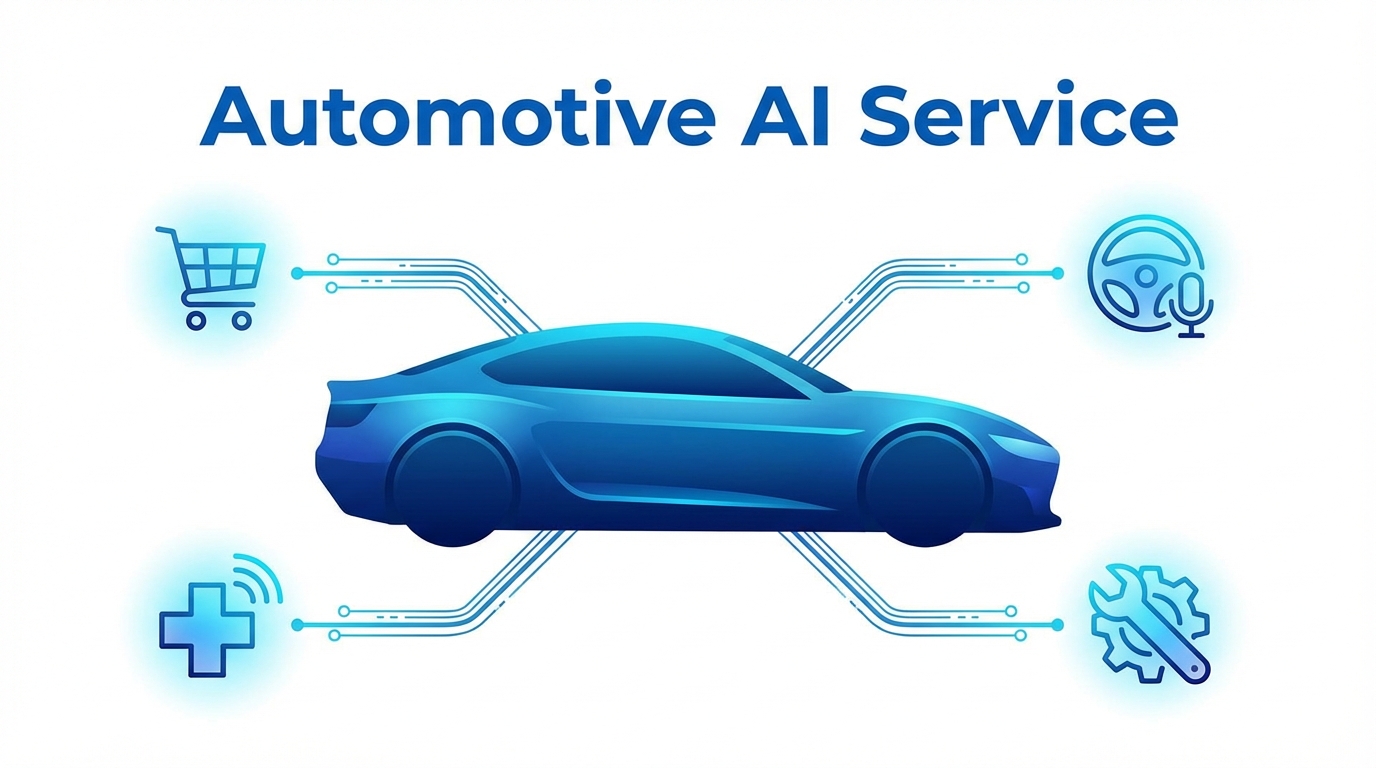
Automotive AI customer service with Multi-Agent architecture. Four sub-Agents for pre-sales, vehicle usage, after-sales & emergency rescue.


Summary
As automotive intelligence accelerates, vehicle owners' demands for scenario-based services continue to rise. Traditional customer service models struggle to keep pace with rapid model iterations, complex configurations, and diverse service scenarios. This article shares a practical case of automotive intelligent customer service built on Tencent Cloud ADP, based on Multi-Agent architecture: a main Agent coordinates four specialized sub-Agents, combined with knowledge base construction, to achieve full-scenario coverage including pre-sales consultation, vehicle usage guidance, after-sales service, and emergency roadside assistance.
Industry Pain Points in Automotive Customer Service
Automotive customer service faces three core challenges:
| Pain Point | Manifestation |
|---|---|
| Rapid model iteration, scattered knowledge | New models and configurations constantly launch, knowledge bases lag behind, agents struggle to master full lineup information |
| Complex and diverse service scenarios | From purchase consultation to emergency rescue, scenarios span widely, single Agents cannot cover everything |
| Low autonomous resolution rate with traditional solutions | Conventional chatbots achieve only ~37% autonomous resolution rate, many issues still require human intervention |
Industry Insight: Automotive Agents are rapidly evolving from basic responses to semi-autonomous decision-making. Vehicle owners need not only "answers" but intelligent assistants that can anticipate needs and make travel more effortless.
Solution: Multi-Agent Architecture Design
Overall Architecture
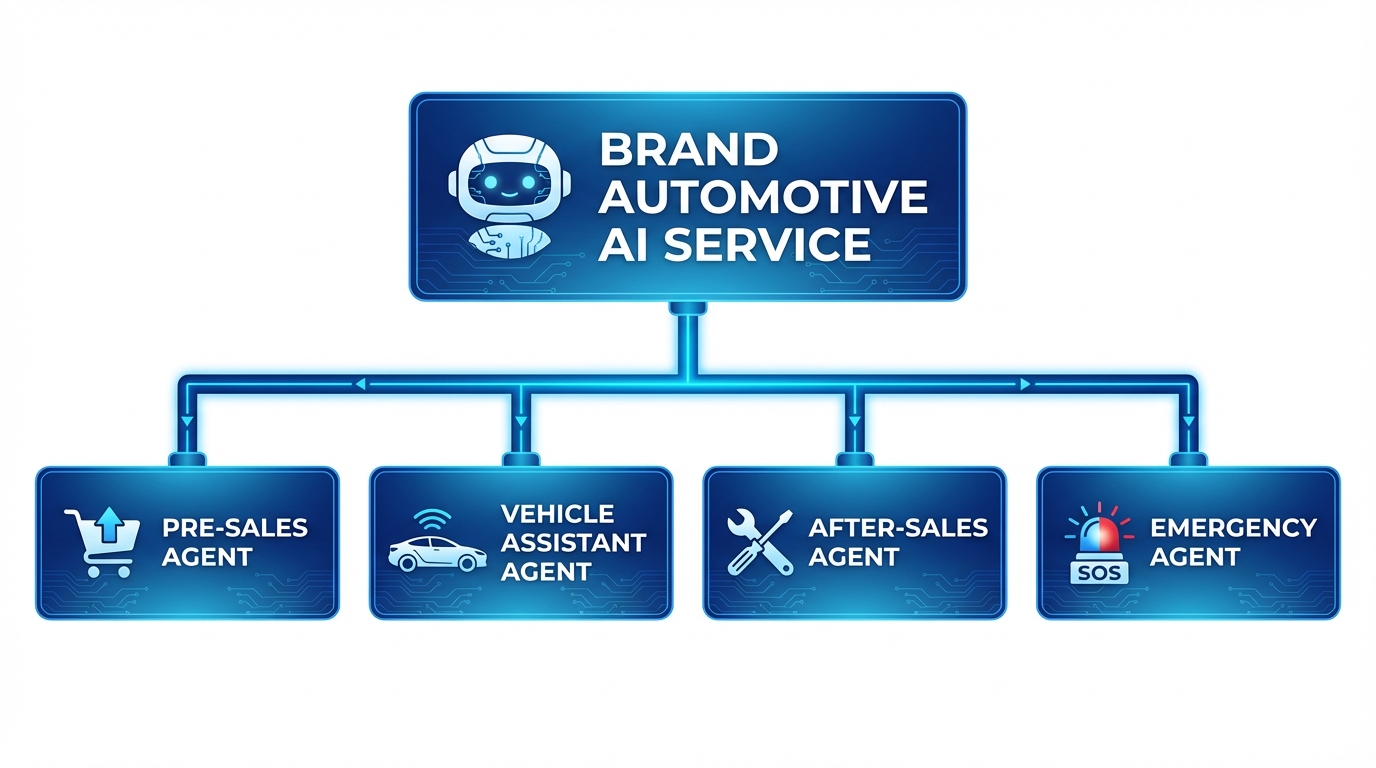
Adopting a "1+4" Multi-Agent architecture, the main Agent handles intent recognition and task distribution, while four specialized sub-Agents each focus on their expertise:
| Component | Role | Core Capabilities |
|---|---|---|
| Brand Automotive AI Service (Main Agent) | Unified entry, intent recognition, task scheduling | Understand user intent, route to corresponding sub-Agent |
| Pre-Sales Advisor Agent | Purchase consultation expert | Full lineup introduction, configuration comparison, pricing queries |
| Vehicle Assistant Agent | Usage guidance expert | Smart system operation, feature guidance, driving tips |
| After-Sales Service Agent | Service expert | Maintenance advice, repair appointments, parts queries |
| Emergency Rescue Agent | 24/7 rescue expert | Roadside assistance, fault handling, emergency guidance |
Design Principles
| Principle | Description |
|---|---|
| Professional Specialization | Each sub-Agent focuses on specific domain, deeply mastering corresponding knowledge |
| Unified Entry | Users don't need to choose; main Agent automatically identifies intent and routes |
| Knowledge Isolation | Each Agent accesses corresponding domain documents, avoiding confusion |
| Seamless Collaboration | Complex issues can be handled through cross-Agent collaboration |
Four Sub-Agents in Detail
1. Pre-Sales Advisor Agent
Positioning: Intelligent assistant for purchase decisions
| Capability | Scenario Example |
|---|---|
| Model Consultation | "What SUV models does your brand have?" |
| Configuration Comparison | "What's the difference between Luxury and Premium editions?" |
| Pricing Query | "What's the approximate on-road price for this model?" |
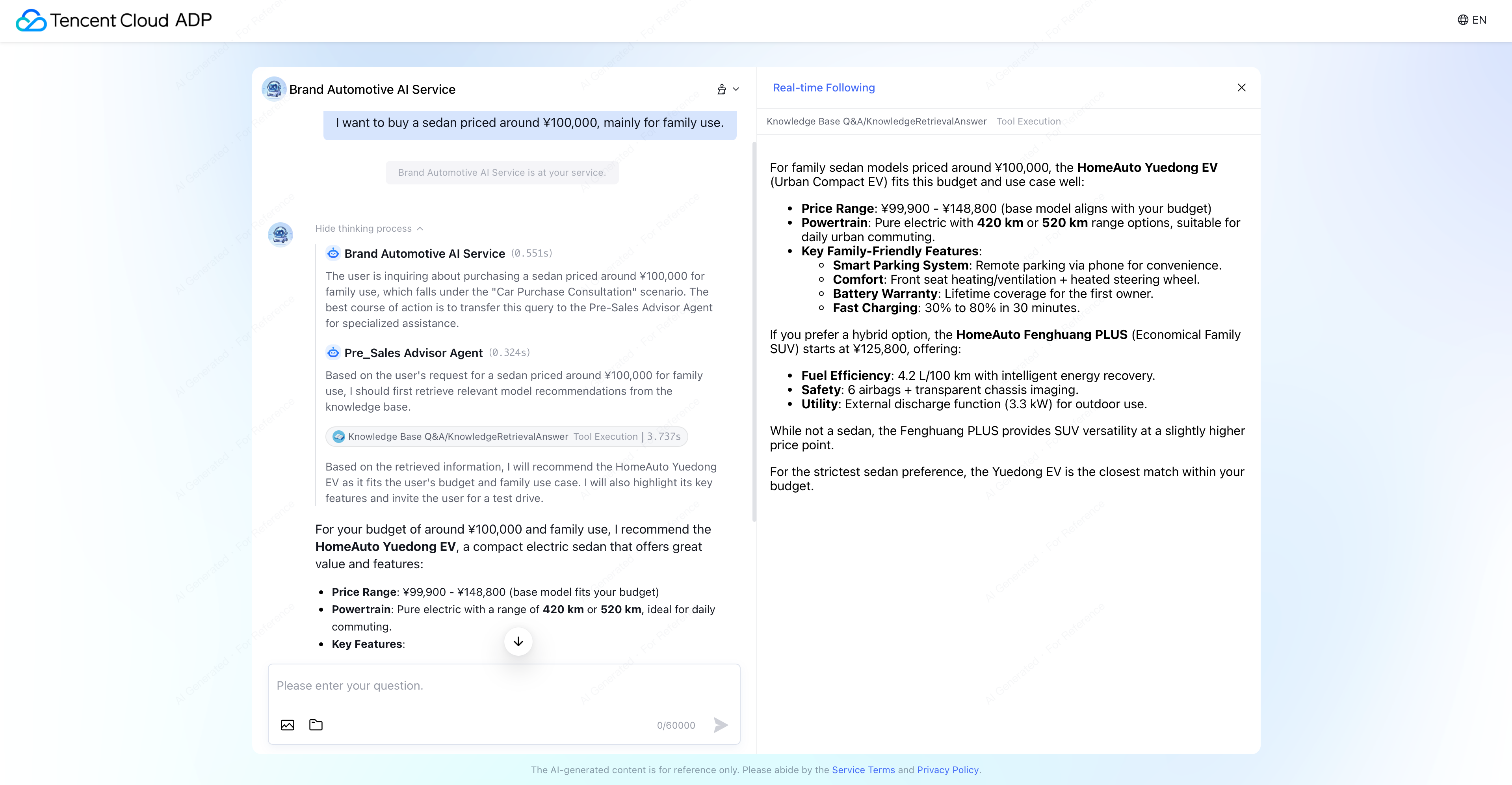
| Recommendation Matching | "Budget 30K, mainly for family use, which model do you recommend?" |
Knowledge Base Support:
- Full lineup product manuals
- Configuration parameter comparison tables
- Official guide prices and promotional policies
- Competitive comparison materials
2. Vehicle Assistant Agent
Positioning: Caring companion for vehicle owners
| Capability | Scenario Example |
|---|---|
| Smart System Operation | "How do I connect CarPlay?" |
| Feature Guidance | "How do I activate adaptive cruise control?" |
| Driving Tips | "What should I pay attention to when driving in rain?" |
| Warning Light Interpretation | "What does this dashboard light mean?" |
Knowledge Base Support:
- User manuals (all models)
- Smart system operation guides
- Frequently asked questions FAQ
- Fault code explanations
3. After-Sales Service Agent
Positioning: Professional advisor for after-sales service
| Capability | Scenario Example |
|---|---|
| Maintenance Advice | "What maintenance does my car need now?" |
| Repair Appointment | "Help me schedule maintenance for next week" |
| Parts Query | "How much does this part cost?" |
| Warranty Policy | "Is this issue covered under warranty?" |
Knowledge Base Support:
- Maintenance manuals and schedules
- Repair labor and parts pricing
- Warranty policy documentation
- Service center information
4. Emergency Rescue Agent
Positioning: 24/7 emergency response center
| Capability | Scenario Example |
|---|---|
| Roadside Assistance | "My car broke down, I need a tow truck" |
| Fault Handling | "My car won't start, what should I do?" |
| Emergency Guidance | "I have a flat tire, how do I change the spare?" |
| Accident Handling | "I had an accident, what should I do?" |
Knowledge Base Support:
- Emergency rescue service procedures
- Common fault emergency handling guides
- Accident handling procedures
- Rescue service network locations
Knowledge Base Construction Practice
Knowledge Base Architecture
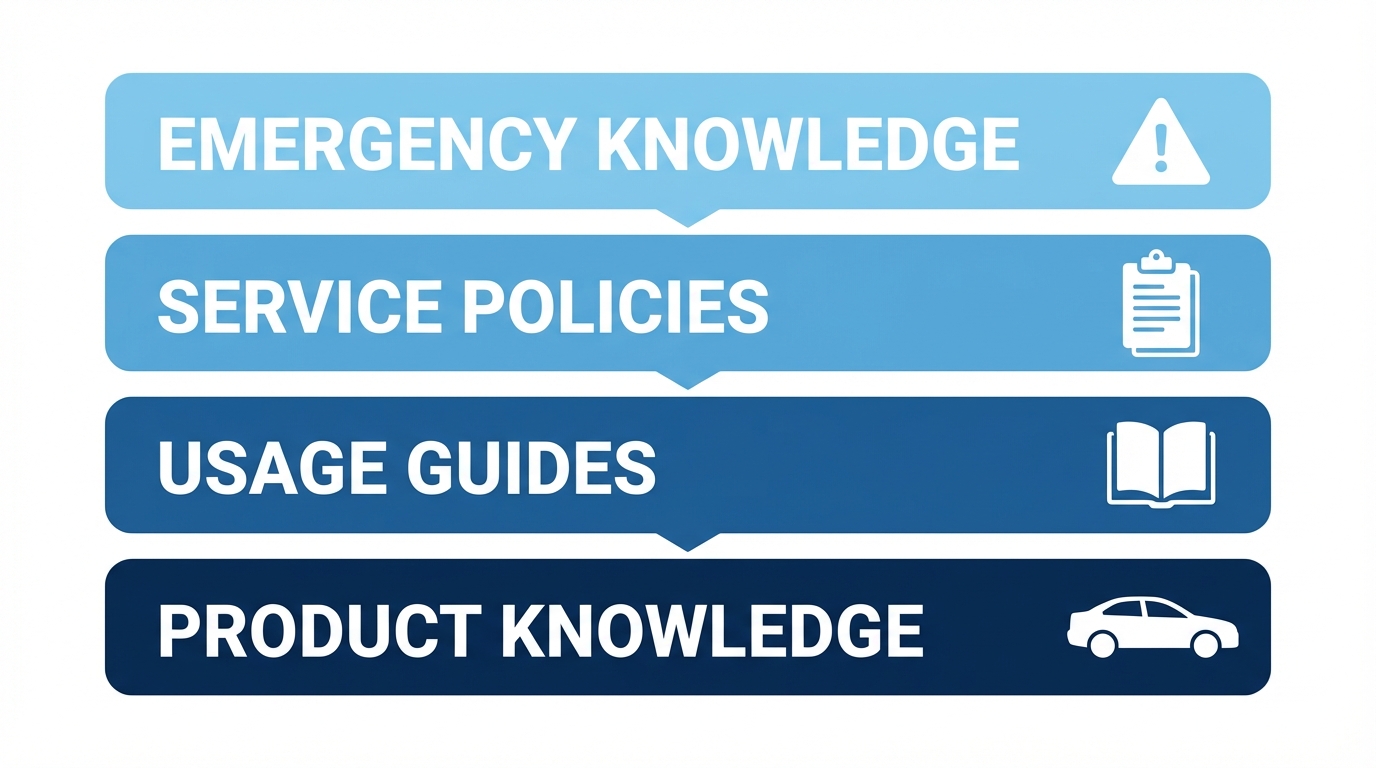
A layered knowledge base was constructed:
| Layer | Content | Corresponding Agent |
|---|---|---|
| Product Knowledge Layer | Model parameters, configuration info, pricing system | Pre-Sales Advisor |
| Usage Guide Layer | Operation manuals, feature descriptions, driving guides | Vehicle Assistant |
| Service Policy Layer | Maintenance manuals, warranty policies, repair standards | After-Sales Service |
| Emergency Knowledge Layer | Rescue procedures, fault handling, emergency guides | Emergency Rescue |
Knowledge Management Key Points
| Key Point | Practice |
|---|---|
| Knowledge Collection | Extract from official documents: product manuals, user manuals, service policies |
| Knowledge Processing | Structured processing, categorized by scenario, tagged for easy retrieval |
| Knowledge Updates | Timely updates when new models launch or policies change |
| Knowledge Isolation | Each Agent only accesses corresponding domain documents, ensuring precise answers |
Typical Conversation Examples (Agent responses based on fictional knowledge base, for reference only)
Scenario 1: Pre-Sales Consultation
Scenario 2: Vehicle Usage Guidance
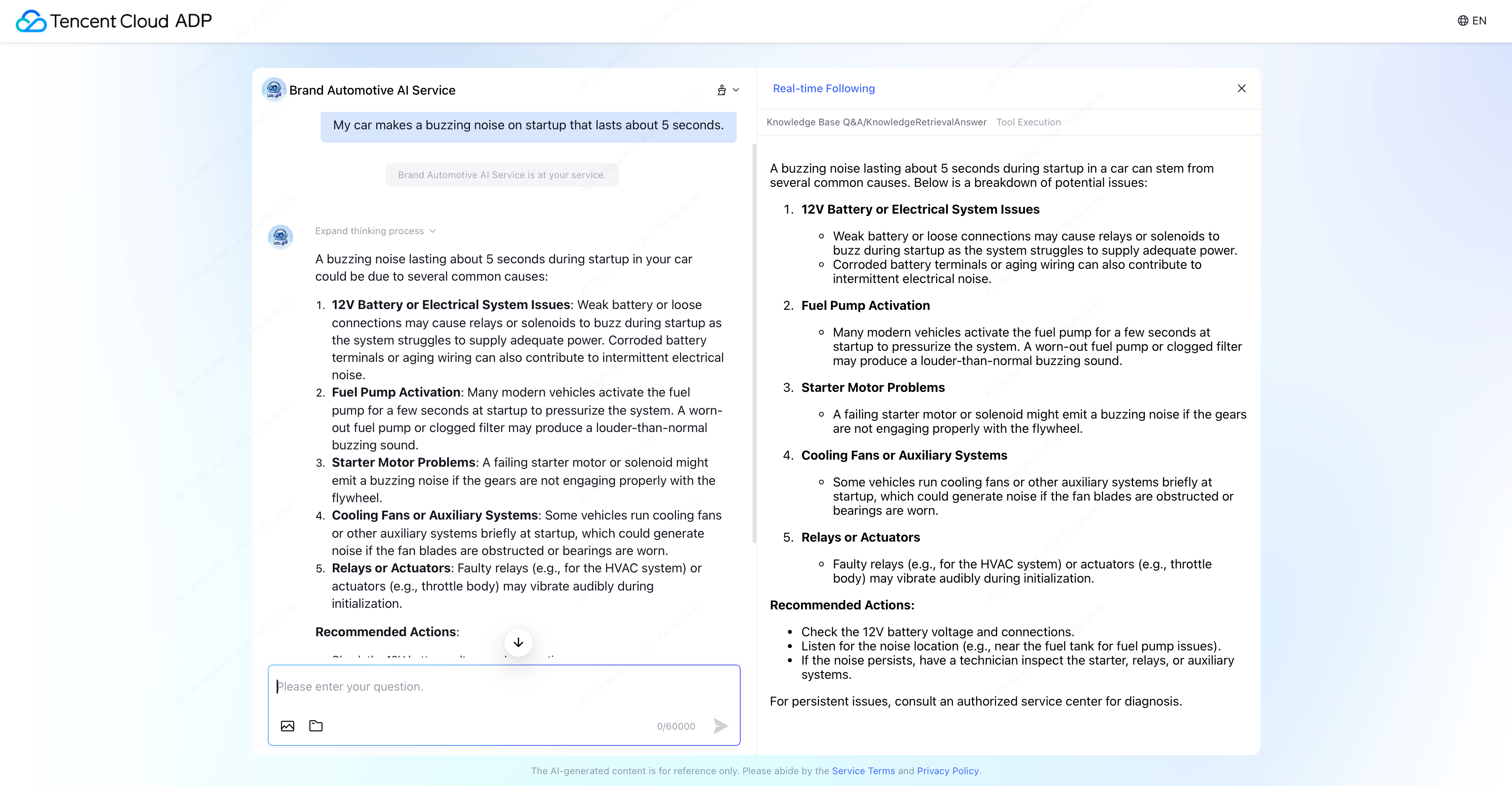
Scenario 3: Emergency Rescue
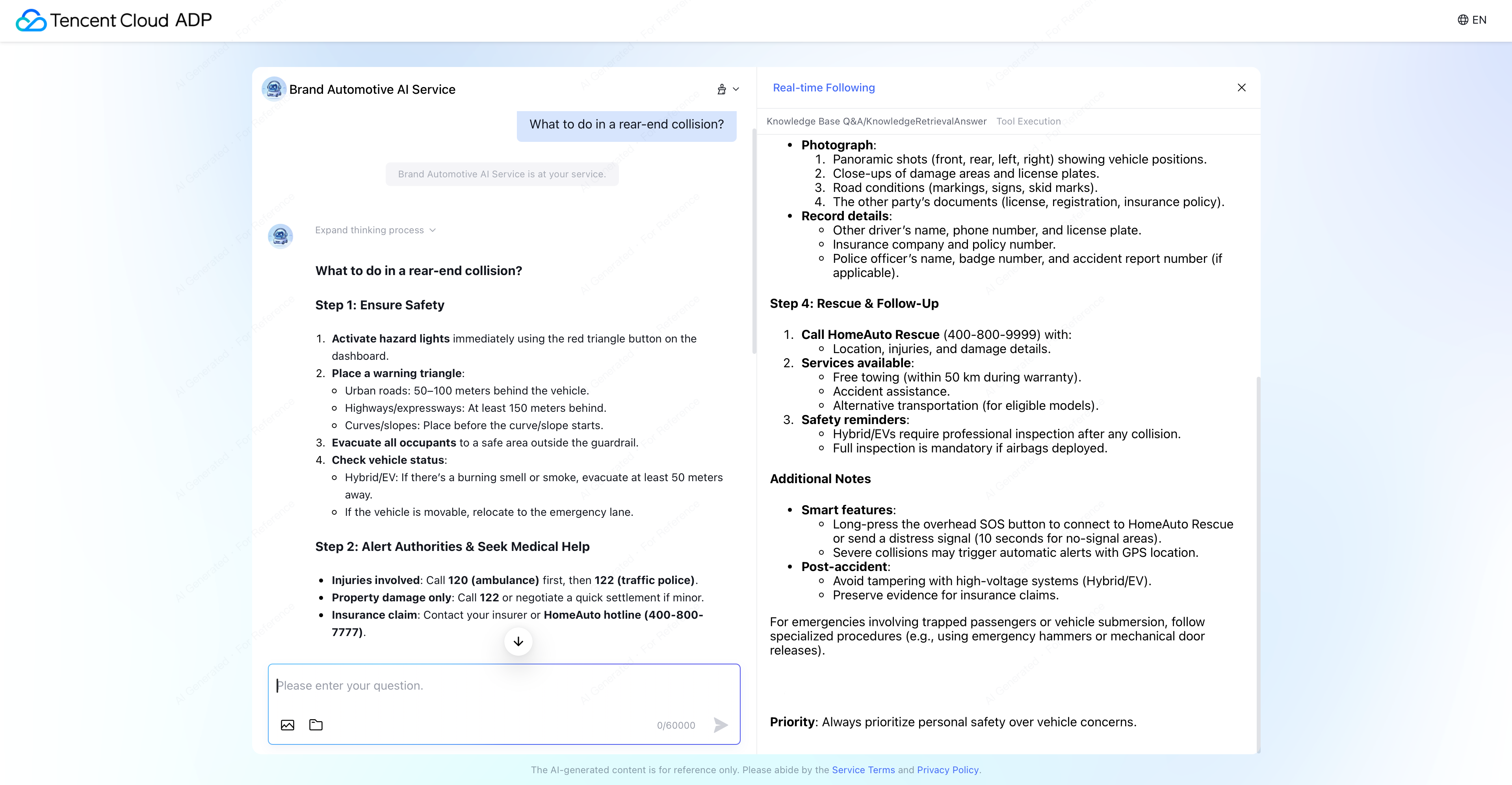
Project Results
Core Metrics Improvement
| Metric | Result |
|---|---|
| Autonomous Resolution Rate | Increased from traditional 37% to 80%+ |
| Response Time | Average response within 3 seconds, 24/7 availability |
| User Satisfaction | Significantly improved, reduced wait time for human transfer |
| Labor Costs | Substantial reduction in human agent workload |
Industry Benchmark Comparison
Referencing industry cases, FAW Toyota achieved similar results through comparable solutions:
- Intelligent customer service autonomous resolution rate increased from 37% to 84%
- Monthly handling of 17,000+ customer inquiries
- Significant reduction in manual service costs
Implementation Path Summary
This case implementation path can be divided into five key steps:
| Step | Key Point | Our Practice |
|---|---|---|
| Scenario Anchoring | Select high-value, low-complexity scenarios | Focus on customer service, segmented by pre-sales/usage/after-sales/rescue |
| Knowledge Foundation Building | Build dedicated knowledge base | Layered knowledge base, each Agent with corresponding documents |
| Technology Adaptation | Adapt to enterprise architecture | Multi-Agent architecture, integrated with existing systems |
| Phased Implementation | From pilot to rollout | Single scenario validation first, then full-scenario coverage |
| Asset-Based Iteration | Continuous optimization | Regular knowledge base updates, continuous answer quality improvement |
Key Success Factor: The core of automotive Agent deployment lies in Knowledge Foundation Building—consolidating proprietary knowledge such as vehicle manuals, maintenance policies, and historical consultation records into searchable knowledge assets.
FAQ
Q1: Why choose Multi-Agent instead of a single Agent?
Automotive customer service scenarios span widely, from purchase to rescue involving completely different knowledge domains. Multi-Agent architecture advantages:
- Professional Depth: Each sub-Agent focuses on one domain, providing more professional answers
- Knowledge Isolation: Prevents cross-domain knowledge confusion causing incorrect answers
- Flexible Expansion: Adding new scenarios only requires adding corresponding sub-Agents
Q2: How often should the knowledge base be updated?
Recommended layered updates:
- Product Knowledge: Immediate updates when new models launch or configurations change
- Service Policies: Timely updates on policy changes (typically quarterly review)
- Operation Guides: Updates after system upgrades
- Emergency Procedures: Relatively stable, annual review sufficient
Q3: How to handle questions the Agent cannot answer?
Establish human-agent collaboration mechanism:
- When Agent identifies unanswerable questions, proactively inform users
- Provide transfer-to-human option, while logging questions for knowledge base supplementation
- Regularly analyze unresolved questions, supplement knowledge gaps
Q4: How to ensure response speed for emergency rescue scenarios?
Emergency Rescue Agent design points:
- Identify "emergency" keywords, elevate priority
- Preset quick response templates, reduce generation time
- Interface with rescue dispatch system, support one-click dispatch
Conclusion
The core challenge of automotive intelligent customer service lies in numerous models, diverse scenarios, and scattered knowledge. Through the combination of Multi-Agent architecture + layered knowledge base, you can achieve:
- Full-Scenario Coverage: One-stop service for pre-sales, usage, after-sales, and rescue
- Professional Precision: Each Agent focuses on specific domain, providing more professional answers
- High Efficiency Autonomy: Significantly improved autonomous resolution rate, reduced labor costs
- Continuous Evolution: Ongoing knowledge base updates, continuously improving service capabilities
Key success factors:
- Knowledge base is the foundation: Proprietary knowledge determines answer quality
- Architecture determines ceiling: Multi-Agent architecture supports complex scenarios
- Iteration is the norm: Continuous optimization maintains competitiveness
Take Action
Ready to build an intelligent customer service Agent for the automotive industry?
Try Tencent Cloud ADP Now
Related Reading

Start building today
If you need more support, please contact us