
Omdia 2026: Tencent Cloud ADP
Breaking Down the Omdia Market Radar Evaluation


In the first half of 2025, a leading hotel group deployed a digital butler across 19 countries and 12,000+ hotels in just 3 months—while the industry average implementation cycle runs 6 to 12 months. A top securities firm launched an intelligent investment assistant that processed nearly 2 million queries, with user penetration growing 3x month-over-month. Behind both achievements: Tencent Cloud ADP (Agent Development Platform).
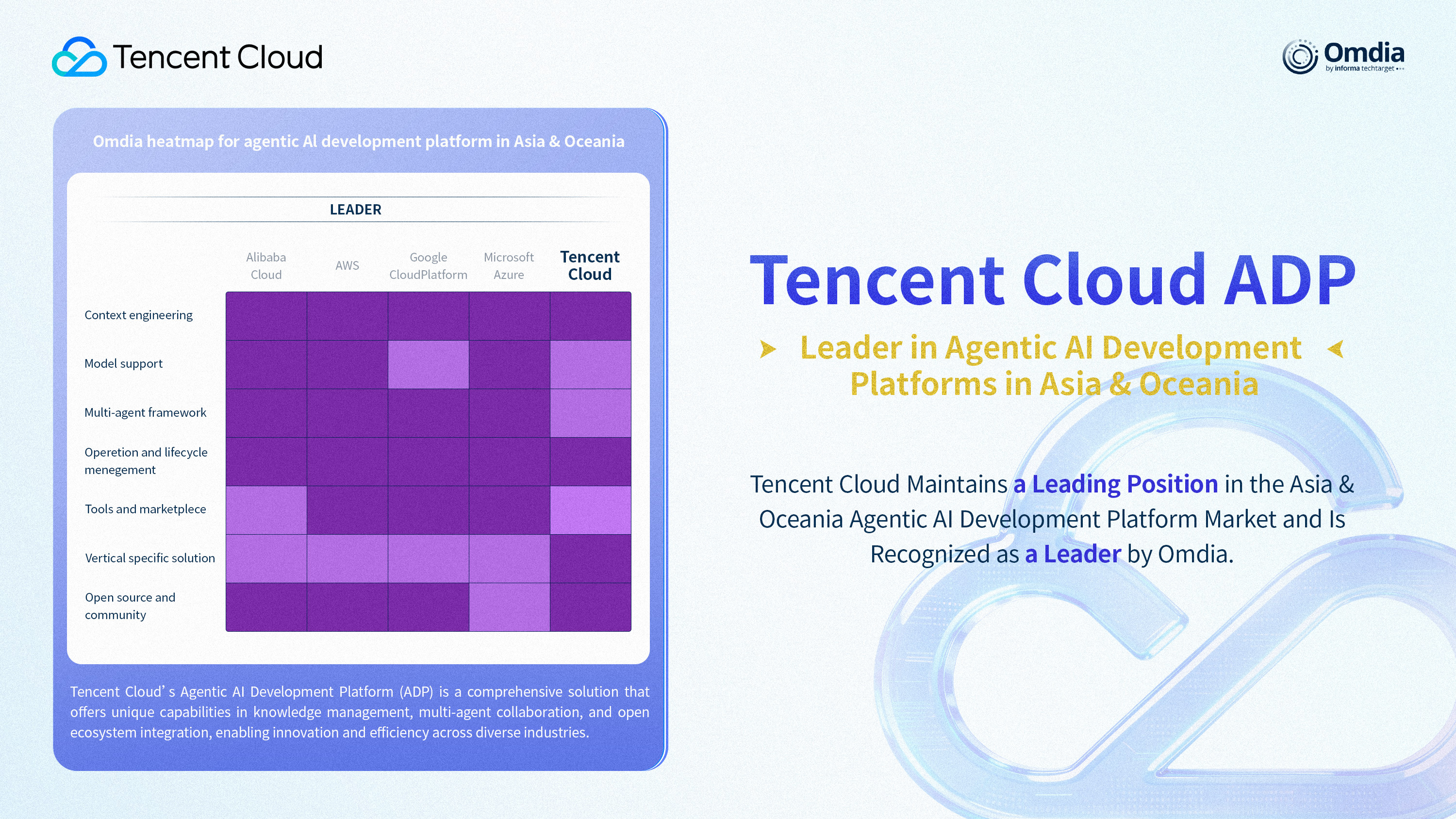
In February 2026, Omdia—a globally recognized technology research firm—released the Omdia Market Radar: Agentic AI Development Platform in Asia & Oceania, 2026. In this authoritative assessment covering the Asia-Pacific and Oceania region, Tencent Cloud was positioned as a Market Leader alongside Alibaba Cloud, AWS, Google Cloud Platform, and Microsoft Azure—the highest tier in the report.
An agentic AI development platform is the core infrastructure enterprises use to build, deploy, and manage autonomous AI agents. These platforms enable intelligent reasoning, task planning, multi-agent collaboration, and end-to-end workflow execution with minimal human intervention. Omdia forecasts the agentic AI software market in Asia & Oceania will surge from $271 million in 2025 to $9.7 billion by 2030, representing a compound annual growth rate (CAGR) of 105%.
This article breaks down the Omdia evaluation framework and examines how Tencent Cloud ADP earned its Market Leader position across 7 core capability dimensions.
The Omdia Market Radar Framework: 7 Core Capability Dimensions
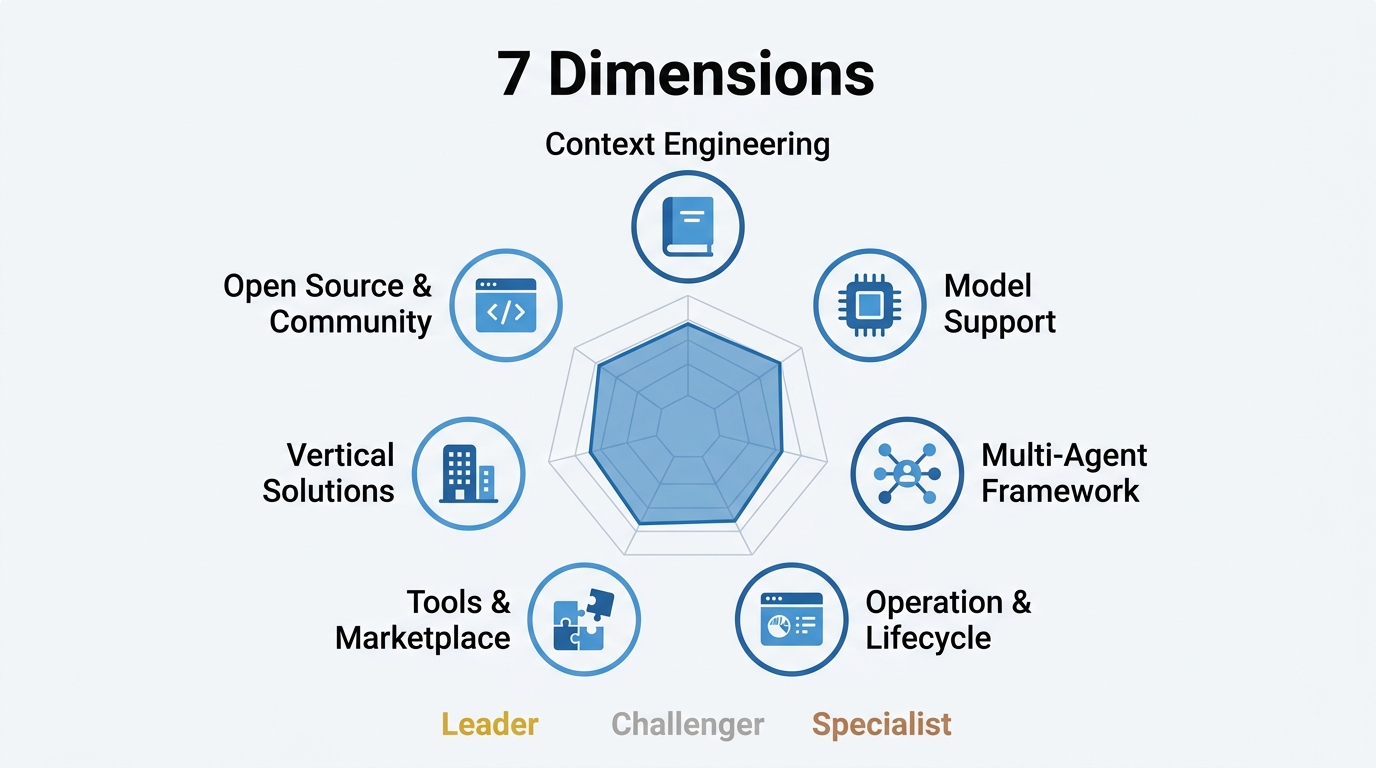
The Omdia Market Radar is a systematic vendor evaluation framework that assesses technology providers across technical capabilities, market penetration, strategic positioning, and commercial success. For this agentic AI development platform assessment, Omdia defined 7 core capability dimensions:
| Dimension | Evaluation Focus |
|---|---|
| Context Engineering | Knowledge management, RAG capabilities, document processing |
| Model Support | Proprietary + third-party model compatibility |
| Multi-agent Framework | Multi-agent collaboration, task decomposition & orchestration |
| Operation & Lifecycle Management | Monitoring, version control, canary deployment |
| Tools & Marketplace | Plugin ecosystem, template richness, API integration |
| Vertical-specific Solutions | Industry coverage, pre-built solutions |
| Open Source & Community | Open-source projects, developer ecosystem |
Based on comprehensive evaluation across these 7 dimensions, Omdia classified vendors into three tiers:
- Market Leader: Alibaba Cloud, AWS, Google Cloud Platform, Microsoft Azure, Tencent Cloud
- Market Challenger: Automation Anywhere, OneReach.ai, Sensetime, UiPath, Zhipu AI
- Market Specialist: EvoluteIQ, Neutrinos
Tencent Cloud received Advanced Capability ratings—the highest capability level in the report—across multiple dimensions.
5 Technical Differentiators of Tencent Cloud ADP
The Omdia report highlighted Tencent Cloud ADP's technical capabilities with strong recognition. Here are the 5 key differentiators identified in the assessment:
Low-Code Visual Orchestration: Implementation Cut from 6–12 Months to Under 3
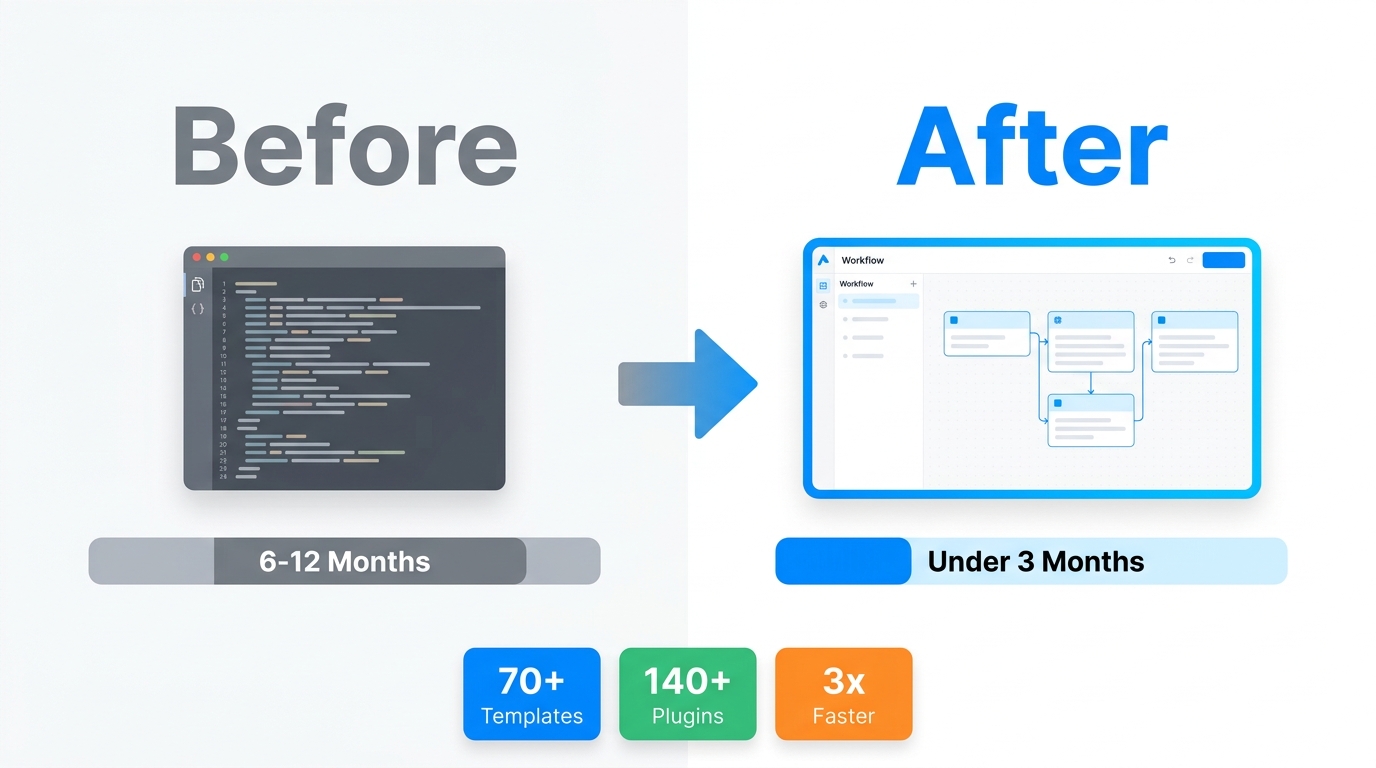
Tencent Cloud ADP's workflow orchestration supports drag-and-drop design, enabling enterprises to build AI agent business logic without deep coding expertise. The Omdia report notes this low-code capability reduces system implementation cycles from the industry average of 6–12 months to under 3 months, significantly lowering the barrier to enterprise AI adoption.
The platform offers 70+ application templates and 140+ plugins covering high-frequency scenarios including customer service, marketing, knowledge management, and data analytics—allowing enterprises to customize from proven templates rather than building from scratch.
Two-Step Multi-Agent Framework: Separating Planning from Execution
Tencent Cloud ADP's innovation in the multi-agent framework dimension stands out. The platform pioneers a two-step multi-agent workflow framework:
- Planning Phase: A planning agent receives complex tasks, performs strategic reasoning, and decomposes them into subtasks
- Execution Phase: The planning agent invokes specialized agents or tools to complete each subtask based on the decomposition
This "plan-then-execute" architecture excels in high-complexity enterprise scenarios (such as cross-department approval workflows or multi-turn investment research analysis), where the planning agent can dynamically adjust execution strategies rather than following rigid pre-defined processes.
Enhanced RAG Technology: GraphRAG + Agentic RAG Dual Engine
In the context engineering dimension, Tencent Cloud ADP integrates two advanced RAG (Retrieval-Augmented Generation) technologies:
- GraphRAG: Knowledge graph-based retrieval augmentation supporting multi-hop retrieval and cross-document reasoning—ideal for complex questions requiring synthesis across multiple information sources
- Agentic RAG: Agent-driven retrieval augmentation that automatically decomposes complex queries into sub-queries, progressively retrieving and synthesizing answers to effectively eliminate AI hallucinations
The combination of these two RAG technologies gives Tencent Cloud ADP enterprise-grade accuracy in both structured data querying and unstructured document understanding.
Full-Scenario Model Support: Proprietary + Third-Party Compatibility
Tencent Cloud ADP demonstrates high flexibility in the model support dimension:
- Proprietary Models: Hunyuan large language model, Youtu series fine-tuned models
- Third-Party Models: Compatible with Qwen, Doubao, Kimi, MiniMax, and other mainstream models
- Specialized Capabilities: HunyuanOCR vision-language model supporting 26+ document types with single files up to 200MB
This "proprietary + open" model strategy allows enterprises to select the optimal model for each specific scenario without being locked into a single model ecosystem.
Enterprise-Grade Security & Compliance: CAICT Level 5 + International Standards
In the operation and lifecycle management dimension, Tencent Cloud ADP's security and compliance capabilities received significant recognition from Omdia:
- CAICT (China Academy of Information and Communications Technology) AI Agent Evaluation Level 5 Certification—the highest level
- SOC 2 and ISO 27001 international security certifications
- Multi-layer data isolation and privacy protection mechanisms
- Industry-specific compliance certifications (finance, government, etc.)
For enterprises operating across the Asia-Pacific region, cross-regional compliance capability is a critical factor in selecting an agentic AI development platform.
Real-World Customer Cases: Scaled Deployment from Hospitality to Finance
The Omdia report and Tencent Cloud's official data show that Tencent Cloud ADP has achieved scaled deployment across key verticals including finance, government, retail, manufacturing, healthcare, and media.
Huazhu Group: Digital Butler Across 19 Countries and 12,000+ Hotels
Huazhu Group built a 24/7 digital butler on Tencent Cloud ADP, covering 19 countries and 12,000+ hotels. The system delivers intelligent services including information inquiry, order management, and in-room IoT control, significantly improving hotel operational efficiency.
Leading Securities Firm: Investment Assistant Handling Nearly 2 Million Queries
A leading securities firm launched an intelligent investment assistant on Tencent Cloud ADP, providing investors with professional analysis of earnings reports, industry trends, and market data. The system processed nearly 2 million queries post-launch, with user penetration achieving 3x month-over-month growth.
Market Growth Metrics
In the first half of 2025, Tencent Cloud ADP added 1,615 new enterprise customers (accounting for 85% of total paid customers), with monthly active users exceeding 7,000—demonstrating sustained market momentum.
Asia-Pacific Agentic AI Market: Opportunities and Challenges Behind 105% CAGR
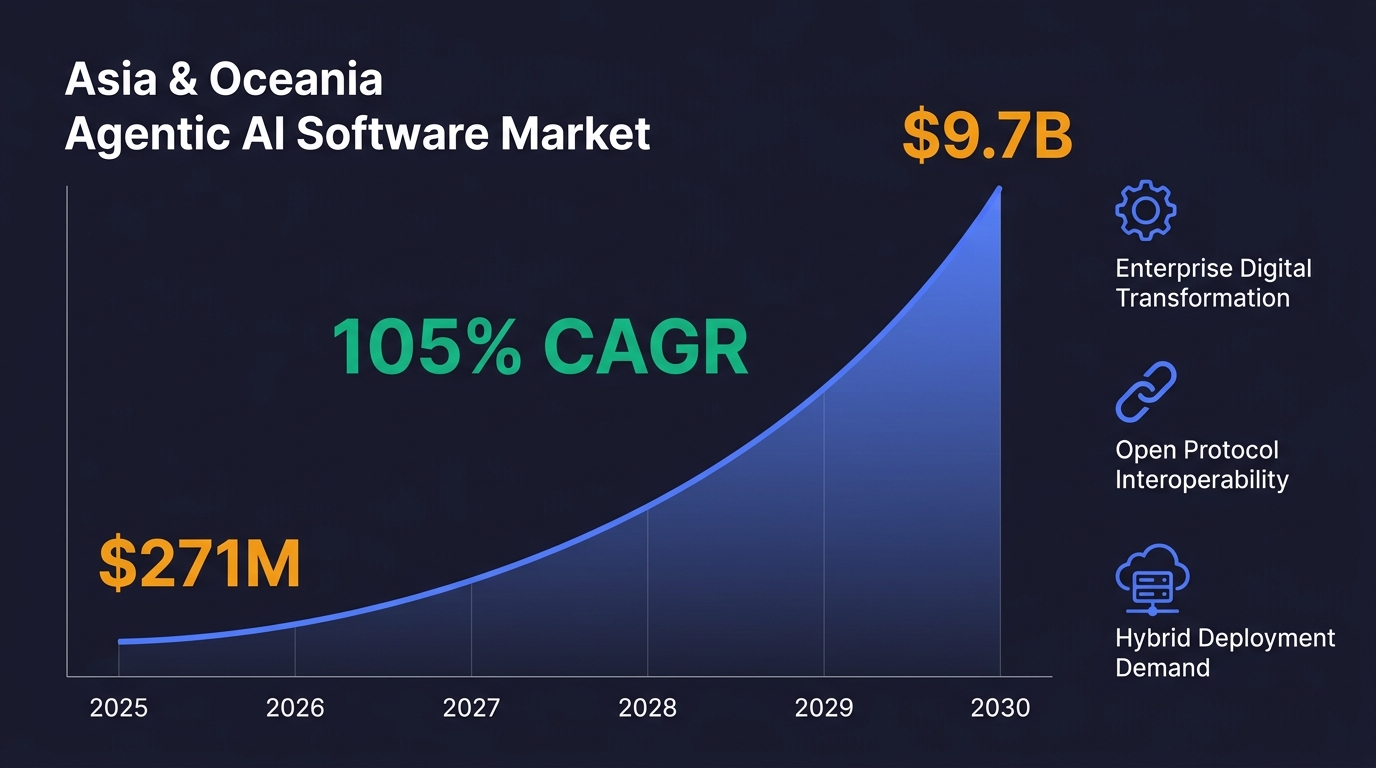
Omdia forecasts the Asia-Pacific agentic AI software market will grow at a 105% CAGR from $271 million in 2025 to $9.7 billion by 2030. Three key drivers fuel this growth:
- Enterprise Digital Transformation: Asia-Pacific enterprises are moving from "AI pilots" to "AI at scale," making agentic AI development platforms core infrastructure
- Open Protocols Driving Interoperability: Open protocols like MCP (Model Context Protocol) and A2A (Agent-to-Agent) are lowering barriers to multi-platform integration
- Hybrid Deployment Demand: Enterprises need flexible AI agent deployment across public cloud, private cloud, and edge computing environments
Selection Risks Enterprises Should Consider
However, a rapidly growing market also brings selection risks:
- Vendor Lock-in: Some platforms have closed model and tool ecosystems, creating high migration costs
- Compliance Complexity: Data privacy regulations vary significantly across Asia-Pacific countries, requiring platforms with localized compliance capabilities
- ROI Uncertainty: Return on investment timelines for agentic AI vary widely by industry and scenario—enterprises need clear evaluation frameworks
- Talent Gap: Professionals with AI agent development and operations skills remain scarce, making platform usability a critical differentiator
Platform Selection Guide: How to Read the Omdia Market Radar
The following comparison is provided as a selection reference to help enterprises match the right agentic AI development platform to their needs.
The Omdia Market Radar classifies vendors into three tiers, each suited to different enterprise requirements:
| Tier | Best For | Representative Vendors |
|---|---|---|
| Market Leader | Large and mid-size enterprises needing full-stack capabilities, large-scale deployment, and cross-industry coverage | Alibaba Cloud, AWS, Google Cloud, Microsoft Azure, Tencent Cloud |
| Market Challenger | Enterprises with deep needs in specific domains (e.g., RPA, conversational AI) | Automation Anywhere, UiPath, Sensetime, etc. |
| Market Specialist | Enterprises with highly customized needs in niche industries (e.g., insurance) | EvoluteIQ, Neutrinos |
For enterprises operating in the Asia-Pacific region with Chinese-language scenario requirements, Tencent Cloud ADP offers distinct advantages:
- Chinese NLP Depth: Advanced Chinese language understanding powered by the Hunyuan large language model
- Localized Compliance: Compliance solutions covering Mainland China, Hong Kong, Macau, Singapore, Indonesia, Malaysia, and other markets
- Industry Depth: Mature pre-built solutions and customer cases in finance, government, retail, and healthcare
- Implementation Speed: 70+ templates + 140+ plugins + low-code orchestration, enabling go-live within 3 months
Open Source Ecosystem and Future Roadmap
Tencent Cloud's open-source contributions in the agentic AI space were also a significant factor in the Omdia evaluation. Currently open-sourced projects include:
- Youtu-Agent: Agent development framework
- Youtu-GraphRAG: Graph-enhanced retrieval framework
- Youtu-Embedding: Vector embedding model
- ADP-Chat-Client: Agent conversation client
Looking ahead, Tencent Cloud will continue investing in:
- Enhanced Multi-Agent Orchestration: Supporting more complex cross-system, cross-organization collaboration scenarios
- Edge Deployment: Extending agentic AI capabilities to edge devices
- AI Ethics Guardrails: Building more comprehensive safety and ethical constraint mechanisms
- Cost Optimization: Reducing enterprise operational costs through intelligent scheduling and resource management
Frequently Asked Questions
What Is the Omdia Market Radar and How Does It Evaluate Vendors?
The Omdia Market Radar is a vendor evaluation framework from globally recognized technology research firm Omdia. It systematically assesses technology providers across technical capabilities, market penetration, strategic positioning, and commercial success. For the agentic AI development platform assessment, Omdia defined 7 core capability dimensions including context engineering, model support, and multi-agent framework, classifying vendors into Market Leader, Market Challenger, and Market Specialist tiers.
What Is an Agentic AI Development Platform and How Does It Differ from Traditional AI Platforms?
An agentic AI development platform is the core infrastructure enterprises use to build, deploy, and manage autonomous AI agents. Unlike traditional AI platforms that focus on model training and inference, agentic AI development platforms emphasize intelligent reasoning, task planning, multi-agent collaboration, and end-to-end workflow execution—enabling AI to autonomously complete complex business processes with minimal human intervention.
What Rating Did Tencent Cloud ADP Receive in the Omdia Report?
Tencent Cloud was positioned as a Market Leader—the highest tier—in the Omdia Market Radar: Agentic AI Development Platform in Asia & Oceania, 2026 report, alongside Alibaba Cloud, AWS, Google Cloud Platform, and Microsoft Azure. Tencent Cloud ADP received Advanced Capability ratings across multiple core capability dimensions.
How Do GraphRAG and Agentic RAG Differ in Tencent Cloud ADP?
GraphRAG uses knowledge graph-based retrieval augmentation supporting multi-hop retrieval and cross-document reasoning for complex questions requiring synthesis across multiple sources. Agentic RAG is agent-driven retrieval augmentation that automatically decomposes complex queries into sub-queries, progressively retrieving and synthesizing answers. Together, they provide enterprise-grade accuracy in both structured data querying and unstructured document understanding.
What Is the Growth Outlook for the Asia-Pacific Agentic AI Market?
According to Omdia, the Asia-Pacific agentic AI software market will grow from $271 million in 2025 to $9.7 billion by 2030, representing a CAGR of 105%. Key drivers include enterprise digital transformation demand, open protocols (MCP, A2A) driving interoperability, and growing hybrid deployment (public cloud + private cloud + edge computing) requirements.
How Can Enterprises Use the Omdia Market Radar for Agentic AI Platform Selection?
Enterprises can match vendors to their needs by tier: Market Leaders for full-stack capabilities and large-scale deployment; Market Challengers for deep needs in specific domains like RPA or conversational AI; Market Specialists for highly customized niche industry requirements. Key evaluation criteria include model openness, compliance capabilities, implementation efficiency, and industry case studies.
How Does Tencent Cloud ADP's Low-Code Capability Accelerate Enterprise AI Agent Deployment?
Tencent Cloud ADP provides drag-and-drop workflow orchestration, 70+ application templates, and 140+ plugins, enabling enterprises to build AI agent business logic without deep coding expertise. The Omdia report notes this low-code capability reduces system implementation cycles from the industry average of 6–12 months to under 3 months, covering high-frequency scenarios including customer service, marketing, knowledge management, and data analytics.
Conclusion
The Omdia Market Radar 2026 report provides an authoritative reference for enterprise agentic AI platform selection in the Asia-Pacific region. Tencent Cloud ADP earned its Market Leader position through full-stack technical capabilities, extensive industry deployments, and sustained open-source contributions.
For enterprise decision-makers evaluating agentic AI development platforms, we recommend a comprehensive assessment across these dimensions: technical capability breadth, model ecosystem openness, industry scenario fit, compliance coverage, and implementation efficiency combined with total cost of ownership (TCO).
This article is part of the Enterprise AI Agent series. Related reading:

Start building today
If you need more support, please contact us